
Close Menu
    Facebook X (Twitter) Instagram
    SciTechDaily
    • Biology
    • Chemistry
    • Earth
    • Health
    • Physics
    • Science
    • Space
    • Technology
    Facebook X (Twitter) Pinterest YouTube RSS
    SciTechDaily
    Home»Science»Contradicting Previous Theories, Neuroscientists Find Overlap Between Fear and Anxiety Brain Circuits
    Science

    Contradicting Previous Theories, Neuroscientists Find Overlap Between Fear and Anxiety Brain Circuits

    By Society for NeuroscienceSeptember 21, 2020No Comments3 Mins Read
    Facebook Twitter Pinterest Telegram LinkedIn WhatsApp Email Reddit
    Share
    Facebook Twitter LinkedIn Pinterest Telegram Email Reddit
    Brain Network Artist Concept
    Scientific theory differentiates “fear” and “anxiety” as distinct, with separate brain circuits controlling them. However, new evidence suggests that both brain regions are equally sensitive to certain and uncertain threats.

    Contrary to previous theories, fear and anxiety reflect shared neural building blocks.

    Fear and anxiety reflect overlapping brain circuits, according to research published today (September 21, 2020) in JNeurosci. The findings highlight a need to reevaluate the existing models guiding anxiety research.

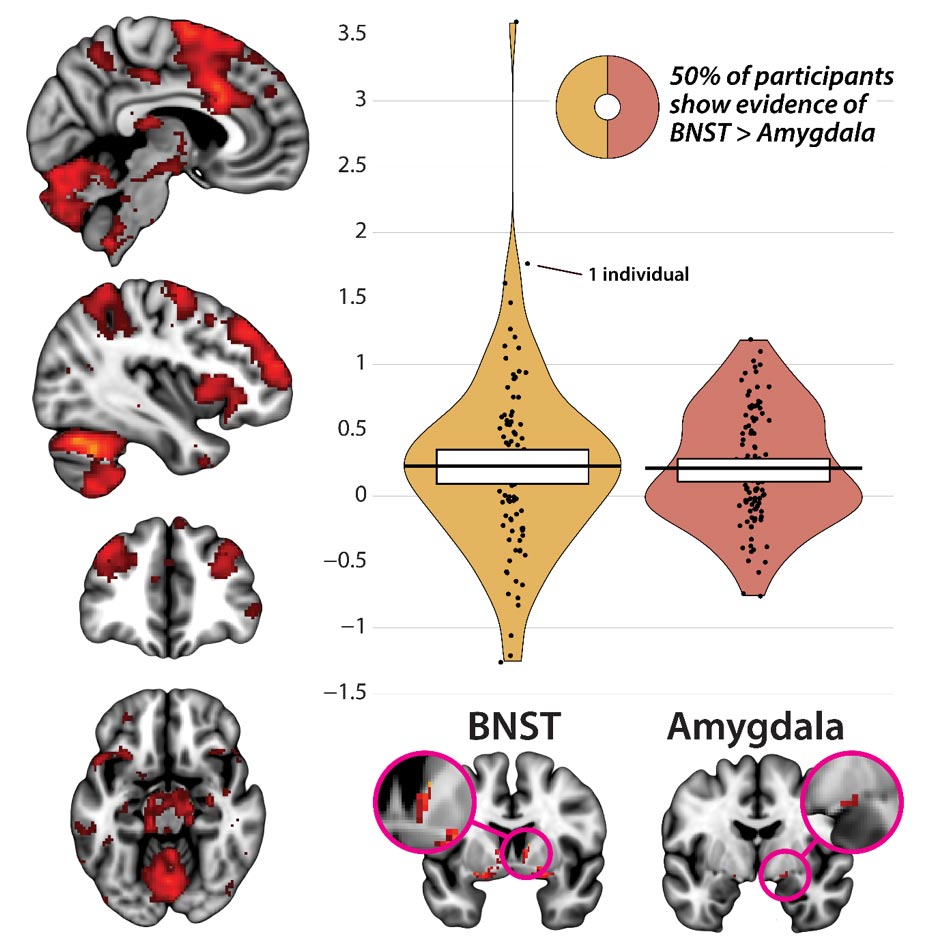
    While “fear” and “anxiety” are often used interchangeably, prevailing scientific theory suggests that they are distinct, with different triggers and separate brain circuits. Fear — a fleeting reaction to certain danger — is thought to be controlled by the amygdala, whereas anxiety — a persistent, heightened state of distress in response to uncertain threat — is thought to be orchestrated by the bed nucleus of the stria terminalis (BNST). However, new evidence from Hur et al. suggests these two brain regions are equally sensitive to certain and uncertain threat.
    Fear and Anxiety Brain Circuits
    Both certain and uncertain anticipation recruited a common network of core brain regions, including the Amygdala and BNST (depicted in red in the left column and bottom row). Magenta rings provide magnified views of the core BNST and Amygdala regions. Across a variety of head-to-head tests, the BNST and Amygdala showed statistically indistinguishable responses, as illustrated in the central panel. Each of the black dots represents an index of threat reactivity for 1 of the 99 research participants. Mean threat reactivity is indicated by the thick horizontal bars. Inset ring plot (top-right) indicates the percentage of individuals showing greater reactivity in the BNST compared to the Amygdala. A value of 50% indicates that participants were just as likely to show greater reactivity in one region compared to the other (i.e. a 50/50 toss-up). Taken together, these new observations underscore the need to reconsider widely accepted neuroscientific models of fear and anxiety. Credit: Hur et al., JNeurosci 2020

    The research team measured brain activity with fMRI while people anticipated receiving a painful shock paired with an unpleasant image and sound. Waiting for threat, whether predictable or not in its timing, recruited an overlapping network of brain regions including the BNST and the amygdala. Across a variety of tests, the two structures showed statistically indistinguishable responses, suggesting that states of fear and anxiety are assembled from a common set of core neural building blocks. These observations raise important questions about the U.S. National Institute of Mental Health’s model guiding research into the biology of emotional disorders.

    Reference: “Anxiety and the Neurobiology of Temporally Uncertain Threat Anticipation” by Juyoen Hur, Jason F. Smith, Kathryn A. DeYoung, Allegra S. Anderson, Jinyi Kuang, Hyung Cho Kim, Rachael M. Tillman, Manuel Kuhn, Andrew S. Fox and Alexander J. Shackman, 21 September 2020, JNeurosci.
    DOI: 10.1523/JNEUROSCI.0704-20.2020

    Never miss a breakthrough: Join the SciTechDaily newsletter.
    Follow us on Google and Google News.

    Brain Mental Health Neuroscience Society for Neuroscience
    Share. Facebook Twitter Pinterest LinkedIn Email Reddit

    Related Articles

    Activity in Brain’s Risk Circuits Can Forecast Changes in Stock Prices

    Musicians Have Brains With Stronger Connections Than Non-musicians

    Brain Tissue Analysis Yields Clues to Causes of PTSD

    Managing Your Emotions: Targeted Brain Stimulation Dulls Social Pain

    Infant Brain Circuitry Shaped by Language Exposure

    “Area 32” – How the Brain Balances Emotion and Reason

    Why Time Sometimes Flies or Drags: How the Brain Creates the Experience of Time

    Researchers Discover How Stress Restructures the Brain

    Scientists Can See the Bias in Your Brain – Even Before You Make Your Decision

    Leave A Reply Cancel Reply

    • Facebook
    • Twitter
    • Pinterest
    • YouTube

    Don't Miss a Discovery

    Subscribe for the Latest in Science & Tech!

    Trending News

    Scientists Say Love Follows Mathematical Patterns

    “Zombie Cells” Reveal a Hidden Weakness That Could Help Fight Aging

    Alien Signals May Be Hiding in a Radio Band SETI Has Barely Explored

    Earth’s Hidden Thermostat Has Regulated Climate for 60 Million Years

    This 518-Million-Year-Old Creature Reveals How Spiders Got Their Bite

    Scientists Built a Programmable Chip That Can Slow Light on Command

    The Backyard “Silly Sprinkler” That Cracked One of Physics’ Biggest Puzzles

    This Common Sleep Habit Could Be Making You Gain Weight

    Follow SciTechDaily
    • Facebook
    • Twitter
    • YouTube
    • Pinterest
    • Newsletter
    • RSS
    SciTech News
    • Biology News
    • Chemistry News
    • Earth News
    • Health News
    • Physics News
    • Science News
    • Space News
    • Technology News
    Recent Posts
    • Underwater Drones Find “Dead” Coral Reefs Teeming With Life
    • How Brown Tree Snakes Became an Unstoppable Invasive Species
    • Scientists Discover the Brain Is Not Always Ready To Make Memories
    • Earth’s First Complex Organisms May Hold Clues to Life Beyond Our Planet
    • Dark Matter’s Secret Force Could Reshape Our Understanding of the Universe
    Copyright © 1998 - 2026 SciTechDaily. All Rights Reserved.
    • Science News
    • About
    • Contact
    • Editorial Board
    • Privacy Policy
    • Terms of Use

    Type above and press Enter to search. Press Esc to cancel.