
Close Menu
    Facebook X (Twitter) Instagram
    SciTechDaily
    • Biology
    • Chemistry
    • Earth
    • Health
    • Physics
    • Science
    • Space
    • Technology
    Facebook X (Twitter) Pinterest YouTube RSS
    SciTechDaily
    Home»Biology»Researchers Discover How Stress Restructures the Brain
    Biology

    Researchers Discover How Stress Restructures the Brain

    By Society for NeuroscienceMarch 30, 2020No Comments2 Mins Read
    Facebook Twitter Pinterest Telegram LinkedIn WhatsApp Email Reddit
    Share
    Facebook Twitter LinkedIn Pinterest Telegram Email Reddit
    How Stress Remodels Brain
    Recent mouse research shows that stress stops the production of vital ion channel proteins, leading to structural changes in the brain.

    Stress restructures the brain by halting the production of crucial ion channel proteins, according to research in mice recently published in JNeurosci.

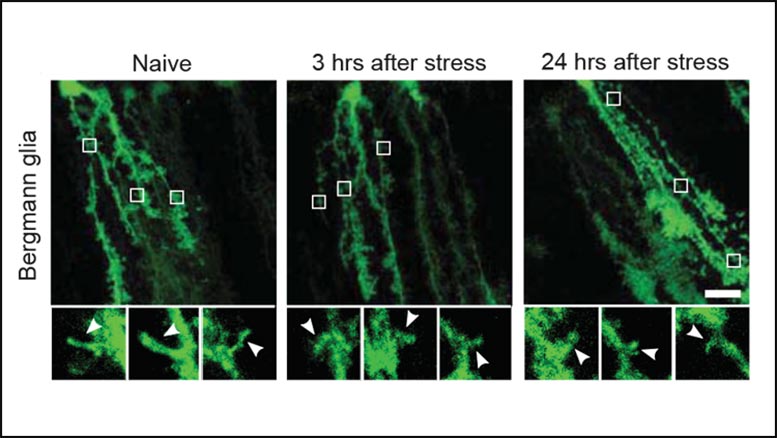
    Stress harms the brain and body in profound ways. One way is by altering astrocytes, the brain’s housekeepers tasked with mopping up neurotransmitters after they’ve been released into the synapse. On the cellular level, stress causes the branches of astrocytes to retract from the synapses they wrap around.
    Stress Remodels the Brain
    The branches of astrocytes retract from synapses 3 hours after stress and remain retracted for 24 hours. Credit: Bender et al. JNeurosci 2020

    Bender et al. investigated what controlled astrocyte changes after mice experienced exposure to the urine of a fox, their natural predator. This single stressful event caused quick but long-lasting retraction of the astrocyte’s branches. Stress induces this change by halting the production of GluA1, an essential subunit of glutamate receptors. During a stressful event, the stress hormone norepinephrine suppresses a molecular pathway that normally culminates in the protein synthesis of GluA1. Without functional GluA1 or glutamate receptors, neurons and astrocytes lose their ability to communicate with each other.

    Reference: “Emotional Stress Induces Structural Plasticity in Bergmann Glial Cells via an AC5-CPEB3-GluA1 Pathway” by Christian Luis Bender, Xingxing Sun, Muhammad Farooq, Qian Yang, Caroline Davison, Matthieu Maroteaux, Yi-shuian Huang, Yoshihiro Ishikawa and Siqiong June Liu, 30 March 2020, JNeurosci.
    DOI: 10.1523/JNEUROSCI.0013-19.2020

    Never miss a breakthrough: Join the SciTechDaily newsletter.
    Follow us on Google and Google News.

    Brain Mental Health Neuroscience Society for Neuroscience Stress
    Share. Facebook Twitter Pinterest LinkedIn Email Reddit

    Related Articles

    Managing Your Emotions: Targeted Brain Stimulation Dulls Social Pain

    Contradicting Previous Theories, Neuroscientists Find Overlap Between Fear and Anxiety Brain Circuits

    Deep Inside the Brain: Neuroscientists Discover the Missing Piece of the Brain’s Multitasking Network

    Scientists Uncover Brain Mechanism That May Explain Why Sleep Helps You Learn

    Adult-Born Neurons Grow More Than Their Counterparts From Infancy – May Even Have Unique Functions

    Feeling Disconnected? Loneliness Alters Your Brain’s Social Network

    A Child’s Unique Brain Activity Reveals Their Memory Ability

    Unlocking the Neuroscience of How Experiencing Traumatic Stress Leads to Aggression

    Functional Magnetic Resonance Imaging Shows How the Brain Repurposes Unused Regions

    Leave A Reply Cancel Reply

    • Facebook
    • Twitter
    • Pinterest
    • YouTube

    Don't Miss a Discovery

    Subscribe for the Latest in Science & Tech!

    Trending News

    Scientists Say This Natural Hormone Reverses Obesity by Targeting the Brain

    35-Million-Year-Old Mystery: Strange Arachnid Discovered Preserved in Amber

    Is AI Really Just a Tool? It Could Be Altering How You See Reality

    JWST Reveals a “Forbidden” Planet With a Baffling Composition

    The Protein “Sabotaging” Aging Muscle Recovery Could Be Key to Surviving Aging

    This Diet–Gut Interaction Could Transform Fat Into a Calorie-Burning Machine

    Scientists Discover Hidden Virus Linked to Colorectal Cancer

    Scientists Discover 132-Million-Year-Old Dinosaur Tracks on South Africa’s Coast

    Follow SciTechDaily
    • Facebook
    • Twitter
    • YouTube
    • Pinterest
    • Newsletter
    • RSS
    SciTech News
    • Biology News
    • Chemistry News
    • Earth News
    • Health News
    • Physics News
    • Science News
    • Space News
    • Technology News
    Recent Posts
    • Beyond “Safe Levels”: Study Challenges What We Know About Pesticides and Cancer
    • Researchers Have Found a Dietary Compound That Increases Longevity
    • 5 Things Experts Say You’re Getting Wrong About Protein
    • Scientists Create “Optical Tornadoes” That Twist Light Into a Swirling Vortex
    • Scientists Uncover Hidden Superconductivity in Material Once Thought Only Magnetic
    Copyright © 1998 - 2026 SciTechDaily. All Rights Reserved.
    • Science News
    • About
    • Contact
    • Editorial Board
    • Privacy Policy
    • Terms of Use

    Type above and press Enter to search. Press Esc to cancel.