
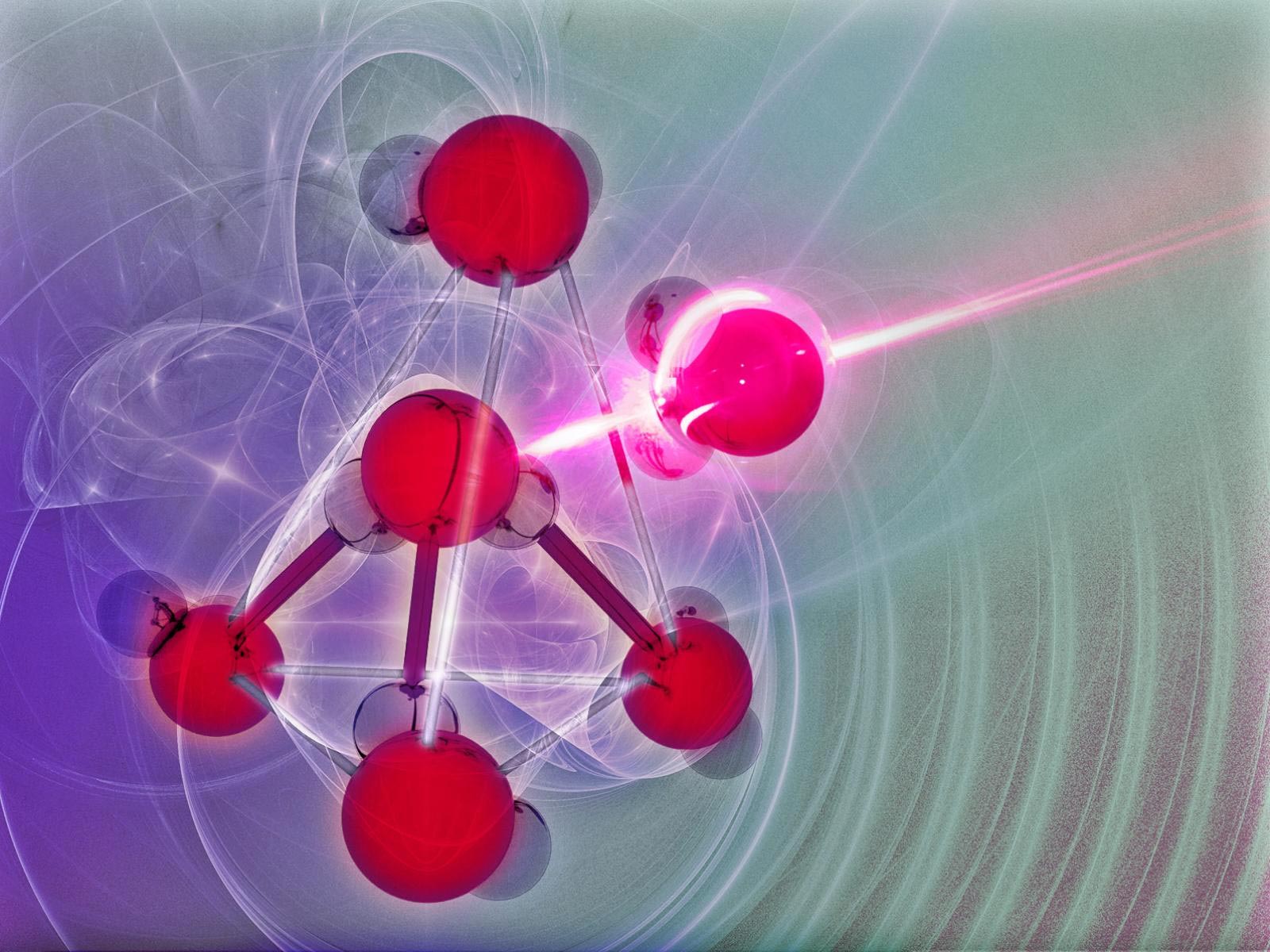
First-ever measurements provide evidence that extremely cold liquid water exists in two distinct structures that co-exist and vary in proportion dependent on temperature.
Supercooled water is really two liquids in one. That’s the conclusion reached by a research team at the U.S. Department of Energy’s Pacific Northwest National Laboratory after making the first-ever measurements of liquid water at temperatures much colder than its typical freezing point.
The finding, published recently in the journal Science, provides long-sought experimental data to explain some of the bizarre behavior water exhibits at extremely cold temperatures found in outer space and at the far reaches of Earth’s own atmosphere. Until now, liquid water at the most extreme possible temperatures has been the subject of competing theories and conjectures. Some scientists have asked whether it is even possible for water to truly exist as a liquid at temperatures as low as -117.7 F (190 K) or whether the odd behavior is just water rearranging on its inevitable path to a solid.
The argument matters because understanding water, which covers 71 percent of the Earth’s surface, is critical to understanding how it regulates our environment, our bodies, and life itself.
“We showed that liquid water at extremely cold temperatures is not only relatively stable, it exists in two structural motifs,” said Greg Kimmel, a chemical physicist at PNNL. “The findings explain a long-standing controversy over whether or not deeply supercooled water always crystallizes before it can equilibrate. The answer is: no.”
Supercooled water: a tale of two liquids
You’d think we understand water by now. It’s one of the most abundant and most studied substances on the planet. But despite its seeming simplicity—two atoms of hydrogen and one atom of oxygen per molecule—H2O is deceptively complicated.
It is surprisingly difficult for water to freeze just below its melting point: water resists freezing unless it has something to get it started, like dust or some other solid to cling to. In pure water, it takes an energetic nudge to jostle the molecules into the special arrangement needed to freeze. And it expands when it freezes, which is weird behavior compared with other liquids. But that weirdness is what sustains life on Earth. If ice cubes sank or water vapor in the atmosphere didn’t retain warmth, life on Earth as we know it wouldn’t exist.
Water’s weird behavior has kept chemical physicists Bruce Kay and Greg Kimmel occupied for more than 25 years. Now, they and postdoctoral scientists Loni Kringle and Wyatt Thornley have accomplished a milestone that they hope will expand our understanding of the contortions liquid water molecules can make.
Various models have been proposed to explain water’s unusual properties. The new data obtained using a sort of stop-motion “snapshot” of supercooled water shows that it can condense into a high-density, liquid-like structure. This higher-density form co-exists with a lower-density structure that is more in line with the typical bonding expected for water. The proportion of high-density liquid decreases rapidly as the temperature goes from -18.7 F (245 K) to -117.7 F (190 K), supporting predictions of “mixture” models for supercooled water.
Kringle and Thornley used infrared spectroscopy to spy on the water molecules trapped in a kind of stop motion when a thin film of ice got zapped with a laser, creating a supercooled liquid water for a few fleeting nanoseconds.
“A key observation is that all of the structural changes were reversible and reproducible,” said Kringle, who performed many of the experiments.
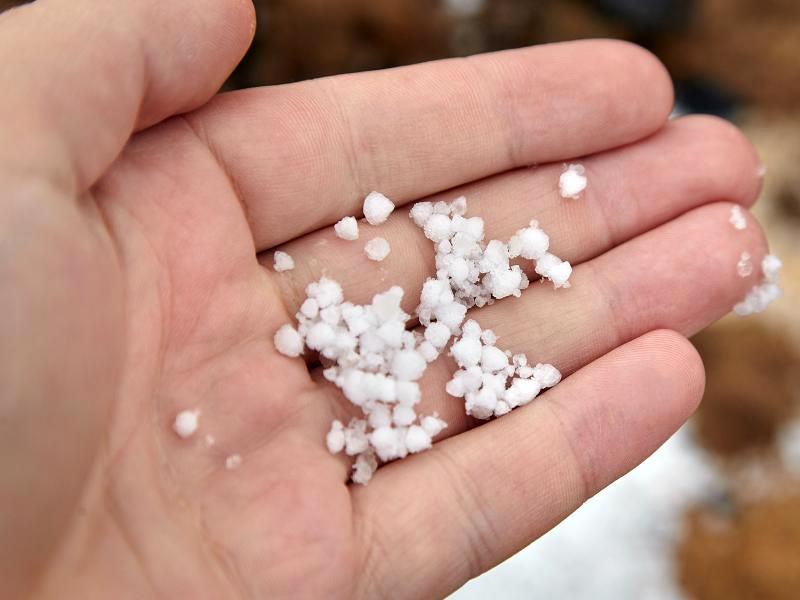
Graupel: it’s supercooled water!
This research may help explain graupel, the fluffy pellets that sometimes fall during cool-weather storms. Graupel forms when a snowflake interacts with supercooled liquid water in the upper atmosphere.
“Liquid water in the upper atmosphere is deeply cooled,” says Kay, a PNNL lab fellow and expert in the physics of water. “When it encounters a snowflake it rapidly freezes and then in the right conditions, falls to Earth. It’s really the only time most people will experience the effects of supercooled water.”
These studies may also help understand how liquid water can exist on very cold planets—Jupiter, Saturn, Uranus, and Neptune—in our solar system, and beyond. Supercooled water vapor also creates the beautiful tails that trail behind comets.
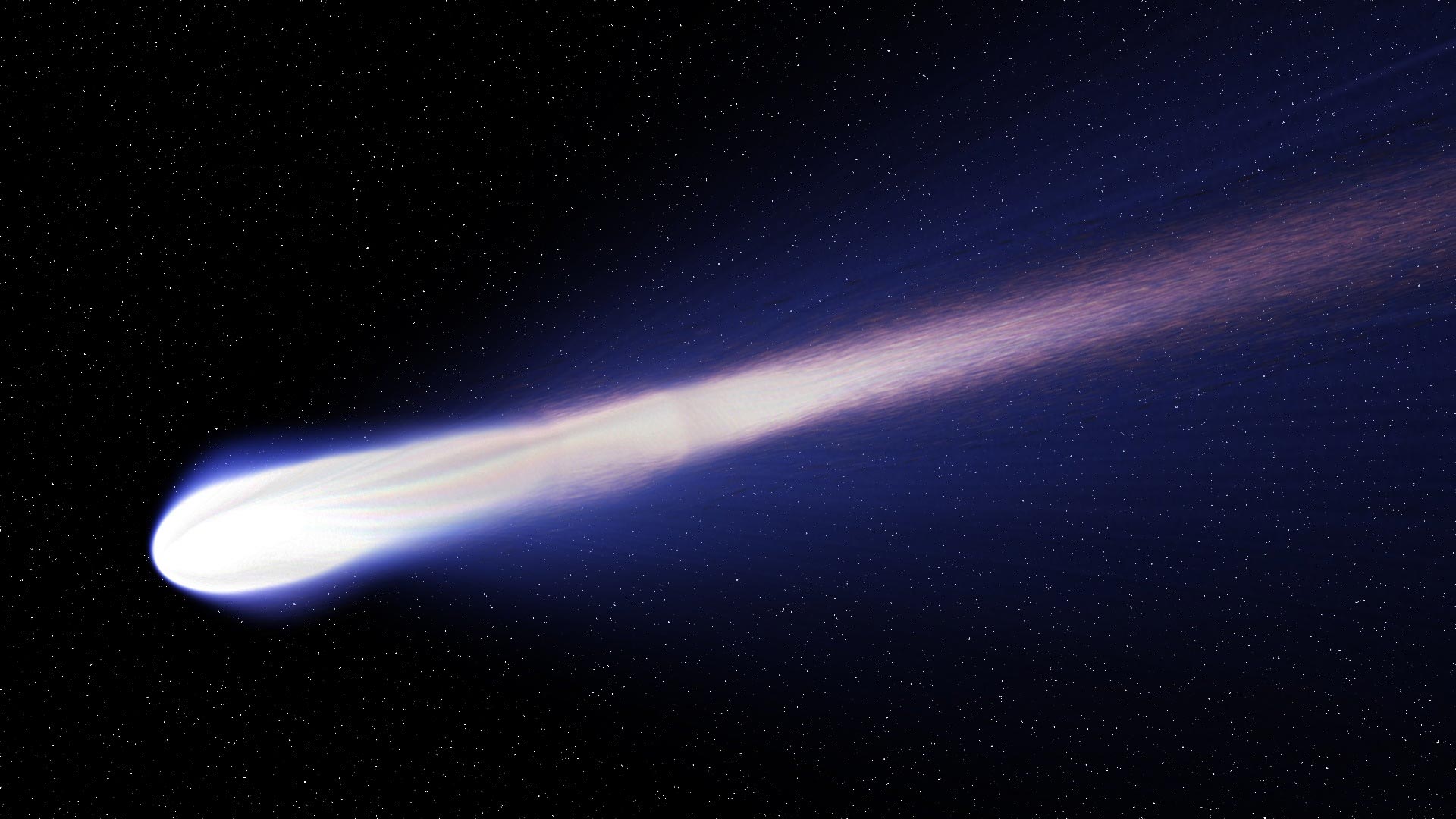
water may help explain how water can be liquid in outer space and our own frigid upper atmosphere.
Water molecule gymnastics
Here on Earth, a better understanding of the contortions water can perform when placed in a tight situation, such as a single water molecule wedged into a protein, could help scientists design new medicines.
“There isn’t a lot of space for the water molecules that surround individual proteins,” said Kringle. “This research could shed light on how liquid water behaves in closely packed environments.”
Thornley noted that “in future studies, we can use this new technique to follow the molecular rearrangements underlying a broad range of chemical reactions.”
There is still much to be learned, and these measurements will help lead the way to a better understanding of the most abundant life-giving liquid on Earth.
Reference: “Reversible structural transformations in supercooled liquid water from 135 to 245 K” by Loni Kringle, Wyatt A. Thornley, Bruce D. Kay and Greg A. Kimmel, 18 September 2020, Science.
DOI: 10.1126/science.abb7542
This work was supported by the U.S. Department of Energy, Office of Science. The pulsed laser and infrared spectroscopy measurements were performed at EMSL, the Environmental Molecular Sciences Laboratory, a DOE Office of Science user facility located at PNNL.
Never miss a breakthrough: Join the SciTechDaily newsletter.
Follow us on Google and Google News.
3 Comments
Very Interesting.
Well done Ms Loni Kringle (and team!).Hope you don’t have any relatives called Kris Kringle. We were brought up on tales of this gentlemen (North Pole based!), who went around distributing Gifts to little children around Chistman Time. One wayto make sure that the kids behaved themselves and were GOOD.
Jokes apart, the research finding is really very interesting.The Physical properties of mmaterials (especially liquids) and the entire field of inorganic chemistry is compratively ignored by researchers across the Globe. The fascination with Carbon and maybe the shining attraction of the Hardest of materials which is carbon based, which is part of an engagement ring and also a highly valued rock (never really understood why?) and gleam attacting humans from time immemorial and also the fascination with Carbon based lifeforms is probably the culprit.
Well my Dad did his Ph.D in Inorganic Chemistry in 1950, from the University of Bombay. Probaby long long before you wetre born. Great to see young talent doing tireless research for 25 yeard on Water. Hope the engineers can Join the Chemists and Physics team and come up with uses for the finding related to this basic research. Maybe,this research can open up a different field of Scientific breakthroufhs viz. Properties of other materials, (liquids) at various temperatures) and the usefulness of such materials for emerging technologies.
Ur comment has a typo
I counted at least seven typos, depending upon what punctuation rules regarding brackets one abides by.