
Close Menu
    Facebook X (Twitter) Instagram
    SciTechDaily
    • Biology
    • Chemistry
    • Earth
    • Health
    • Physics
    • Science
    • Space
    • Technology
    Facebook X (Twitter) Pinterest YouTube RSS
    SciTechDaily
    Home»Chemistry»Researchers Develop a Flexible Color-Changing Film Inspired by Chameleon Skin
    Chemistry

    Researchers Develop a Flexible Color-Changing Film Inspired by Chameleon Skin

    By American Chemical SocietyOctober 21, 20201 Comment3 Mins Read
    Facebook Twitter Pinterest Telegram LinkedIn WhatsApp Email Reddit
    Share
    Facebook Twitter LinkedIn Pinterest Telegram Email Reddit
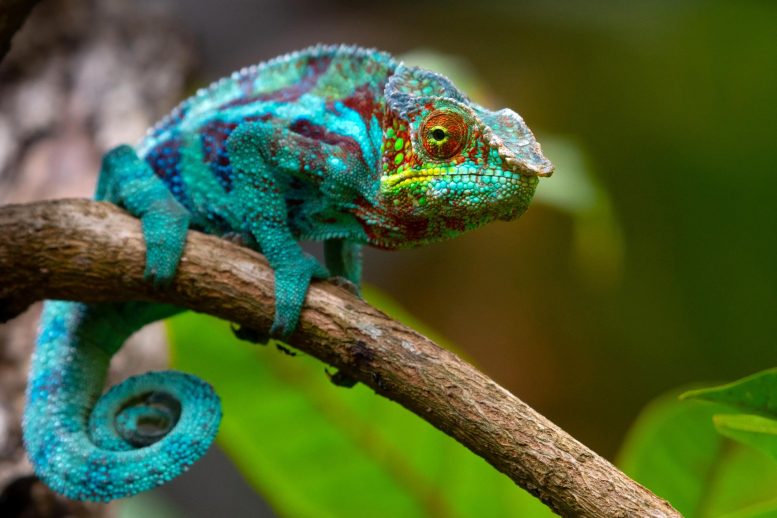
    Colorful Chameleon
    Scientists mimic chameleons’ color-changing with a flexible film that responds to stretching, pressure, and humidity.

    Chameleons can famously change their colors to camouflage themselves, communicate, and regulate their temperature. Scientists have tried to replicate these color-changing properties for stealth technologies, anti-counterfeiting measures, and electronic displays, but the materials have limitations.

    Now, researchers have developed a flexible film that changes color in response to stretching, pressure, or humidity. They report their results in ACS Applied Materials & Interfaces.

    Watch a video of the chameleon-inspired material here:

    By tensing or relaxing their skin, chameleons can change the way light reflects from guanine crystals under the surface, producing what’s known as structural coloration. These structural colors are different from the pigments that give many other creatures their hues.

    Scientists have mimicked the crystalline nanostructures of chameleon skin in various color-changing materials, but they’re typically difficult to produce, or they rely on non-renewable petroleum resources. In contrast, cellulose nanocrystals are renewable material that can self-assemble into a film with iridescent structural colors. However, the films are typically fragile and, unlike chameleon skin, can’t be stretched without breaking. Fei Song, Yu-Zhong Wang, and colleagues wanted to develop a highly flexible film made of cellulose nanocrystals that changes color when stretched.

    To increase the flexibility of cellulose nanocrystals, the researchers added a polymer called PEGDA and used UV light to crosslink it to the rod-shaped nanocrystals, producing films with bright iridescent colors ranging from blue to red, depending on the PEGDA amount. The films were both strong and flexible, stretching up to 39% of their original length before breaking. During stretching, the color of one film gradually changed from red to green, and then changed back when relaxed.

    According to the researchers, this is the first time that stretching- and relaxing-induced, reversible structural color changes that are brilliant and visible to the naked eye have been realized for cellulose nanocrystal materials. The film also changed color with pressure and humidity, allowing the team to show or hide writing made by an inkless pen. The new bio-based smart skin could find applications in strain sensing, encryption, and anti-counterfeiting measures, the researchers say.

    Reference: “Chameleon-Inspired Variable Coloration Enabled by a Highly Flexible Photonic Cellulose Film” by Ze-Lian Zhang, Xiu Dong, Yi-Ning Fan, Lu-Ming Yang, Lu He, Fei Song, Xiu-Li Wang and Yu-Zhong Wang, 23 September 2020, ACS Applied Materials & Interfaces.
    DOI: 10.1021/acsami.0c13551

    The authors acknowledge funding from the National Natural Science Foundation of China, the Science and Technology Fund for Distinguished Young Scholars of Sichuan Province, the State Key Laboratory of Polymer Materials Engineering and the Fundamental Research Funds for the Central Universities.

    Never miss a breakthrough: Join the SciTechDaily newsletter.
    Follow us on Google and Google News.

    American Chemical Society Electrical Engineering Materials Science Nanotechnology Zoology
    Share. Facebook Twitter Pinterest LinkedIn Email Reddit

    Related Articles

    Reducing Blue Light: A New Type of LED That Won’t Keep You Up All Night

    What Happens Between the Sheets? Extremely-Promising Superconductor Surprises Everyone

    New Hydrogel Can Cool Down Electronic Devices and Convert Waste Heat Into Electricity

    Researchers Develop a Better Method for Making Perovskite Solar Cells

    Copper Foam Provides a New Way to Turn CO2 into Useful Chemicals

    Researchers Grow Single-Walled Carbon Nanotubes with Identical Electronic Properties

    Scientists Develop a New Nanobiocomposite Material

    Researchers Identify a New Form of Carbon: Grossly Warped ‘Nanographene’

    Scientists Examine Platinum-Based Catalyst Design

    1 Comment

    1. kamir bouchareb st on October 22, 2020 3:04 am

      good

      Reply
    Leave A Reply Cancel Reply

    • Facebook
    • Twitter
    • Pinterest
    • YouTube

    Don't Miss a Discovery

    Subscribe for the Latest in Science & Tech!

    Trending News

    Scientists May Have Discovered How To Heal Damaged Kidneys

    Interstellar Visitor 3I/ATLAS Is Bursting With an Unexpected Chemical

    Scientists Just Found All 5 Genetic “Letters” of DNA and RNA on an Asteroid

    The 4,000-Year-Old City That Defied History’s Rules on Wealth and Power

    The World’s Biggest Population Fear Has Flipped – and It Could Change Everything

    This “Fake” Pill Improved Memory and Physical Performance in Just 3 Weeks

    Scientists Say Frequent Ejaculation May Improve Sperm Quality and Fertility

    Scientists Have Found “The Heaven Sword” After Years of Looking

    Follow SciTechDaily
    • Facebook
    • Twitter
    • YouTube
    • Pinterest
    • Newsletter
    • RSS
    SciTech News
    • Biology News
    • Chemistry News
    • Earth News
    • Health News
    • Physics News
    • Science News
    • Space News
    • Technology News
    Recent Posts
    • Critically Endangered Monkey Defies the Odds With New Baby After Surgery
    • 17-Million-Year-Old Ape Fossil in Egypt Could Change What We Know About Human Origins
    • NASA’s Orbiting Quantum Lab Pushes Deeper Into the Unknown
    • NASA’s James Webb Discovers Bizarre Salt Clouds on the Pink Planet
    • Mysterious Signals Keep Coming From Space. Scientists May Finally Know Why
    Copyright © 1998 - 2026 SciTechDaily. All Rights Reserved.
    • Science News
    • About
    • Contact
    • Editorial Board
    • Privacy Policy
    • Terms of Use

    Type above and press Enter to search. Press Esc to cancel.