
Close Menu
    Facebook X (Twitter) Instagram
    SciTechDaily
    • Biology
    • Chemistry
    • Earth
    • Health
    • Physics
    • Science
    • Space
    • Technology
    Facebook X (Twitter) Pinterest YouTube RSS
    SciTechDaily
    Home»Space»Hubble Space Telescope Explores a Turbulent Tarantula
    Space

    Hubble Space Telescope Explores a Turbulent Tarantula

    By ESA/HubbleJanuary 29, 2023No Comments2 Mins Read
    Facebook Twitter Pinterest Telegram LinkedIn WhatsApp Email Reddit
    Share
    Facebook Twitter LinkedIn Pinterest Telegram Email Reddit
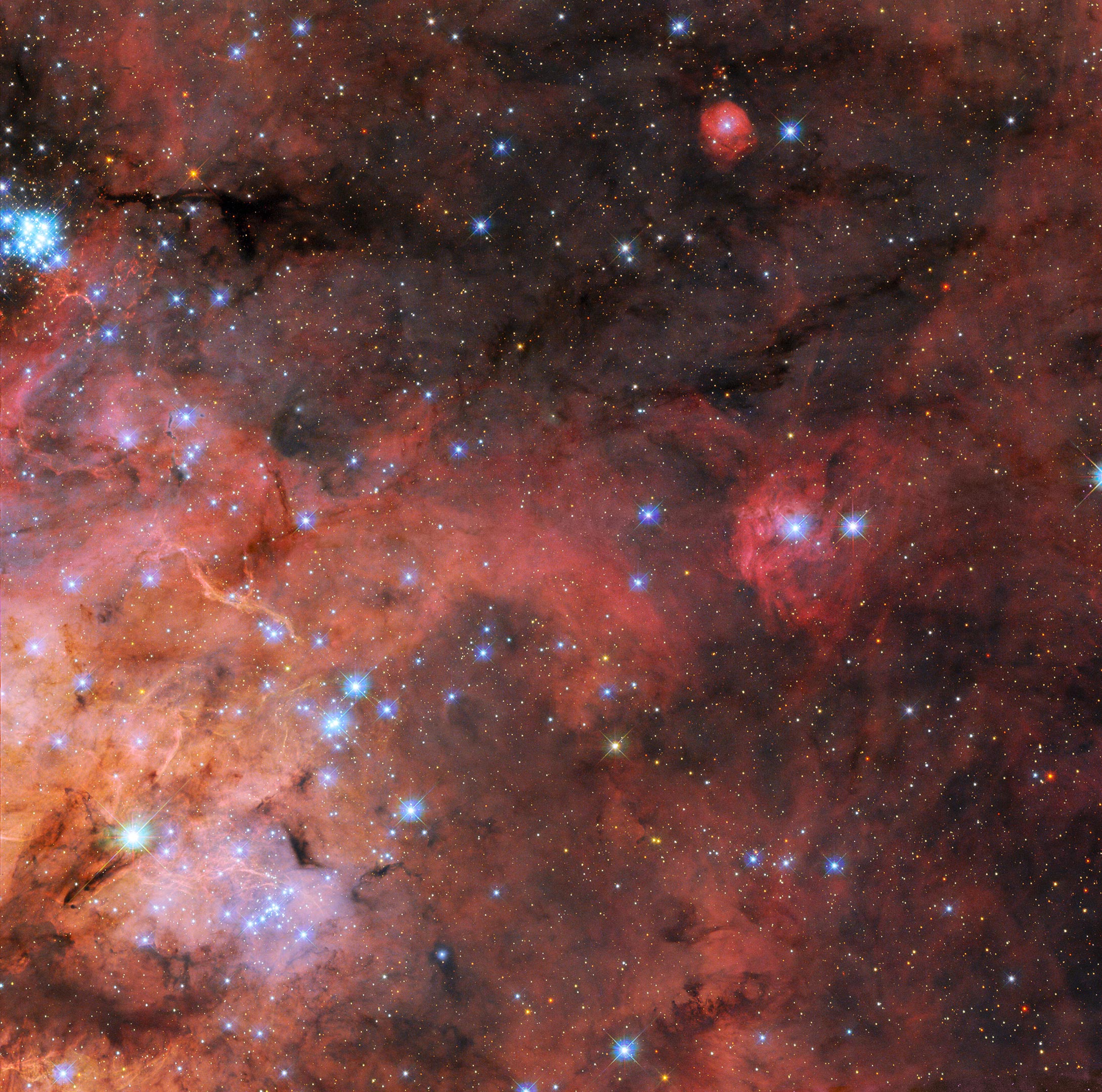
    Hubble Tarantula Nebula
    Hubble Space Telescope snapshot of the Tarantula Nebula (also known as 30 Doradus). Credit: ESA/Hubble & NASA, C. Murray, E. Sabbi, Acknowledgment: Y.-H. Chu

    A snapshot of the Tarantula Nebula (also known as 30 Doradus) is the most recent Hubble Space Telescope Picture of the Week. The Tarantula Nebula is a large star-forming region of ionized hydrogen gas located approximately 161,000 light years from Earth in the Large Magellanic Cloud, and its turbulent clouds of gas and dust can be seen swirling between the region’s bright, newly-formed stars.

    The Tarantula Nebula is a familiar site for Hubble. It is the brightest star-forming region in our galactic neighborhood and home to the hottest, most massive stars known. This makes it a perfect natural laboratory in which to test out theories of star formation and evolution, and a rich variety of Hubble images of this region have been released to the public in recent years. The NASA/ESA/CSA James Webb Space Telescope also recently delved into this region, revealing thousands of never-before-seen young stars.

    Tarantula Nebula (NIRCam)
    In this mosaic image stretching 340 light-years across, Webb’s Near-Infrared Camera (NIRCam) displays the Tarantula Nebula star-forming region in a new light, including tens of thousands of never-before-seen young stars that were previously shrouded in cosmic dust. The most active region appears to sparkle with massive young stars, appearing pale blue. Scattered among them are still-embedded stars, appearing red, yet to emerge from the dusty cocoon of the nebula. NIRCam is able to detect these dust-enshrouded stars thanks to its unprecedented resolution at near-infrared wavelengths. Credit: NASA, ESA, CSA, STScI, Webb ERO Production Team

    This new image combines data from two different observing proposals. The first was designed to explore the properties of the dust grains that exist in the void between stars and which make up the dark clouds winding through this image. This proposal, which astronomers named Scylla, complements another Hubble observing proposal called Ulysses and is revealing how interstellar dust interacts with starlight in a variety of environments. This image also incorporates data from an observing program studying star formation in conditions similar to the early Universe, as well as cataloging the stars of the Tarantula Nebula for future science with Webb.

    Never miss a breakthrough: Join the SciTechDaily newsletter.
    Follow us on Google and Google News.

    Astronomy European Space Agency Hubble Space Telescope
    Share. Facebook Twitter Pinterest LinkedIn Email Reddit

    Related Articles

    A Diamond Necklace of Cosmic Proportions

    Hubble Snaps a Stunning Close-Up of a Magnificent Spiral Galaxy

    Extraordinary Hubble Image: Light Bends From the Beyond

    Hubble Space Telescope Sees Volcanic Activity Reforming the Atmosphere on a Rocky Exoplanet

    Hubble Spies a Luminous Heart With Dark Tendrils

    Spectacular Return to the Veil Nebula

    Hubble Spots a Peculiar Sight: Unusual Spiral Galaxy With a Heavy Arm

    A Flash of Life: Hubble Spies an Unusual Planetary Nebula

    Through the Cosmic Clouds: Hubble Spots a Beautiful Stellar Nursery

    Leave A Reply Cancel Reply

    • Facebook
    • Twitter
    • Pinterest
    • YouTube

    Don't Miss a Discovery

    Subscribe for the Latest in Science & Tech!

    Trending News

    Stanford Scientists Discover a Remarkable Way To Rescue Dying Corals in Just Seven Weeks

    0 to 15 MPH in a Single Swipe: New Research Reveals How Ancient Giant Sea Monsters Ambushed Their Prey

    Late-Night Snacking Could Be Putting Your Liver at Risk

    40 Years of Superconductor Science Just Got Turned Upside Down by a Stunning Discovery

    A 50-Year-Old Mystery: Scientists Discover What May Have Killed Brazil’s Frogs

    Scientists Discover Exercise Changes the Body in Ways We Never Fully Understood

    Scientists Restore Memory in Mice With Alzheimer’s by Boosting a Single Brain Protein

    Scientists Create “Super Ice” That’s 10 Times Stronger and Rivals Concrete in Strength

    Follow SciTechDaily
    • Facebook
    • Twitter
    • YouTube
    • Pinterest
    • Newsletter
    • RSS
    SciTech News
    • Biology News
    • Chemistry News
    • Earth News
    • Health News
    • Physics News
    • Science News
    • Space News
    • Technology News
    Recent Posts
    • Your Saliva Could Hold the Key to Detecting a Deadly Cancer
    • Scientists Discover a Hidden Cholesterol Switch That Could Change How We Treat Heart Disease
    • A Major Drug Breakthrough Could Change How Ozempic and Wegovy Work
    • Researchers Find an Unexpected Benefit of Putting Sheep on Solar Farms
    • Scientists Discover a New Butterfly Species Hiding in Plain Sight
    Copyright © 1998 - 2026 SciTechDaily. All Rights Reserved.
    • Science News
    • About
    • Contact
    • Editorial Board
    • Privacy Policy
    • Terms of Use

    Type above and press Enter to search. Press Esc to cancel.