
Researchers have finally succeeded in building a long-sought nanoparticle structure, opening the door to new materials with special properties.
Alex Travesset does not have a sparkling research lab stocked with the most cutting-edge instruments for probing new nanomaterials and measuring their unique properties.
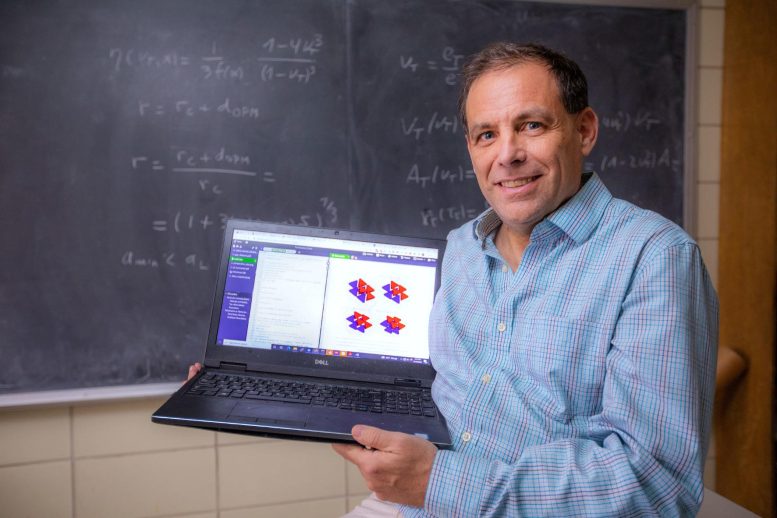
Instead of using traditional laboratory instruments, Alex Travesset, a professor of physics and astronomy at Iowa State University and an affiliate of the U.S. Department of Energy’s Ames National Laboratory, relies on computer models, equations, and figures to understand the behavior of new nanomaterials.
When he joins a research project, he often contributes detailed analyses of nanoparticle assembly using these computational methods. Travesset’s expertise in theoretical physics allows him to provide valuable insights and understanding of the complex processes at work within nanomaterials.
Breakthrough in Chiral Nanostructures
Case in point: Travesset’s “Chiral Tetrahedra” calculations and illustrations that are part of a research paper just published by the journal Nature. Those calculations show how controlled evaporation of a solution containing tetrahedron-shaped gold nanoparticles on a solid silicon substrate can assemble into a pinwheel-shaped, two-layered structure.
It turns out the nanostructure is chiral, meaning it’s not identical to its mirror image. (The classic example is a hand and its reflection. The thumbs end up on opposite sides and so one hand can’t be superimposed on the other. That’s chirality.)
Travesset said producing a stable nanostructure with chiral properties is a big deal.
Researchers have been trying to assemble chiral nanostructures for nearly 20 years – about as long as researchers have been studying nanostructures. Such structures could lead to specially engineered materials with “unusual optical, mechanical and electronic characteristics,” according to the Nature paper.
Travesset, who was introduced to the project’s lead researchers from the University of Illinois Urbana-Champaign during a virtual scientific conference, wasn’t even sure this new chiral structure could exist in the real world.
Achieving Stability in Nanostructures
“This was a very open structure,” he said. “Usually, with nanoparticles, these structures are never stable.”
But this one was “held together by different types of electrostatic forces,” Travesset said. “They were unusual in their continuity.”
The structure’s chirality was made possible by being sandwiched in two different substrates – air at the top and a solid surface at the bottom. Optical measurements at the University of Michigan corroborated the chirality by reporting a very strong chiro-optical effect in response to polarized light.
“This very open structure with chiral optical response was very important,” Travesset said. “People have been trying to do this for a long time. But the structure has always been unstable or not realizable. This is the first example of this having been achieved.”
Again, a big deal.
“As a theorist working in all things nanoparticle, I have always been interested in how to assemble nanoparticle arrangements that are chiral,” Travesset said.
The “unique topology and physics” of these chiral nanostructures, “make their self-assembly from nanoparticles highly sought after yet challenging,” according to the Nature paper.
Travesset said the experimentalists in the research group will build on their discovery, learning more about the nanostructure’s properties and, potentially, how they could be used in, say, coatings for optical applications.
For nanoparticle theorists working with their models, equations, and figures, Travesset said there’s also a lot of work ahead.
“Despite some successes, theory is somehow lagging behind,” he said. “We are not yet in a position where we can design nanoparticle-based materials from theoretical/computational models alone. In fact, other colleagues and I are organizing an eight-week workshop to address this challenge.”
Reference: “Chiral assemblies of pinwheel superlattices on substrates” by Shan Zhou, Jiahui Li, Jun Lu, Haihua Liu, Ji-Young Kim, Ahyoung Kim, Lehan Yao, Chang Liu, Chang Qian, Zachary D. Hood, Xiaoying Lin, Wenxiang Chen, Thomas E. Gage, Ilke Arslan, Alex Travesset, Kai Sun, Nicholas A. Kotov and Qian Chen, 28 November 2022, Nature.
DOI: 10.1038/s41586-022-05384-8
The study was funded by the US Department of Energy.
Never miss a breakthrough: Join the SciTechDaily newsletter.
Follow us on Google and Google News.