
Close Menu
    Facebook X (Twitter) Instagram
    SciTechDaily
    • Biology
    • Chemistry
    • Earth
    • Health
    • Physics
    • Science
    • Space
    • Technology
    Facebook X (Twitter) Pinterest YouTube RSS
    SciTechDaily
    Home»Technology»A Black Computing Pioneer Takes His Place in Technology History at MIT
    Technology

    A Black Computing Pioneer Takes His Place in Technology History at MIT

    By Maia Weinstock, Massachusetts Institute of TechnologyFebruary 7, 2021No Comments2 Mins Read
    Facebook Twitter Pinterest Telegram LinkedIn WhatsApp Email Reddit
    Share
    Facebook Twitter LinkedIn Pinterest Telegram Email Reddit
    Joe Thompson and Jack Gilmore
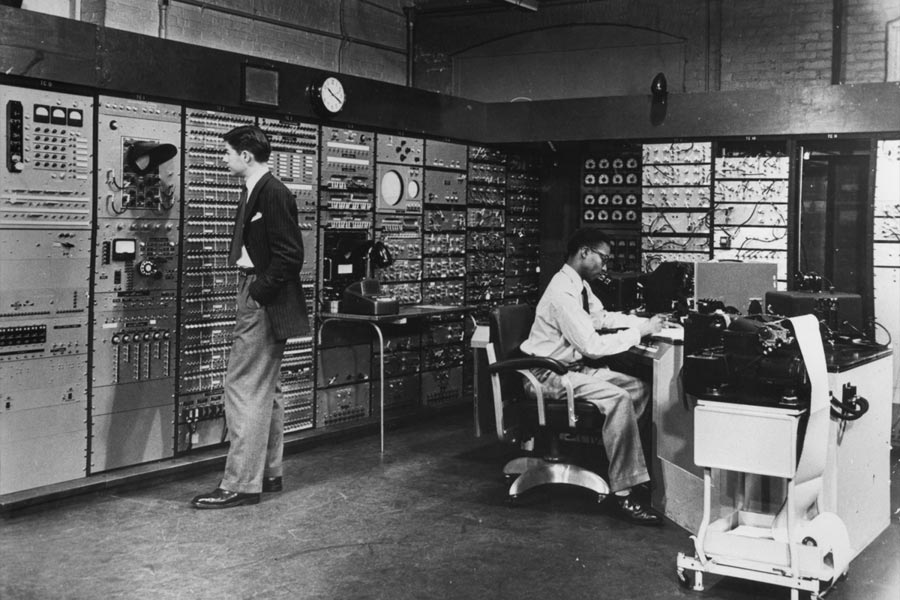
    Joe Thompson (seated) and Jack Gilmore operated Whirlwind, the first digital computer able to operate in real-time and the first digital computer at MIT. Credit: MIT Museum

    A brief history of a 1950s photo featuring Joseph Thompson, one of the original operators of MIT’s groundbreaking Whirlwind computer.

    The caption on a black-and-white photo reads, in part: “In 1951, high school graduate Joe Thompson, 18, was trained as one of the first two computer operators. The computer was the Whirlwind, the prototype for the SAGE air defense system.”

    MIT’s Whirlwind was one of the earliest high-speed digital computers, and Thompson played a key role in its operation at the start of his decades-long career in computing. With help from Deborah Douglas, director of collections at the MIT Museum, David Brock of the Computer History Museum recently caught up with Thompson, the first person trained as a Whirlwind operator at the MIT Digital Computer Laboratory, to learn more about his time with the project and his subsequent years as a leader in the computing industry.

    “They at MIT were looking for bright, young kids who were not going to college,” Thompson told Brock. “I was the first [operator] to see if it would work, and I guess it worked well. … You had to learn the whole system, and you’d get to the point where you understand what they’re doing.”

    Also seen in the photo is system programmer John “Jack” Gilmore. According to a publication from the Computer History Museum, “It had been Jack Gilmore of the Whirlwind project, famous for his software contributions, who had been key to bringing Joe Thompson into the project in an MIT push to meet the demands for skilled staff by recruiting from local high schools those students who were academically and socially exceptional, but for whom, for whatever reasons, college was inaccessible.”

    After Whirlwind, Thompson accepted a job with RAND as a programmer working on the SAGE air defense system software. He transferred to California with the company, and his group eventually spun off into the non-profit System Development Corporation. Thompson retired in the 1990s after four decades in computing.

    Gilmore would go on to work in advanced computing research at MIT Lincoln Laboratory before starting his own firm and spending the rest of his career in the computing industry. He died in 2015.

    Never miss a breakthrough: Join the SciTechDaily newsletter.
    Follow us on Google and Google News.

    Computer Science History MIT
    Share. Facebook Twitter Pinterest LinkedIn Email Reddit

    Related Articles

    Tensor Display Uses Several Layers of LCDs to Produce 3D Illusion

    New Chip Combines Energy from Solar, Thermal and Vibration Sources

    New Algorithm Enables Wi-Fi Connected Vehicles to Share Data

    New MIT Software Solves Many of SSH’s Problems

    New Programming System Could Help Prevent Information Leaks

    Algorithm Enables Robots to Learn and Adapt to Help Complete Tasks

    New Approach Uses Mathematics to Improve Automated Security Monitoring

    Mathematical Framework Formalizes Loop Perforation Technique

    Calculating the Total Capacity of a Data Network

    Leave A Reply Cancel Reply

    • Facebook
    • Twitter
    • Pinterest
    • YouTube

    Don't Miss a Discovery

    Subscribe for the Latest in Science & Tech!

    Trending News

    Two Drinks a Day May Be Riskier Than Many Americans Think

    A Lost Human Lineage May Have Left a Genetic Legacy in People Today

    Study Reveals a Surprising Link Between Birth Control Pills and Binge Eating

    NASA’s HiRISE Captures Perseverance Rover Completing a Marathon on Mars

    Ancient DNA Reveals the Hidden Origins of China’s Mysterious Shimao Civilization

    Scientists Discover a Surprising Link Between Sleep, Genes, and Alzheimer’s

    Popular Childhood Drinks Linked to Higher Blood Pressure Later in Life

    Scientists Just Challenged a 70-Year-Old Myth About the Human Brain

    Follow SciTechDaily
    • Facebook
    • Twitter
    • YouTube
    • Pinterest
    • Newsletter
    • RSS
    SciTech News
    • Biology News
    • Chemistry News
    • Earth News
    • Health News
    • Physics News
    • Science News
    • Space News
    • Technology News
    Recent Posts
    • The Ancient Survival Mechanism Making Weight Loss So Difficult
    • Just 3,000 Steps a Day May Help Protect the Brain From Alzheimer’s
    • “Weird Clams” Reveal a New Invasion Along the U.S. Northeast Coast
    • Why Ancient Mesopotamians Took Their Signatures So Seriously
    • Archaeologists Decapitated Tutankhamun and Glued His Body Back Together
    Copyright © 1998 - 2026 SciTechDaily. All Rights Reserved.
    • Science News
    • About
    • Contact
    • Editorial Board
    • Privacy Policy
    • Terms of Use

    Type above and press Enter to search. Press Esc to cancel.