
Close Menu
    Facebook X (Twitter) Instagram
    SciTechDaily
    • Biology
    • Chemistry
    • Earth
    • Health
    • Physics
    • Science
    • Space
    • Technology
    Facebook X (Twitter) Pinterest YouTube RSS
    SciTechDaily
    Home»Space»Mars Reconnaissance Orbiter Reveals Squiggles in Hellas Planitia
    Space

    Mars Reconnaissance Orbiter Reveals Squiggles in Hellas Planitia

    By SciTechDailyOctober 26, 2017No Comments2 Mins Read
    Facebook Twitter Pinterest Telegram LinkedIn WhatsApp Email Reddit
    Share
    Facebook Twitter LinkedIn Pinterest Telegram Email Reddit
    MRO Views Hellas Planitia
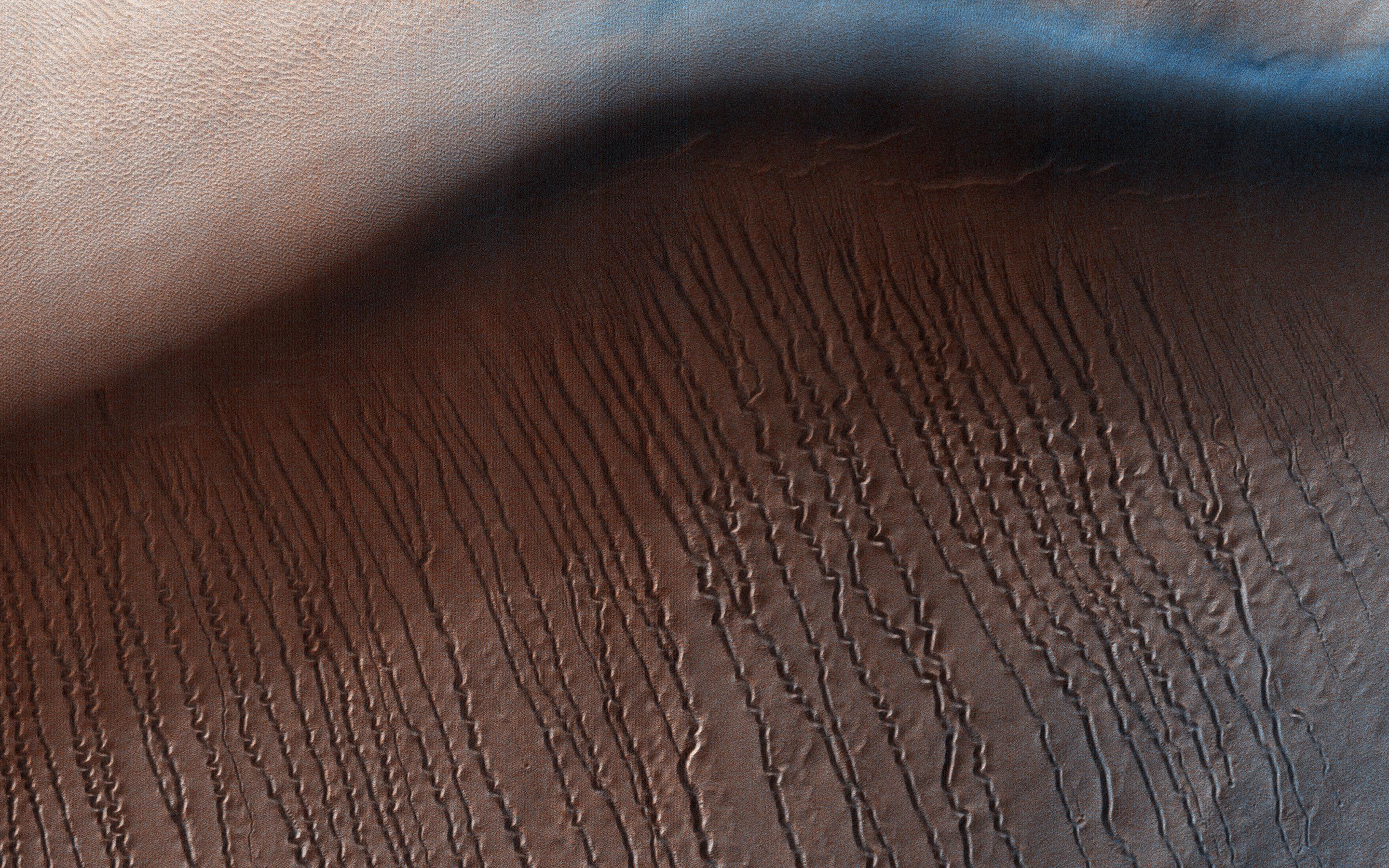
    This image depicts a dune field in a small central area of Hellas Planitia on Mars, marked with numerous trails left by dust devils. Credit: NASA/JPL-Caltech/University of Arizona

    This newly released image from the Mars Reconnaissance Orbiter shows a small central portion of Hellas Planitia and shows a dune field with lots of dust devil trails.

    At around 2,200 kilometers (1,400 miles) in diameter, Hellas Planitia is the largest visible impact basin in the Solar System, and hosts the lowest elevations on Mars’ surface as well as a variety of landscapes. This image from NASA’s Mars Reconnaissance Orbiter (MRO) covers a small central portion of the basin and shows a dune field with lots of dust devil trails.

    In the middle, we see what appears to be long and straight “scratch marks” running down the southeast (bottom-right) facing dune slopes. If we look closer, we can see these scratch marks actually squiggle back and forth on their way down the dune. These scratch marks are linear gullies.

    Just like on Earth, high-latitude regions on Mars are covered with frost in the winter. However, the winter frost on Mars is made of carbon dioxide ice (dry ice) instead of water ice. We believe linear gullies are the result of this dry ice breaking apart into blocks, which then slide or roll down warmer sandy slopes, sublimating and carving as they go.

    The linear gullies exhibit exceptional sinuosity (the squiggle pattern) and we believe this to be the result of repeated movement of dry ice blocks in the same path, possibly in combination with different hardness or flow resistance of the sand within the dune slopes. Determining the specific process that causes the formation and evolution of sinuosity in linear gullies is a question scientists are still trying to answer. What do you think causes the squiggles?

    This is a stereo pair with ESP_051836_1345.

    The University of Arizona, Tucson, operates HiRISE, which was built by Ball Aerospace & Technologies Corp., Boulder, Colo. NASA’s Jet Propulsion Laboratory, a division of Caltech in Pasadena, California, manages the Mars Reconnaissance Orbiter Project for NASA’s Science Mission Directorate, Washington.

    Never miss a breakthrough: Join the SciTechDaily newsletter.
    Follow us on Google and Google News.

    Astronomy Mars Mars Reconnaissance Orbiter Planetary Science
    Share. Facebook Twitter Pinterest LinkedIn Email Reddit

    Related Articles

    New NASA Image of the Northern Plains of Mars

    Mars Orbiter Preparing for Mars InSight Lander’s 2016 Arrival

    New HiRISE Image of a “Fresh” Crater Near Sirenum Fossae

    NASA’s Mars Reconnaissance Orbiter Completes 40,000 Mars Orbits

    Orbiter Examines Clues to Possible Water Flows on Mars

    Mars Reconnaissance Orbiter Examines a New Impact Crater

    Scientists Find Evidence for Granite on Mars

    Data Indicates Temperatures Rise and Fall Twice a Day on Mars

    Mars Orbiter Shows McLaughlin Crater May Have Once Held a Groundwater-Fed Lake

    Leave A Reply Cancel Reply

    • Facebook
    • Twitter
    • Pinterest
    • YouTube

    Don't Miss a Discovery

    Subscribe for the Latest in Science & Tech!

    Trending News

    First-of-Its-Kind Discovery: Homer’s Iliad Found Embedded in a 1,600-Year-Old Egyptian Mummy

    Beyond Inflammation: Scientists Uncover New Cause of Persistent Rheumatoid Arthritis

    A Simple Molecule Could Unlock Safer, Easier Weight Loss

    Scientists Just Built a Quantum Battery That Charges Almost Instantly

    Researchers Unveil Groundbreaking Sustainable Solution to Vitamin B12 Deficiency

    Millions of People Have Osteopenia Without Realizing It – Here’s What You Need To Know

    Researchers Discover Boosting a Single Protein Helps the Brain Fight Alzheimer’s

    World-First Study Reveals Human Hearts Can Regenerate After a Heart Attack

    Follow SciTechDaily
    • Facebook
    • Twitter
    • YouTube
    • Pinterest
    • Newsletter
    • RSS
    SciTech News
    • Biology News
    • Chemistry News
    • Earth News
    • Health News
    • Physics News
    • Science News
    • Space News
    • Technology News
    Recent Posts
    • New Research Challenges Long-Held Beliefs About How the Brain Makes Decisions
    • Breakthrough Technology Reveals New Treatment Targets for Cancer
    • Scientists Discover New Way To Make Drug-Resistant Cancer Treatable Again
    • This Simple Exercise Trick Builds Muscle With Less Effort, Study Finds
    • Middle Age Is Becoming a Breaking Point in America, Study Reveals
    Copyright © 1998 - 2026 SciTechDaily. All Rights Reserved.
    • Science News
    • About
    • Contact
    • Editorial Board
    • Privacy Policy
    • Terms of Use

    Type above and press Enter to search. Press Esc to cancel.