
Close Menu
    Facebook X (Twitter) Instagram
    SciTechDaily
    • Biology
    • Chemistry
    • Earth
    • Health
    • Physics
    • Science
    • Space
    • Technology
    Facebook X (Twitter) Pinterest YouTube RSS
    SciTechDaily
    Home»Earth»Initial SAGE III Atmospheric Data Released for Public Use
    Earth

    Initial SAGE III Atmospheric Data Released for Public Use

    By Joe Atkinson, Langley Research CenterOctober 26, 2017No Comments4 Mins Read
    Facebook Twitter Pinterest Telegram LinkedIn WhatsApp Email Reddit
    Share
    Facebook Twitter LinkedIn Pinterest Telegram Email Reddit
    First SAGE III Atmospheric Data Released for Public Use
    SAGE III launched to the International Space Station in February of 2017. The first publicly available data from the instrument includes measurements of ozone, aerosols and nitrogen dioxide. Credits: NASA

    The initial atmospheric data from the Stratospheric Aerosol and Gas Experiment III (SAGE III), a NASA instrument that launched to the International Space Station earlier this year, is now available for public use.

    The data, available through NASA’s Atmospheric Science Data Center, was collected June through August and includes measurements of ozone, aerosols and nitrogen dioxide. SAGE III scientists are releasing this initial dataset in order to solicit feedback from the international atmospheric science community.

    “The intention of this initial release is validation,” said SAGE III Project Scientist Joe Zawodny of NASA’s Langley Research Center in Hampton, Virginia. “We’re putting it out there so people can start comparing it to their measurements. A lot of these folks have been around for a very long time. They’ve used [data from previous SAGE missions] in the past. They are the ones who are best positioned to give us honest opinions of what they like and what they don’t like.”
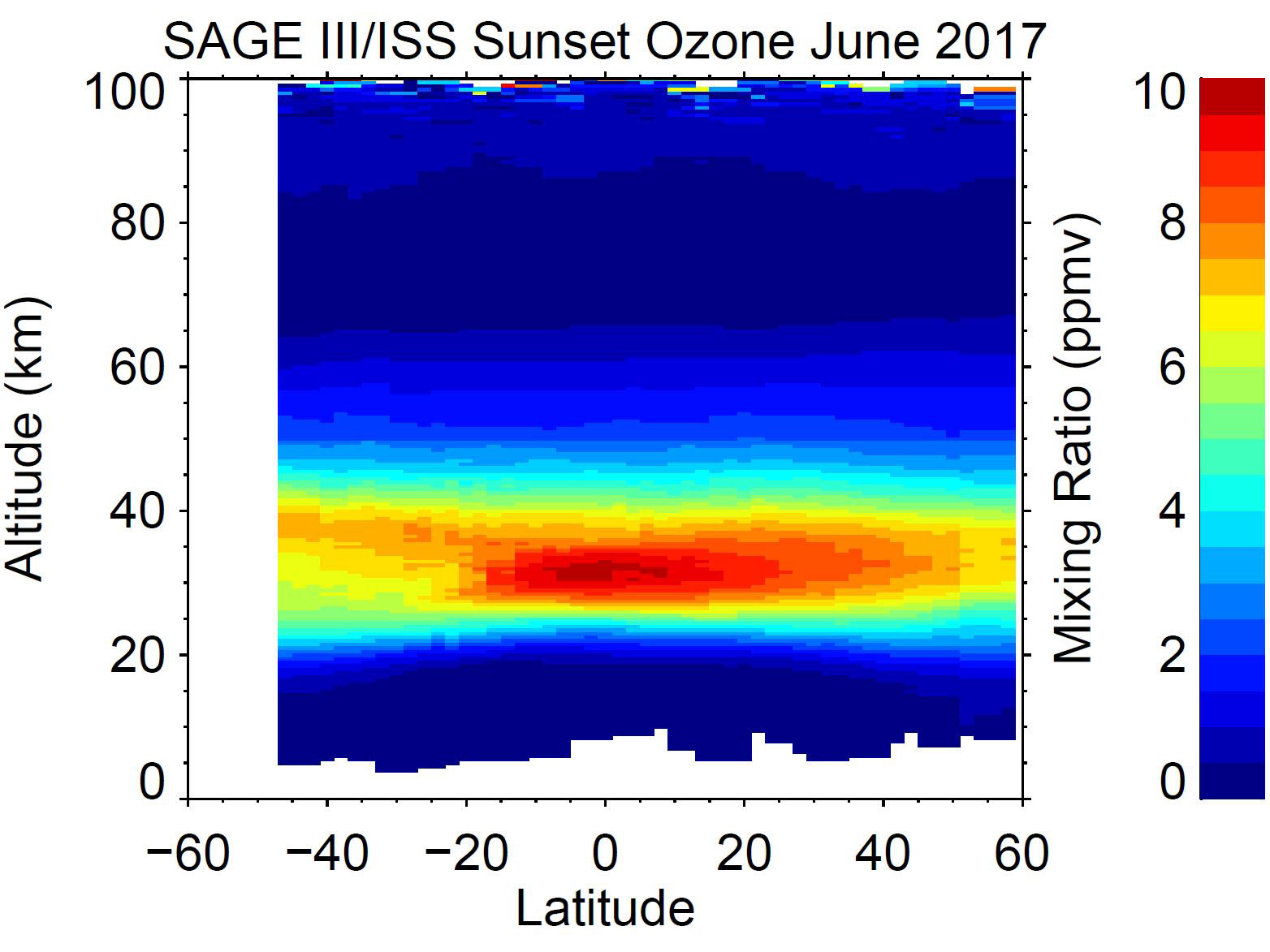
    First SAGE III Atmospheric Data Released for Public Use
    This figure shows a slice through the atmosphere depicting the amount of ozone. This is a sunset sweep for June of 2017. Ozone peaks near 30 kilometers in the equatorial lower stratosphere. There is also a secondary peak high up in the mesosphere around 90 kilometers. Near the bottom of the figure ozone decreases rapidly as the measurements drop below the tropopause (13 to 18 kilometers, depending upon latitude) into the upper and mid troposphere. Credits: NASA/Robert Damadeo

    To take measurements, SAGE III uses a technique known as occultation, which involves looking at the light from the Sun or Moon as it passes through Earth’s atmosphere at the edge, or limb, of the planet. The space station provides a unique vantage point from which to take those measurements. This initial data release is of solar occultation measurements.

    SAGE III is the latest in a legacy of Langley instruments that go back to the Stratospheric Aerosol Measurement (SAM), which flew on the 1975 Apollo-Soyuz mission. SAGE II, which was operational from 1984 to 2005, measured global declines in stratospheric ozone that were later shown to be caused by human-induced increases in atmospheric chlorine. Data from it and other sources led to the development of the Montreal Protocol on Substances that Deplete the Ozone Layer.

    After the passage of the protocol, SAGE II data also provided key evidence that the ozone layer was showing signs of recovery.

    SAGE III, which launched to the station February 19 from Kennedy Space Center in Florida, will continue to monitor that recovery, but with more of Earth’s atmosphere in its sights. SAGE II monitored only the stratosphere. SAGE III is monitoring both the stratosphere and the mesosphere, which is the layer directly above the stratosphere. Ozone in the upper atmosphere acts as Earth’s sunscreen, protecting the surface from cancer-causing, crop-damaging ultraviolet rays. Atmospheric aerosols contribute to variability in the climate record.

    ”It’s exciting to see these data reach the research community,” said SAGE III Program Scientist Richard Eckman of NASA Headquarters in Washington, D.C. “Earlier SAGE observations have been used extensively in the World Meteorological Organization’s periodic assessments of ozone depletion, which were begun in 1981. SAGE measurements have also contributed to the UN’s Intergovernmental Panel on Climate Change assessment process. These ISS-based observations will reinitiate SAGE’s contribution toward the long-term monitoring of ozone vertical profiles that inform these ongoing international assessment activities.”

    SAGE III includes a disturbance monitoring package that detects vibrations on the station. For the current release, data that may have been affected by significant vibrations or movement were not used.

    “Future versions will likely have more data than for the months we’ve already released,” said Zawodny. “This has been a fairly conservative filtering and subsetting of the data to put out what we think is representative of good quality data for validation purposes.”

    The SAGE science team will begin releasing lunar occultation data later this year. Water vapor data is not part of this initial release, but will be available in future datasets. Following this initial release, SAGE III data will be released on a monthly basis.

    Never miss a breakthrough: Join the SciTechDaily newsletter.
    Follow us on Google and Google News.

    Atmospheric Science Earth Science International Space Station NASA
    Share. Facebook Twitter Pinterest LinkedIn Email Reddit

    Related Articles

    Astronauts Reveal Dazzling Red Sprites: Stunning Phenomena Captured From Space Station [Video]

    NASA Releases Most Accurate Space-Based Map of Los Angeles’ Carbon Dioxide

    Aurora, Meet Airglow: Two of Earth’s Most Colorful Atmospheric Phenomena Meet in Stunning Photo From Space Station

    International Space Station Investigates Thunderstorms in Earth’s Upper Atmosphere

    Two New NASA Missions Team Up To Explore Earth’s Ionosphere

    Total and Spectral Solar Irradiance Sensor Measures Solar Energy Input to Earth

    New NASA Study Shows That Hydrofluorocarbons Contribute to Ozone Depletion

    Astronaut Scott Kelly Views the Nile at Night from the International Space Station

    NASA Study Provides New Estimates for the Global Water Cycle

    Leave A Reply Cancel Reply

    • Facebook
    • Twitter
    • Pinterest
    • YouTube

    Don't Miss a Discovery

    Subscribe for the Latest in Science & Tech!

    Trending News

    The Universe Is Expanding Too Fast and Scientists Can’t Explain Why

    “Like Liquid Metal”: Scientists Create Strange Shape-Shifting Material

    Early Warning Signals of Esophageal Cancer May Be Hiding in Plain Sight

    Common Blood Pressure Drug Shows Surprising Power Against Deadly Antibiotic-Resistant Superbug

    Scientists Uncover Dangerous Connection Between Serotonin and Heart Valve Disease

    Scientists Discover a “Protector” Protein That Could Help Reverse Hair Loss

    Bone-Strengthening Discovery Could Reverse Osteoporosis

    Scientists Uncover Hidden Trigger Behind Stem Cell Aging

    Follow SciTechDaily
    • Facebook
    • Twitter
    • YouTube
    • Pinterest
    • Newsletter
    • RSS
    SciTech News
    • Biology News
    • Chemistry News
    • Earth News
    • Health News
    • Physics News
    • Science News
    • Space News
    • Technology News
    Recent Posts
    • Scientists Overcome Major Quantum Bottleneck, Potentially Transforming Teleportation and Computing
    • Quantum Physics’ Strangest Problem May Hold the Key to Time Itself
    • Scientists Create “Liquid Gears” That Spin Without Touching
    • The Simple Habit That Could Help Prevent Cancer
    • Forgotten Medicinal Plant Shows Promise in Fighting Dangerous Superbugs
    Copyright © 1998 - 2026 SciTechDaily. All Rights Reserved.
    • Science News
    • About
    • Contact
    • Editorial Board
    • Privacy Policy
    • Terms of Use

    Type above and press Enter to search. Press Esc to cancel.