
Close Menu
    Facebook X (Twitter) Instagram
    SciTechDaily
    • Biology
    • Chemistry
    • Earth
    • Health
    • Physics
    • Science
    • Space
    • Technology
    Facebook X (Twitter) Pinterest YouTube RSS
    SciTechDaily
    Home»Space»A Cosmic Christmas Tree Lights Up the Milky Way
    Space

    A Cosmic Christmas Tree Lights Up the Milky Way

    By SciTechDaily.comDecember 25, 20251 Comment3 Mins Read
    Facebook Twitter Pinterest Telegram LinkedIn WhatsApp Email Reddit
    Share
    Facebook Twitter LinkedIn Pinterest Telegram Email Reddit
    NGC 2264
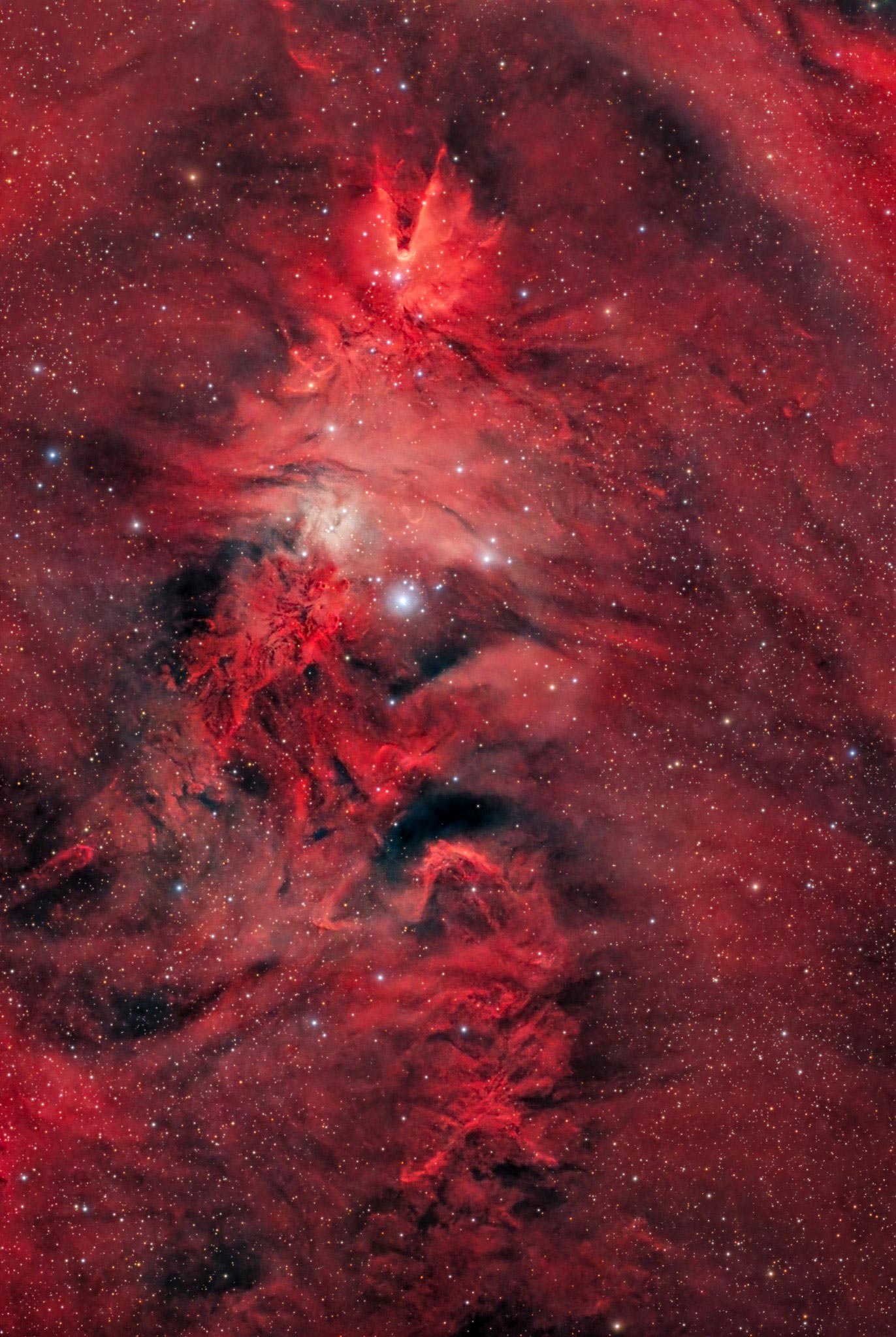
    Glowing clouds of gas and dust form the Christmas Tree cluster in the star-forming region NGC 2264, where newborn stars light up the surrounding nebula like celestial ornaments. The Cone Nebula crowns the scene at the top, while the swirling Fox Fur Nebula spreads below, creating a festive cosmic tableau nearly 80 light-years wide. Credit: Copyright Michael Kalika

    Just in time for Christmas, a vast star-forming region shaped like a Christmas tree is lighting up space 2,700 light-years from Earth.

    NGC 2264 is a vast region of space where new stars are actively forming, located about 2,700 light-years from Earth in the faint constellation Monoceros, also known as the Unicorn. Astronomers use catalog names like NGC 2264 to identify and track objects beyond our solar system, and this particular one stands out for its intricate mix of glowing clouds and young stars. Positioned near the celestial equator and close to the flat disk of the Milky Way, this region is visible at certain times of year from much of the world.

    How Young Stars Light Up Space

    The scene is shaped by enormous clouds of interstellar gas and dust, the raw materials from which stars are born. As newly formed stars ignite, they release powerful energy that causes nearby gas to glow red, creating what scientists call emission nebulae. Dark dust clouds also weave through the area, blocking background starlight and creating striking patches of shadow. In places where these dust clouds sit close to hot, young stars, they reflect light instead of absorbing it, producing soft blue hues known as reflection nebulae.

    The Christmas Tree Cluster and Its Brightest Star

    Near the center of NGC 2264 lies S Monocerotis, a bright and variable star whose light fluctuates over time. It is surrounded by a blue-tinted haze formed by reflected starlight, making it a visual anchor of the region. Above this star, a group of young stars forms a loose triangular pattern. This distinctive shape has led astronomers and skywatchers to nickname it the Christmas Tree star cluster.

    The Cone Nebula and the Fox Fur Nebula

    At the top of this cosmic Christmas tree sits the Cone Nebula, a towering column of gas and dust shaped by intense radiation from nearby stars. Below it spreads a tangled and glowing cloud known as the Fox Fur Nebula, whose textured appearance comes from a combination of illuminated gas and dense dust. Together, these features create one of the most recognizable star-forming landscapes in the night sky.

    A Vast Structure on a Galactic Scale

    When viewed through a telescope, the entire region stretches about 1.5 degrees from top to bottom, roughly the width of three full moons placed side by side. At its immense distance, that apparent size translates to a physical span of nearly 80 light-years, underscoring just how enormous this stellar nursery truly is.

    Never miss a breakthrough: Join the SciTechDaily newsletter.
    Follow us on Google and Google News.

    Astronomy NASA
    Share. Facebook Twitter Pinterest LinkedIn Email Reddit

    Related Articles

    Chunk of Moon Rock? NASA Tracks Asteroid 2024 PT5 During Close Earth Flyby

    Webb’s “Weird” Discovery: Meet the Galaxy Where Gas Outshines the Stars

    Don’t Miss the Comet: Witness Tsuchinshan-ATLAS Before It Disappears for 80,000 Years

    Webb Telescope’s Encounter With a Time-Bending Supernova: Rewriting Cosmic Rules

    Sun Unleashes Monumental X9.0 Solar Flare – Most Intense in 7 Years – Captured by NASA Observatory

    Skywatching Magic: October’s Spectacular Comet Lights Up the Night Sky

    Monster X7.1 Solar Flare Unleashed: Intense Blast Captured by NASA’s Solar Dynamics Observatory

    Astronomers Baffled by Black Hole Jets Igniting Star Explosions

    Webb’s Unprecedented Discovery: Potential Missing Link to First Stars in the Universe

    1 Comment

    1. Eric M. Jones on December 26, 2025 7:38 am

      “Christmas Tree?” That’s a stretch. I have dropped several “science sites” and magazines when they started to become religious. Please stay away from this crap.

      Reply
    Leave A Reply Cancel Reply

    • Facebook
    • Twitter
    • Pinterest
    • YouTube

    Don't Miss a Discovery

    Subscribe for the Latest in Science & Tech!

    Trending News

    Just a Few Breathless Minutes a Day Could Slash Your Risk of 8 Major Diseases

    This Simple Habit Could Cut Your Risk of Dementia by 30%

    Scientists Debunk Rattlesnake Myth That Fooled Hikers and Doctors for Decades

    Scientists Discover Plants Can “Count” – and May Be Smarter Than We Thought

    New Research Reveals Ancient Mars May Have Been Warm, Wet – and Possibly Alive

    This Surprising Daily Habit Could Cut Dementia Risk by 35%

    Just 10 Minutes a Day: Scientists Say This Ancient Chinese Practice Shows Powerful Blood Pressure Benefits

    Scientists Say This Popular Food Could Help Your Body Get Rid of Microplastics

    Follow SciTechDaily
    • Facebook
    • Twitter
    • YouTube
    • Pinterest
    • Newsletter
    • RSS
    SciTech News
    • Biology News
    • Chemistry News
    • Earth News
    • Health News
    • Physics News
    • Science News
    • Space News
    • Technology News
    Recent Posts
    • Quantum Circuits Have a Hidden Weakness and It Changes Everything
    • Liftoff! NASA’s Artemis II Launch Sends Astronauts Around the Moon for First Time in 50 Years
    • Giant Invasive Mantises Are Taking Over Europe
    • Ancient Farmers Accidentally Bred Aggressive “Warrior” Plants
    • Scientists Discover New Way To Eliminate “Zombie Cells” Driving Aging
    Copyright © 1998 - 2026 SciTechDaily. All Rights Reserved.
    • Science News
    • About
    • Contact
    • Editorial Board
    • Privacy Policy
    • Terms of Use

    Type above and press Enter to search. Press Esc to cancel.