
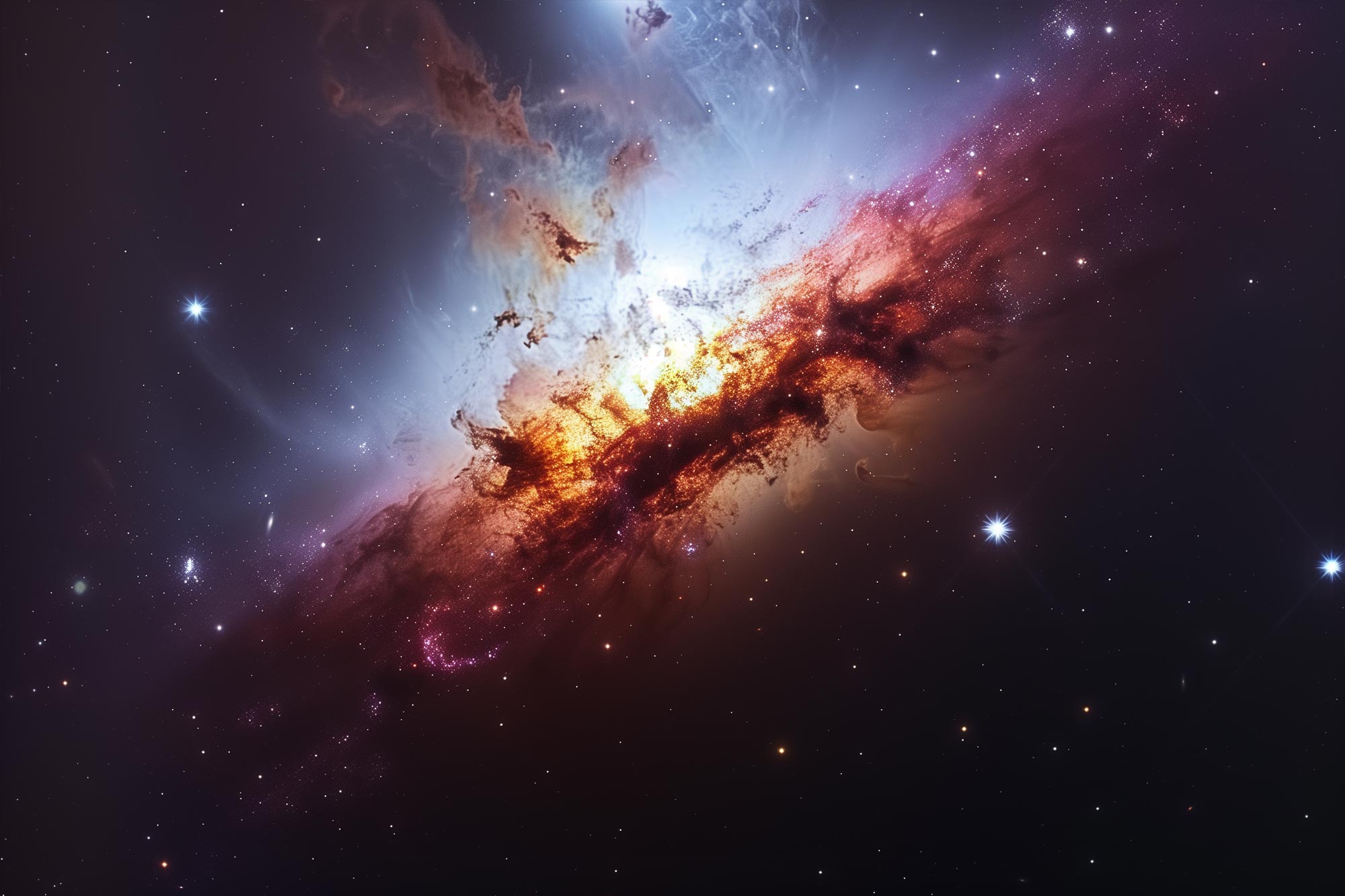
Astronomers have discovered an extraordinary galaxy that stands out due to its unusual light signature suggesting that its gas outshines its stars.
This discovery, made using the James Webb Space Telescope, may represent a transitional phase in galactic evolution crucial for understanding the early universe. This galaxy could provide insights into the conditions that existed just a billion years after the Big Bang, offering clues about the shift from the universe’s first stars to the galaxies we recognize today.
Astronomers have discovered a “weird” and unprecedented galaxy in the early Universe that could “help us understand how the cosmic story began.”
Named GS-NDG-9422 (9422), this galaxy appeared about a billion years after the Big Bang and is notable for its unique light signature, which suggests that the glow from its gas outshines that of its stars.
Researchers consider this “totally new phenomenon” significant because it could be the missing-link phase of galactic evolution between the Universe’s first stars and the well-established galaxies we recognize today.
This extreme class of galaxy was spotted by the $10 billion (£7.6 billion) James Webb Space Telescope (JWST), a joint endeavor of the US, European, and Canadian space agencies, which has been designed to peer back in time to the beginning of the Universe.
Its discovery was made public recently in a research paper published in the Monthly Notices of the Royal Astronomical Society.

Analyzing the Unusual Phenomena
“My first thought in looking at the galaxy’s spectrum was, ‘that’s weird,’ which is exactly what the Webb telescope was designed to reveal: totally new phenomena in the early Universe that will help us understand how the cosmic story began,” said lead researcher Dr. Alex Cameron, of the University of Oxford.
Cameron reached out to colleague Dr. Harley Katz, a theorist, to discuss the strange data. Working together, their team found that computer models of cosmic gas clouds heated by very hot, massive stars, to an extent that the gas shone brighter than the stars, was nearly a perfect match to Webb’s observations.

Environmental Conditions of Early Stars
“It looks like these stars must be much hotter and more massive than what we see in the local Universe, which makes sense because the early Universe was a very different environment,” said Katz, of Oxford and the University of Chicago.
In the local Universe, typical hot, massive stars have a temperature ranging between 70,000 to 90,000 degrees Fahrenheit (40,000 to 50,000 degrees Celsius). According to the team, galaxy 9422 has stars hotter than 140,000 degrees Fahrenheit (80,000 degrees Celsius).

The Peculiar Brightness of Nebular Gas
The researchers suspect that the galaxy is in the midst of a brief phase of intense star formation inside a cloud of dense gas that is producing a large number of massive, hot stars. The gas cloud is being hit with so many photons of light from the stars that it is shining extremely brightly.
In addition to its novelty, nebular gas outshining stars is intriguing because it is something predicted in the environments of the Universe’s first generation of stars, which astronomers classify as Population III stars.
Exploring Galactic Evolution
“We know that this galaxy does not have Population III stars, because the Webb data shows too much chemical complexity. However, its stars are different than what we are familiar with – the exotic stars in this galaxy could be a guide for understanding how galaxies transitioned from primordial stars to the types of galaxies we already know,” said Katz.
At this point, galaxy 9422 is one example of this phase of galaxy development, so there are still many questions to be answered. Are these conditions common in galaxies at this time period, or a rare occurrence? What more can they tell us about even earlier phases of galaxy evolution?
Cameron, Katz, and their research colleagues are now identifying more galaxies to add to this population to better understand what was happening in the Universe within the first billion years after the Big Bang.
“It’s a very exciting time, to be able to use the Webb telescope to explore this time in the Universe that was once inaccessible,” Cameron said.
“We are just at the beginning of new discoveries and understanding.”
For more on this discover, see Webb Discovers Potential Missing Link to First Stars in the Universe.
Reference: “Nebular dominated galaxies: insights into the stellar initial mass function at high redshift” by Alex J Cameron, Harley Katz, Callum Witten, Aayush Saxena, Nicolas Laporte and Andrew J Bunker, 21 June 2024, Monthly Notices of the Royal Astronomical Society.
DOI: 10.1093/mnras/stae1547
Never miss a breakthrough: Join the SciTechDaily newsletter.
Follow us on Google and Google News.
1 Comment
Webb’s Discovery can helps researchers understand how the cosmic story began.
VERY GOOD!
All things follow certain laws, which can be revealed through observation and research ( such as topological structures ). When physics is passionate about studying imaginary particles and things, it is no longer much different from theology.
The physical nature of space is an ideal fluid. It is the material basis and origins of the world we live in. A space with ideal fluid physical characteristics can form vortices through topological phase transitions, which is not difficult to understand mathematically. Based on ideal fluids, numerical simulations of vortex flow and heat exchange can be established. For example, RNG k – ε model, Realizable k – ε model, etc. have been widely applied in various engineering simulations to solve practical problems encountered in daily work.
Scientific research guided by correct theories can help people avoid detours, failures, and exaggeration. The physical phenomena observed by researchers in experiments are always appearances, never the natural essence of things. The natural essence of things needs to be extracted and sublimated based on mathematical theories via appearances , rather than being imagined arbitrarily.
Everytime scientific revolution, the scientific research space brought by the new paradigm expands exponentially. Physics should not ignore the analyzable physical properties of topological vortices.
(1) Traditional physics: based on mathematical formalism, experimental verification and arbitrary imagination.
(2) Topological Vortex Theory (TVT): Although also based on mathematics (such as topology), it focuses more on non intuitive geometry and topological structures, challenging traditional physical intuition.
Topological Vortex Theory (TVT) points out the limitations of the Standard Model in describing the large-scale structure of the universe, proposes the need to consider non-standard model components such as dark matter and dark energy, and suggests that topological vortex fields may be key to understanding these phenomena. Topological vortex theory (TVT) heralds innovative technologies such as topological electronics, topological smart batteries, topological quantum computing, etc., which may bring low-energy electronic components, almost inexhaustible currents, and revolutionary computing platforms, etc.
Topology tells us that topological vortices and antivortices can form new spacetime structures via the synchronous effect of superposition, deflection, or twisting of them. Mathematics does not tell us that there must be God particles, ghost particles, fermions, or bosons present. When physics and mathematics diverge, arbitrary imagination will make physics no different from theology. Topological vortex research reflections on the philosophy and methodology of science help us understand the nature essence of science and the limitations of scientific methods. This not only has guiding significance for scientific research itself, but also has important implications for science education and popularization.
Today, so-called official (such as PRL, Nature, Science, PNAS, etc.) in physics stubbornly believes that two sets of cobalt-60 rotating in opposite directions can become two sets of objects that mirror each other, is a typical case that pseudoscience is rampant and domineering.
Please witness the exemplary collaboration between theoretical physicists and experimentalists (https://scitechdaily.com/microscope-spacecrafts-most-precise-test-of-key-component-of-the-theory-of-general-relativity/#comment-854286). Let us continue to witness with facts the dirtiest and ugliest era in the history of human social sciences and humanities. The laws of nature will not change due to misleading of certain so-called academic publications or endorsements from certain so-called scientific awards.
As some comments have stated ( https://scitechdaily.com/super-photons-unveiled-sculpting-light-into-unbreakable-communication-networks/#comment-861546 ): Fortunately, we have enough pieces to put the puzzle together properly, and there are folks who have chosen to forego today’s societal structures in order to do exactly that.
Additionally, some comments have stated ( https://scitechdaily.com/science-made-simple-what-is-nuclear-fission/#comment-862083 ): You have been spewing this type of nonsensical word salad for several years now. Outrage doesn’t equal competence. If anything, your inability to convince anyone is a sign of your incompetence. Ask the commenter:Today, so-called official (such as PRL, Nature, Science, PNAS, etc.) in physics stubbornly believes that two sets of cobalt-60 rotating in opposite directions can become two sets of objects that mirror each other, and it even won awards. These so-called academic publications blatantly talk nonsense, which is a public humiliation of the normal intellectual level of the public. Do you think this is human misfortune or personal misfortune?
Isn’t this the evil consequence of the Physics Review family misleading science? Academic circle is not Entertainment industry. Have some people really never know what shame is?