
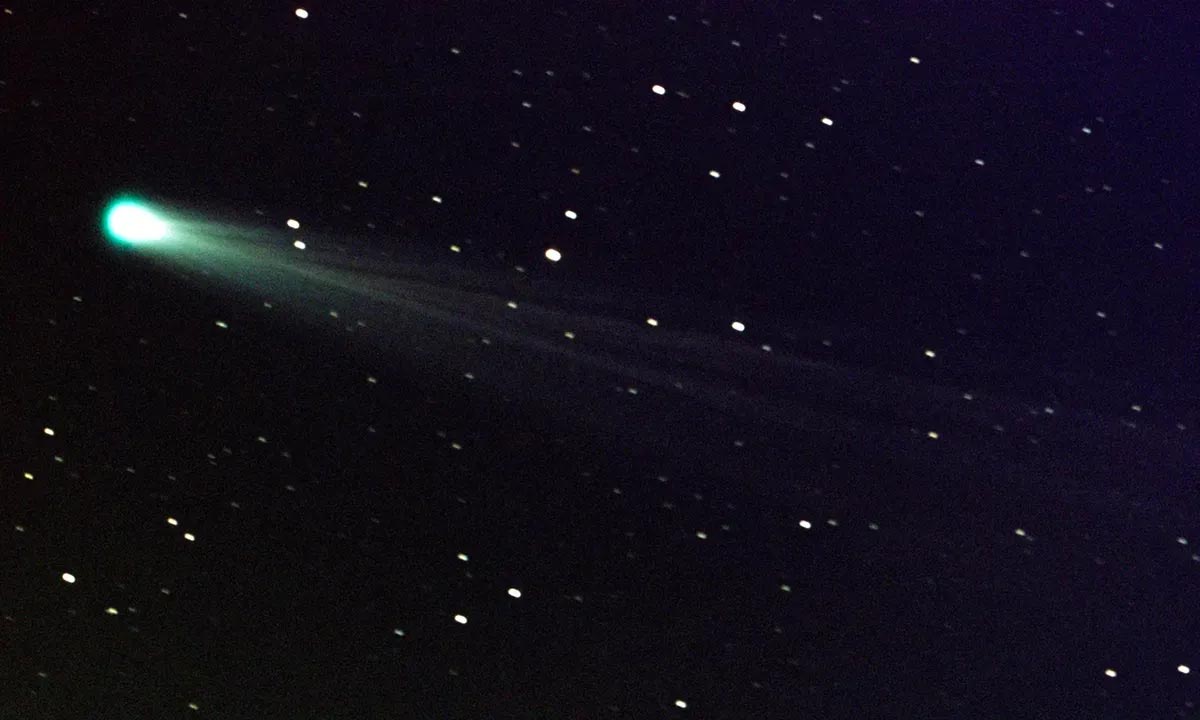
In mid-October, Comet Tsuchinshan-ATLAS, recently discovered by astronomers from China and South Africa, will make its closest approach to Earth.
This celestial traveler, originating from the distant Oort Cloud, will be best visible from the Southern Hemisphere, with potential views from the Northern Hemisphere as well. Surviving a perilous close pass by the Sun, it’s set to offer a rare and stunning spectacle before disappearing for another 80,000 years.
Upcoming Celestial Event
An ancient celestial traveler identified in 2023 will make its first close pass by Earth in mid-October. Mark those calendars – because it won’t return for another 80,000 years.
The Oort Cloud comet, named C/2023 A3 Tsuchinshan-ATLAS, was discovered in 2023 as it ventured into the inner solar system on its highly elliptical orbit for the first time in recorded history. It was detected by observers at China’s Tsuchinshan—or “Purple Mountain”—Observatory and by an ATLAS (Asteroid Terrestrial-impact Last Alert System) telescope in South Africa, and was officially named to honor both observatories.
Comet’s Perilous Journey
The comet successfully made its closest transit past the Sun on September 27. Scientists surmised it might well break up during that pass, its volatile and icy composition unable to withstand the intense heat of our parent star, but it survived more or less intact – and is now on track to come within approximately 44 million miles of Earth on October 12.
“Comets are more fragile than people may realize, thanks to the effects of passing close to the Sun on their internal water ice and volatiles such as carbon monoxide and carbon dioxide,” said NASA astronomer Bill Cooke, who leads the Meteoroid Environment Office at NASA’s Marshall Space Flight Center in Huntsville, Alabama. “Comet Kohoutek, which reached the inner solar system in 1973, broke up while passing too close to the Sun. Comet Ison similarly failed to survive the Sun’s intense heat and gravity during perihelion in 2013.”
Best Views From the South
Though Comet Tsuchinshan-ATLAS will be ideally positioned to view from the Southern Hemisphere, spotters above the equator should have a good chance as well. Peak visibility will occur October 9-10, once the half-moon begins to move away from the comet.
Choose a dark vantage point just after full nightfall, Cooke recommended. Looking to the southwest, roughly 10 degrees above the horizon, identify the constellations of Sagittarius and Scorpio. Tsuchinshan-ATLAS should be visible between them. By Oct. 14, the comet may remain visible at the midway point between the bright star Arcturus and the planet Venus.
“And savor the view,” Cooke advised. Because by early November, the comet will be gone again for the next 800 centuries.
Comet Light, Comet Bright
It’s highly unlikely Tsuchinshan-ATLAS will be visible in daylight hours, except perhaps at twilight, Cooke said. In the past 300 years of astronomical observation, only nine previous comets have been bright enough to spot during the day. (The last were Comet West in 1976 and, under ideal conditions, Comet Hale-Bopp in 1997.)
The brightness of comets is measured on the same scale we use for stars, one that has been in use since roughly 150 B.C., when it was devised by the ancient scholar Hipparchus and refined by the astronomer Ptolemy. Stellar magnitude is measured on a logarithmic scale, which makes a magnitude 1 star exactly 100 times brighter than a magnitude 6 star. The lower the number the brighter the object, making it more likely to be clearly seen, whether by telescope or the naked eye.

“Typically, a comet would have to reach a magnitude of –6 to –10 to be seen in daylight,” Cooke said. “That’s extremely rare.”
The latest data estimates Tsuchinshan-ATLAS’s brightness at between 2 and 4. In comparison, the brightest visible star in the night sky, Sirius, has a magnitude of –1.46. At its brightest, solar reflection from Venus is a magnitude of –4. The International Space Station sometimes achieves a relative brightness of –6.
Comets are often hard to predict because they’re extended objects, Cooke noted, with their brightness spread out and often dimmer than their magnitude suggests. At the same time, they may benefit from a phenomenon called “forward scattering,” which causes sunlight to bounce more intensely off all the gas and debris in the comet’s tail and its coma – the glowing nebula that develops around it during close stellar orbit – and causing a more intense brightening effect for observers.
“If there is a lot of forward scattering, the comet could be as bright as magnitude –1,” Cooke said. That could make it “visible to the unaided eye or truly spectacular with binoculars or a small telescope.”
Comet’s Future in the Cosmos
What will become of Comet Tsuchinshan-ATLAS? Cooke noted that it is not expected to draw too near the planetary giants of our system, but eventually could be flung out of the solar system – like a stone from a sling – due to the gravitational influence of other worlds and its own tenuous bond with the Sun.
But the hardy traveler likely still has miles to go yet. “I learned a long time ago not to gamble on comets,” Cooke laughed. “We’ll have to wait and see.”
Never miss a breakthrough: Join the SciTechDaily newsletter.
Follow us on Google and Google News.
1 Comment
Save passage for the Comet. We are lucky this time around. But at the same time that’s how we get some of our Water. Thanks. M. Luke.