
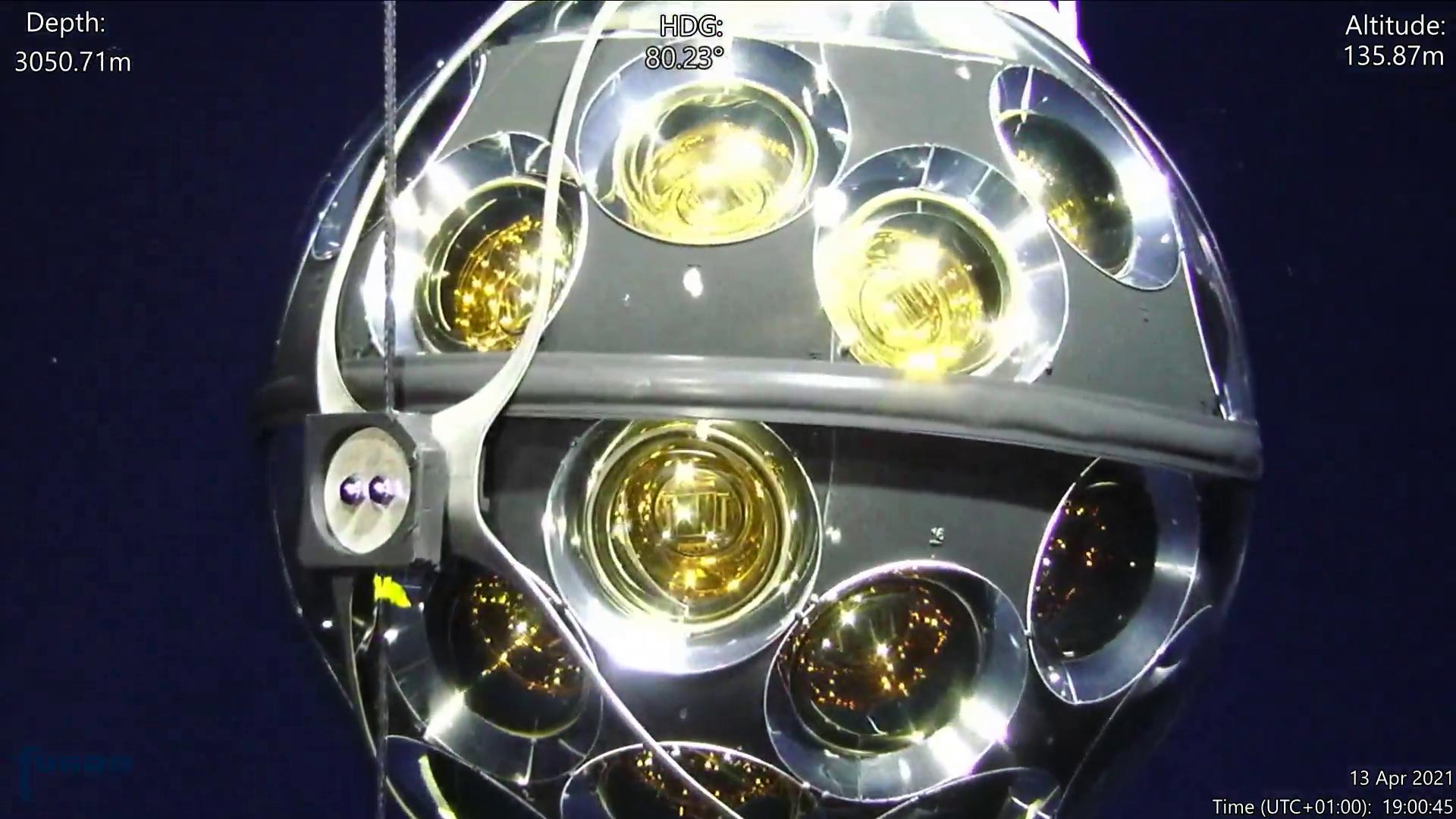
A neutrino of record-breaking energy — 220 PeV — has been detected by the underwater KM3NeT telescope, marking a pivotal moment in astrophysics.
This tiny but powerful particle, born from the universe’s most extreme events, provides fresh clues about cosmic accelerators. While its exact origin remains unknown, scientists believe it could be the first detected cosmogenic neutrino. The discovery fuels new momentum for multi-messenger astronomy, with future observations expected to shed light on the deepest mysteries of the cosmos.
A Record-Breaking Neutrino Discovery
The KM3NeT collaboration, an international team operating a powerful underwater telescope in the Mediterranean, has announced the discovery of the highest-energy neutrino ever detected by such an experiment. Their findings, published on February 12 in Nature and featured on its cover, provide the first evidence that neutrinos of this extreme energy exist in the universe. However, their exact origin remains a mystery. Scientists from the University of Granada are among those contributing to the KM3NeT project.
On February 13, 2023, the ARCA detector — one of KM3NeT’s deep-sea instruments — recorded an extraordinary event linked to a neutrino with an estimated energy of approximately 220 PeV (220,000 trillion electron volts). This is far more energetic than the particles produced at CERN’s Large Hadron Collider (LHC). The event, named KM3-230213A, marks the most energetic neutrino ever observed, confirming that such high-energy neutrinos are indeed produced somewhere in the cosmos. After an extensive process of data analysis and verification, the KM3NeT team has now detailed their discovery in Nature.
Neutrinos are nearly invisible subatomic particles that travel through space at almost the speed of light, passing effortlessly through stars, planets, and even our own bodies without a trace. Known as “ghost particles,” they rarely interact with matter, making them incredibly difficult to detect. Despite their elusive nature, neutrinos hold the key to understanding some of the universe’s most extreme events, from exploding supernovae to the mysterious processes inside black holes. Scientists use massive underground or underwater detectors to catch these fleeting particles, helping to unlock the secrets of the cosmos.

A Glimpse into the Cosmic Origins
Researchers identified the event as a muon — an elementary particle related to the electron — traveling through the detector. The muon’s steep trajectory and immense energy strongly indicate that it originated from a high-energy cosmic neutrino interacting near the detector.
“KM3NeT has begun to explore an energy and sensitivity range where the detected neutrinos can be produced in extreme astrophysical phenomena. This first detection of a neutrino of hundreds of PeV opens a new chapter in neutrino astronomy and a new window for observing the universe,” said Paschal Coyle, KM3NeT spokesperson at the time of the detection and researcher at the IN2P3/CNRS Particle Physics Center in Marseille (France).

Neutrinos: The Universe’s Most Elusive Messengers
The high-energy universe is the realm of colossal events such as supermassive black holes, supernova explosions and gamma-ray bursts, events that are still not fully understood. These powerful cosmic accelerators generate streams of particles called cosmic rays, which can interact with the surrounding matter producing neutrinos and photons. During their journey through the universe, the most energetic cosmic rays can interact with the photons of the microwave background radiation, the first light after the origin of the cosmos, to produce extremely energetic neutrinos, called cosmogenic.
“Neutrinos are one of the most mysterious elementary particles. They have no electric charge, almost no mass and interact weakly with matter. They are special cosmic messengers, providing us with unique information about the mechanisms involved in the most energetic phenomena and allowing us to explore the farthest reaches of the universe,” explains Rosa Coniglione, deputy spokesperson for KM3NeT at the time of detection and researcher at the National Institute of Nuclear Physics (INFN) in Italy.

A Telescope at the Bottom of the Sea
Although they are the second most abundant particles in the universe after the photons that make up light, their extremely weak interaction with matter makes them very difficult to detect, and requires huge detectors. The KM3NeT neutrino telescope, currently under construction, is a gigantic infrastructure on the seabed consisting of two detectors, ARCA and ORCA. KM3NeT uses seawater as the interaction medium to detect neutrinos. Its high-tech optical modules detect Cherenkov light, a bluish glow generated by the propagation in water of ultra-relativistic particles resulting from interactions with neutrinos.
This ultra-high-energy neutrino could originate directly from a powerful cosmic accelerator. Alternatively, it could be the first detection of a cosmogenic neutrino. However, based on this single neutrino, it is difficult to draw conclusions about its origin, say the collaboration’s scientists. Future observations will focus on detecting more events of this type to build a clearer picture. The ongoing expansion of KM3NeT with additional detection units and the acquisition of new data will improve its sensitivity and increase its ability to identify sources of cosmic neutrinos, making KM3NeT a major player in multi-messenger astronomy.

The University of Granada’s Role in KM3NeT
The KM3NeT collaboration brings together more than 360 scientists, engineers, technicians and students from 68 institutions in 22 countries around the world. On behalf of the University of Granada, researchers from the departments of Theoretical and Cosmos Physics and Computer Engineering, Automation and Robotics have been participating in the KM3NeT Collaboration for a decade. Since then, their research has been funded through various programs of the Ministry of Science, Innovation and Universities, as well as regional programs funded by the Regional Government of Andalusia, and through Next Generation EU funds. The UGR works in coordination with researchers from the Institute of Corpuscular Physics (IFIC) in Valencia, the Polytechnic University of Valencia (UPV), the IGIC of the UPV and the Joint Unit of the Spanish Institute of Oceanography (IEO) in KM3NeT.

Granada’s Scientists on the Front Lines of Discovery
“The group from the University of Granada that is part of KM3NeT contributes to the experiment in two main aspects. On the one hand, based on the analysis of the data collected by the detector, we work on various physics analyses focused on the search for neutrino sources in the Universe, the detection of dark matter or the study of new physics effects through the measurement of neutrino properties,” explains Sergio Navas, one of the principal investigators of KM3NeT at the University of Granada.
“On the other hand, we are participating in the construction of telescope elements focused on the optimal measurement of the time of arrival of signals at optical sensors, which is a key aspect in reconstructing the direction of arrival of neutrinos. We have an infrastructure in the laboratory that allows us to design and apply protocols that ensure that the components we build and install in the experiment meet the required precision requirements (temporal accuracies of less than a billionth of a second),” adds Antonio Díaz García, co-leader of the project at the University of Granada.

A Future of Groundbreaking Discoveries
“The detection of the KM3-230213A event has been a huge incentive for those of us working on the experiment,” says Sergio Navas, ”and it is acting as a magnet for new research centers to join the project. At the UGR we continue to work on unraveling the nature of this unique event, about which there are still so many unknowns to be deciphered.” The research team is confident that with the full installation of the two KM3NeT detectors, ARCA and ORCA, new light can be shed on the mystery of the origin of cosmic neutrinos.
Reference: “Observation of an ultra-high-energy cosmic neutrino with KM3NeT” by The KM3NeT Collaboration, 12 February 2025, Nature.
DOI: 10.1038/s41586-024-08543-1
Never miss a breakthrough: Join the SciTechDaily newsletter.
Follow us on Google and Google News.
12 Comments
While its exact origin remains unknown, scientists believe it could be the first detected cosmogenic neutrino.
Ask the scientists:
1. Do you believe that neutrinos are scientific?
2. Is’ The Blind and the Elephant ‘just a fable?
Scientific research guided by correct theories can enable researchers to think more.
A topological vortex is a concept in physics that describes the natural gravitational field or the fluid-body coupled system. A topological vortex is formed by the interaction and balance of vortex and anti-vortex field pairs, which can be set into resonance by the body motion and interaction.
Topological Vortex Theory (TVT) treats space as an ideal fluid, posits that the topological vortex gravitational field is fundamental to the structure of the universe, and emphasizes the importance of topological phase transitions in understanding mass, inertia, and energy.
According to the Topological Vortex Theory (TVT), spins create everything, spins shape the world. There are substantial distinctions between Topological Vortex Theory (TVT) and traditional physical theories. Grounded in the inviscid, incompressible, and isotropic spaces, TVT introduces the concept of topological phase transitions and employs topological principles to elucidate the formation and evolution of matter in the universe, as well as the impact of interactions between topological vortices and anti-vortices on spacetime dynamics and thermodynamics.
Within TVT, low-dimensional spacetime matter serves as the foundation for high-dimensional spacetime matter, and the hierarchical structure of matter and its interaction mechanisms challenge conventional macroscopic and microscopic interpretations. The conflict between Quantum Physics and Classical Physics can be attributed to their differing focuses: Quantum Physics emphasizes low-dimensional spacetime matter, whereas Classical Physics centers on high-dimensional spacetime matter.
Subatomic particles in the quantum world often defy the familiar rules of the physical world. The fact repeatedly suggests that the familiar rules of the physical world are pseudoscience. In the familiar rules of the physical world, two sets of cobalt-60 can form the mirror image of each other by rotating in opposite directions, and should receive the Nobel Prize for physics.
Please witness the grand performance of some so-called peer review publications (including PRL, PNAS, Nature, Science, etc.). https://scitechdaily.com/microscope-spacecrafts-most-precise-test-of-key-component-of-the-theory-of-general-relativity/#comment-854286. Some so-called academic publications (including PRL, PNAS, Nature, Science, etc.) are addicted to their own small circles and have deviated from science for a long time.
As the background of various material interactions and movements, space exhibits inviscid, absolutely incompressible and isotropic physical characteristics. It may form various forms of spacetime vortices through topological phase transitions. Hence, vortex phenomena are ubiquitous in cosmic space, from vortices of quantum particles and living cells to tornados and black holes. Stars and radioactive elements are one of the most active topological nodes in spacetime. Utilizing them is more valuable and meaningful than simulating them. Small or micro power topology intelligent batteries may be the direction of future energy research and development for human society.
Under the topological vortex architecture, science and pseudoscience are clear at a glance. Topological Vortex Theory (TVT) can play a crucial role in elucidating the foundations of physics, establishing its principles, and combating pseudoscience. Therefore, TVT has been strongly opposed and boycotted by traditional so-called peer review publications (such as PRL, PNAS, Nature, Science, etc.).
These so-called peer review publications (including PRL, PNAS, Nature, Science, etc.) mislead the direction of science and are known for their various absurdities and wonders. They collude together, reference each other, and use so-called Impact Factor (IF) or the Nobel Prize to deceive people around.
Ask the so-called peer review publications (including PRL, PNAS, Nature, Science, etc.):
1. What are your criteria for distinguishing science from pseudoscience?
2. Is your Impact Factor (IF) the standard for distinguishing science from pseudoscience?
3. Is the Nobel Prize the standard for distinguishing science from pseudoscience?
4. What is the most important aspect of academic publications?
5. Is the most important aspect of academic publications being flashy and impractical articles?
Pseudo academic publications (including PRL, PNAS, Nature, Science, etc.) are neither inclusivity nor openness, nor transparency and fairness, and have already had a serious negative impact on the progress of science and technology. Some so-called peer review publications (including PRL, PNAS, Nature, Science, etc.) are addicted to their own small circle and no longer know what science is. They hardly know what is dirty and ugly.
Publications that mislead the public under the guise of scholarship are more reprehensible than ordinary publications. The field of physics faces an ongoing challenge in maintaining scientific rigor and integrity in the face of pervasive pseudoscientific claims. Fighting against rampant pseudoscience, physics still has a long way to go.
While my comments may be lengthy, they are necessary to combat the proliferation of rampant pseudoscience and to promote the advancement of science and technology, and also is all I can do.
Appreciate the SciTechDaily for its inclusivity, openness, transparency, and fairness. If the researchers are truly interested in cosmic matter, please read: A Brief History of the Evolution of Cosmic Matter (https://scitechdaily.com/microscope-spacecrafts-most-precise-test-of-key-component-of-the-theory-of-general-relativity/#comment-873523).
Some individuals, some AI, and some so-called peer review publications (including PRL, PNAS, Nature, Science, etc.) stubbornly believe that two sets of cobalt-60 can form the mirror image of each other by rotating in opposite directions (https://scitechdaily.com/microscope-spacecrafts-most-precise-test-of-key-component-of-the-theory-of-general-relativity/#comment-854286), and stubbornly believe that the Topological Vortex Theory (TVT) currently lacks validation. This is because they have been misled by pseudoscientific information.
Vortex phenomena are ubiquitous in cosmic space, from vortices of quantum particles and living cells to tornados and black holes. The inviscid and incompressible spaces have been widely used in engineering simulation (https://scitechdaily.com/microscope-spacecrafts-most-precise-test-of-key-component-of-the-theory-of-general-relativity/#comment-870077). These all are the most powerful verification.
Ask some so-called peer review publications (including PRL, PNAS, Nature, Science, etc.) again:
1. Does space not exist?
2. Does time not exist?
3. Does the ideal fluid not exist?
4. Do scientific experiments require time and space?
5. Do certain engineering simulations require ideal fluids?
6. If non-existent things are applied to scientific experiments and engineering simulations, and good results can be achieved. So, what is the difference between the non-existent thing and God?
Some individuals and some so-called peer review publications (including PRL, PNAS, Nature, Science, etc.) have been misleading the public with confusing concepts (https://pic2.zhimg.com/v2-4127b0b58fe8b88feb27c189fb705029_1440w.jpg?source=172ae18b), unscientific logic and reasoning, and self righteous Impact Factor (IF), hindering the progress of science and technology.
Fighting against rampant pseudoscience, physics still has a long way to go.
Your comments are rampant pseudoscience. Among other things, there is no “Topological Vortex Theory”.
VERY GOOD!!!
Your comment is the best endorsement of the popular science achievements of some so-called peer review publications (including PRL, PNAS, Nature, Science, etc.).
In fact, there is no Topological Vortex Theory, while two sets of cobalt-60 can form the mirror image of each other by rotating in opposite directions that is real. As well as https://pic2.zhimg.com/v2-4127b0b58fe8b88feb27c189fb705029_1440w.jpg?source=172ae18b.
Congratulations to you.
In other spooky neutrino news, it appears that it takes a while to unwrap a neutrino from the nucleus that spawned it, and this is being interpreted as implying the neutrino is much bigger than the nucleus.
Maybe others felt this news percolating through the official influencer royalty over the last week like a big bunch of beach balls. Looks like an airy win for the plucky “dark matter” particle mob.
And how about that news about spinning nuclei? Used to be a controversy over whether quantum spin had anything to do with anything actually rotating. Who knows what they’re saying now, other that quantum spin has everything to do with something actually rotating, whether it’s an electron, or a nucleon, or a spinning nucleus with eight independently spinning charged nucleons.
“other (than) that quantum spin has everything to do with something actually rotating”
No question quantum objects are not classical objects, a single electron in orbit could be viewed as something other than an orbiting ball of charge, something enveloping the nucleus, covering over every region of it at once. The news today seems more like an attempt to avoid embarrassment over traditionally claiming quantum spin has nothing to do with anything rotating, particularly if that “anything” carries a charge.
Wanted that comment to be indented for quote context.
Also wanted to add here that gravity journalism is up to its usual stuff with an article that admits in one place that expanding gravity waves are classical waves, not quantum waves, and that quantum gravity waves can also exist. Other than that, it adds a lot of necessary misinformation from the noble bait-and-switch tribe to “hatefully” (to use a noble word) suggest that all gravity is not quantum gravity.
“Quantum effects make distant objects move together: new research finds this may happen with ripples in space” is the article. It is a crony-science-driven waste of time from a site known for that, frankly.
It commits the standard tribal conceit of pretending Newton and others had no idea that gravity waves existed despite their obvious effects on the tides. Another thing it does is imply gravity waves from the big bang are unique somehow. It could be the quantum gravity waves they’re trying to understand not only don’t expand, but they also can be very easily interpreted as crossing ripples of dark matter effects or overlapping dark matter effect “fingerprints.” It’s not clear what makes these supposed big bang waves unique. I imagine the wavelength might be the same everywhere if they’re being interpreted as a remnant of the BB. They clearly show no appreciation of anything even close to quantum gravity waves with galactic-scale stationary phase effects yet.
https://scitechdaily.com/the-universes-hidden-backbone-alma-unveils-dark-matters-fine-scale-fingerprint/
The article is at a website called “the conversation” and the author wanted to be doubly clear on where they stand:
“We’re not suggesting that all gravitational waves are quantum. However, this does not imply that all gravitational waves are quantum in nature.”
Even more evidence of what should be obvious, except for the tribe’s constant blind-mowing lobbying efforts, namely that 100% of all gravity is indeed quantum gravity.
To unravel our comments:
– SciTechDaily is a science media site, whether it supports science or not. And why shouldn’t it? Science is useful.
– Particle size depends on if it is free or confined, c.f. photons. An emitted neutrino was in an intermediate state.
The rest has little to do with neutrinos:
– The consensus on dark matter is that it is particulate – it visibly clumps from gravitation.
– Quantum spin is intrinsic and non-local by entanglement. There are attempts to describe it with rotational field wave functions (c.f. free photons) but no one known how to localize that when entanglement breaks down. The most straightforward description is the current (spin direction is not defined until observation).
– It is easy to make a quantum field theory of gravity (c.f. Scholarpedia “Quantum gravity as a low energy effective field theory”), and that wasn’t what the Conversation discussion of entanglement nature of LIGO detection was about. (Though the science aims to show quantization.) Hence their comment that not all gravitational waves show entanglement when they can be observed, c.f. the imprints in the cosmic background radiation. (Which radiation is *also* scrutinized for other quantum imprints of tensorial character, as they seem to mention.)
It will be interesting when the two ocean neutrino detectors join IceCube in triangulating the sources.
I didn’t see any potential source description in the article. The paper says:
“The cosmic neutrino energy spectrum measured up to now5,6,7 falls steeply with energy. However, the energy of this event is much larger than that of any neutrino detected so far. This suggests that the neutrino may have originated in a different cosmic accelerator than the lower-energy neutrinos, or this may be the first detection of a cosmogenic neutrino8, resulting from the interactions of ultra-high-energy cosmic rays with background photons in the Universe.”