
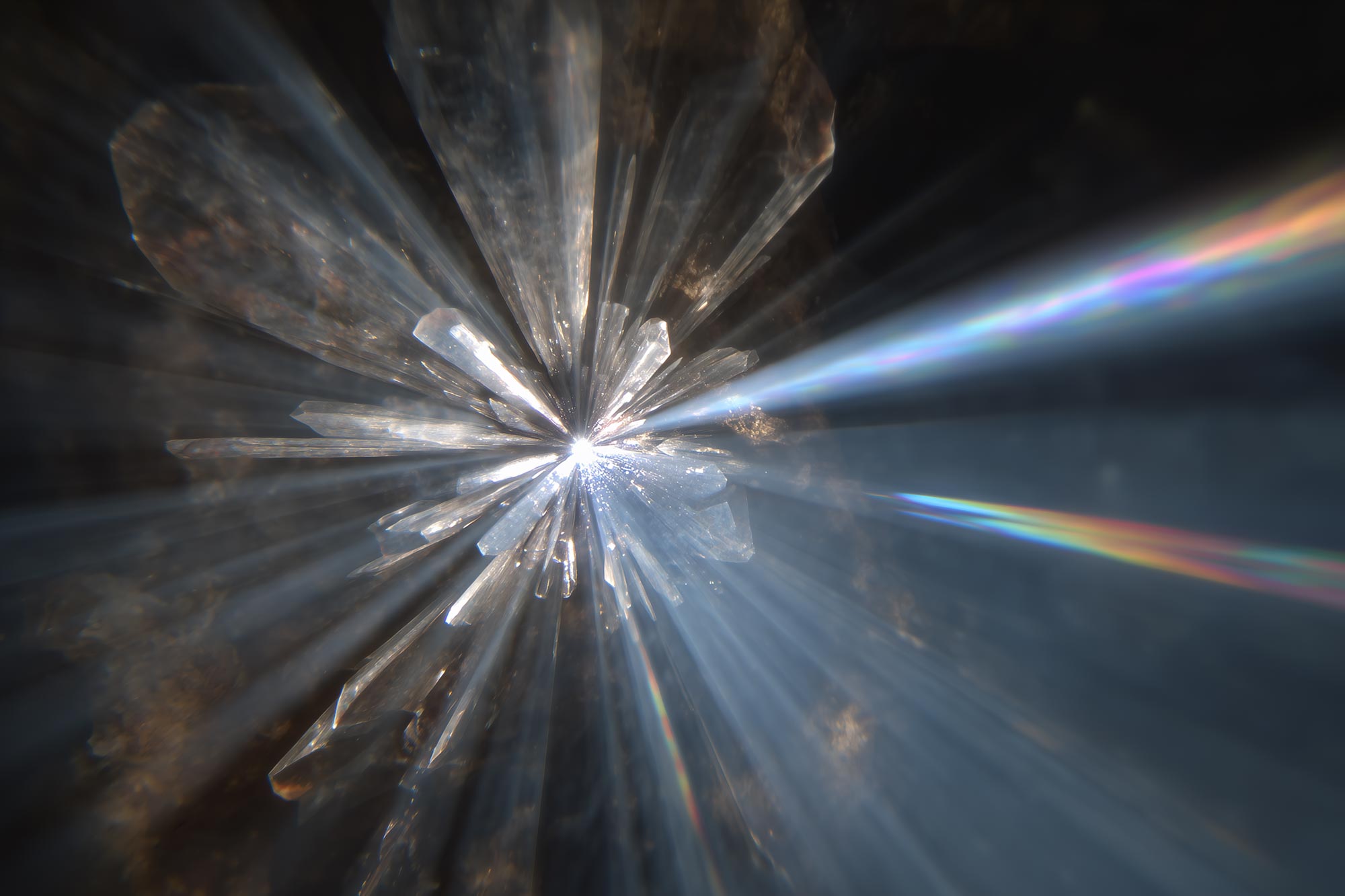
Scientists at NYU have discovered a way to use light as a kind of remote control for building and reshaping crystals.
Researchers at NYU have developed a way to use light to precisely direct how microscopic particles assemble into crystals. The findings, published today (February 24) in the Cell Press journal Chem, describe a straightforward and reversible approach to crystal formation that could help create a new class of adaptable, light-responsive materials.
Crystals, from snowflakes and diamonds to the silicon chips inside electronic devices, consist of particles arranged in highly ordered, repeating structures. To better understand how these patterns emerge, scientists often study colloidal particles, which are tiny spheres suspended in liquid that can spontaneously organize into what are known as colloidal crystals. These particles are also essential components in advanced materials used in optical and photonic technologies such as sensors and lasers.
Even though crystals are common and widely used, controlling exactly when and where they form has been a persistent challenge.
“The challenge in the field has been control: crystals usually form where and when they want, and once conditions are set, you have limited ability to adjust the process in real time,” said study author Stefano Sacanna, professor of chemistry at NYU.
Melting of colloidal crystals in a focused laser spot. Credit: Steven van Kesteren / Sacanna Lab, NYU
Using Light as a Microscale Remote Control
In the new Chem study, the team discovered that simply shining light on their system gives them direct control over crystal assembly.
The researchers introduced light-sensitive molecules called photoacids into a liquid containing colloidal particles. When exposed to light, these photoacids temporarily become more acidic. That shift changes how they interact with the surfaces of the particles, altering the particles’ electric charge. By modifying the charge, the scientists can determine whether the particles attract each other and stick together or repel each other and separate.
“Essentially, we used light as a remote control to program how matter organizes itself at the microscale,” said Sacanna.
Through a combination of laboratory experiments and computer simulations, the team demonstrated that adjusting the intensity, timing, and pattern of light allows them to control crystal behavior with remarkable precision. They can trigger crystals to appear or dissolve on demand, choose where crystallization occurs, reshape and “sculpt” crystal structures, and improve their uniformity and size to build larger and more intricate colloidal assemblies.
“Using our photoacid gave us a surprising level of control over the attraction between particles. Just turning the light up or down a little made the difference between the particle fully sticking or being fully free,” said study author Steven van Kesteren of ETH Zürich, who conducted this work at NYU as a postdoctoral researcher in Sacanna’s lab.
“Because light is so easy to control, we could make our system do quite complex things. We could shoot light at particle blobs and see them melt under the microscope, or shine a light so that random blobs of particles ordered themselves into crystals. We could also remove specific crystals quite easily by simply unsticking the particles at that spot,” added van Kesteren.
Crystallization of colloids by slowly turning down the light intensity. Credit: Steven van Kesteren / Sacanna Lab, NYU
One Pot Experiment With Reversible Control
A key advantage of the approach is its simplicity. The researchers were able to manage the entire process in a “one pot” setup, without repeatedly redesigning particles or adjusting salt concentrations in the solution. By changing the level of illumination, they could prompt the particles to assemble into crystals or fall apart again.
Melting of colloidal aggregates by exposure to light. Credit: Steven van Kesteren / Sacanna Lab, NYU
Toward Light Programmable Materials
This technique could pave the way for materials whose structure, and therefore their properties, can be adjusted using light. For example, photonic materials could have their color or optical response written, erased, and rewritten as needed. Light programmable colloidal crystals may one day enable reconfigurable optical coatings, adaptive sensors, and next-generation display or data storage technologies, where patterns and functions are defined dynamically by illumination rather than fixed during manufacturing.
“Our approach brings us closer to dynamic, programmable colloidal materials that can be reconfigured on demand,” said study author Glen Hocky, associate professor of chemistry and a faculty member at the Simons Center for Computational Physical Chemistry at NYU. “This system also allows us to test a number of predictions on how self-assembly should behave when interactions between particles or molecules are changing across space or time.”
Reference: “Light-controlled colloidal crystallization” by Steven van Kesteren, Nicole Smina, Shihao Zang, Cheuk Wai Leung, Glen M. Hocky and Stefano Sacanna, 25 February 2026, Chem.
DOI: 10.1016/j.chempr.2025.102917
Additional study authors include Nicole Smina, Shihao Zang, and Cheuk Wai Leung of NYU. The research was supported by the US Army Research Office (award W911NF-21-1-0011), the Swiss National Science Foundation (grant 217966), and the NYU Simons Center for Computational Physical Chemistry (grant 839534).
Never miss a breakthrough: Join the SciTechDaily newsletter.
Follow us on Google and Google News.