
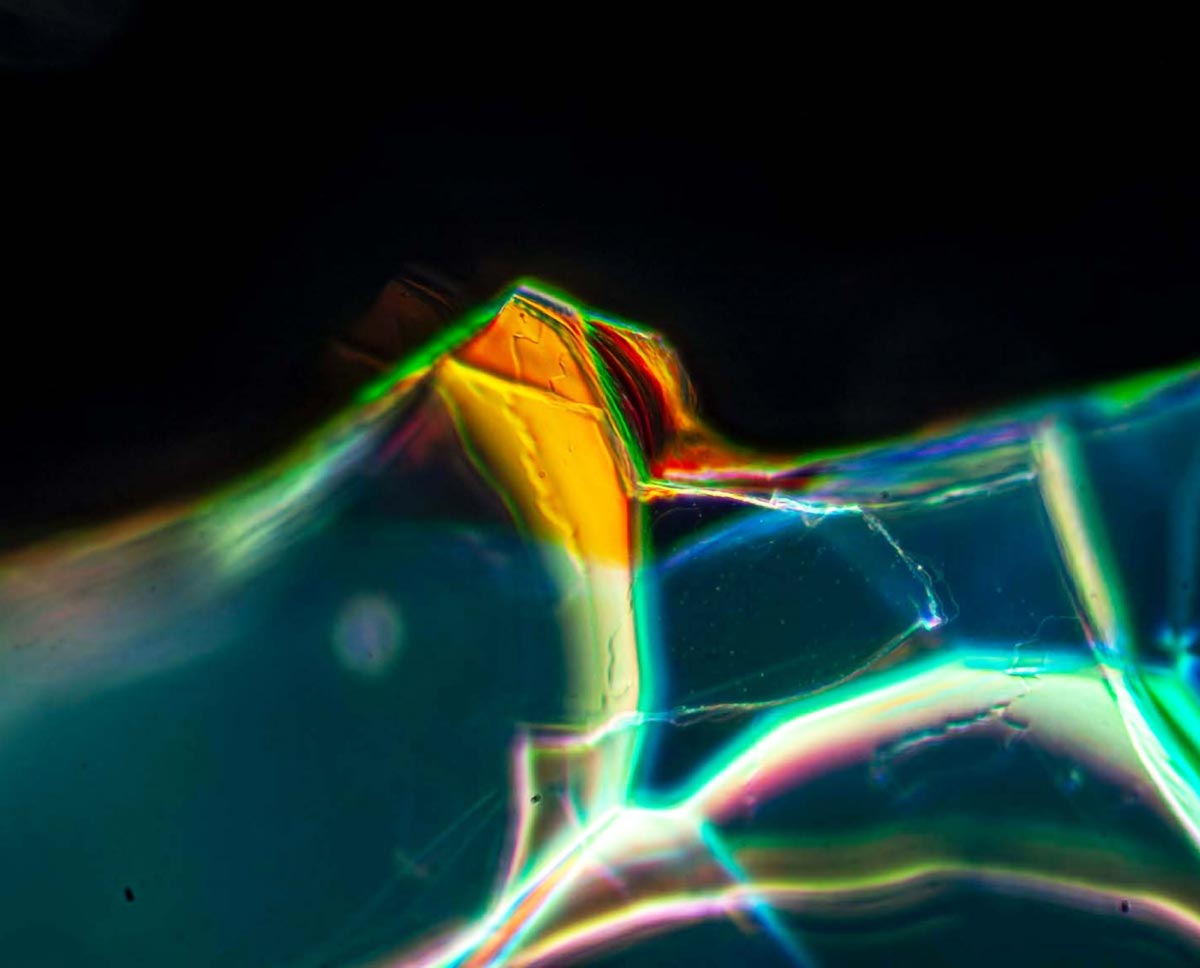
Researchers reveal how photonic crystals were created by corrosion and crystallization over centuries.
Some 2,000 years ago in ancient Rome, glass vessels carrying wine or water, or perhaps an exotic perfumes, tumble from a table in a marketplace, and shatter to pieces on the street. As centuries passed, the fragments were covered by layers of dust and soil and exposed to a continuous cycle of changes in temperature, moisture, and surrounding minerals.
Now these tiny pieces of glass are being uncovered from construction sites and archaeological digs and reveal themselves to be something extraordinary. On their surface is a mosaic of iridescent colors of blue, green and orange, with some displaying shimmering gold-colored mirrors.
These beautiful glass artifacts are often set in jewelry as pendants or earrings, while larger, more complete objects are displayed in museums.
Modern Science Meets Ancient Artifacts
For Fiorenzo Omenetto and Giulia Guidetti, professors of engineering at the Tufts University Silklab and experts in materials science, what’s fascinating is how the molecules in the glass rearranged and recombined with minerals over thousands of years to form what are called photonic crystals – ordered arrangements of atoms that filter and reflect light in very specific ways.
Photonic crystals have many applications in modern technology. They can be used to create waveguides, optical switches and other devices for very fast optical communications in computers and over the internet. Since they can be engineered to block certain wavelengths of light while allowing others to pass, they are used in filters, lasers, mirrors, and anti-reflection (stealth) devices.
In a recent study published in the Proceedings of the National Academy of Sciences (PNAS) USA, Omenetto, Guidetti and collaborators report on the unique atomic and mineral structures that built up from the glass’ original silicate and mineral constituents, modulated by the pH of the surrounding environment, and the fluctuating levels of groundwater in the soil.
Chance Discovery Leads to Scientific Insights
The project started by chance during a visit to the Italian Institute of Technology’s (IIT) Center for Cultural Heritage Technology. “This beautiful sparkling piece of glass on the shelf attracted our attention,” said Omenetto. “It was a fragment of Roman glass recovered near the ancient city of Aquileia Italy.” Arianna Traviglia, director of the Center, said her team referred to it affectionately as the ‘wow glass’. They decided to take a closer look.
The researchers soon realized that what they were looking at was nanofabrication of photonic crystals by nature. “It’s really remarkable that you have glass that is sitting in the mud for two millennia and you end up with something that is a textbook example of a nanophotonic component,” said Omenetto.
Uncovering the Process Behind the Beauty
Chemical analysis from the IIT team dated the glass fragment to between the 1st century BCE and the 1st century CE, with origins from the sands of Egypt – an indication of global trade at the time. The bulk of the fragment preserved its original dark green color, but on its surface was a millimeter-thick patina that had an almost perfect mirror-like gold reflection. Omenetto and Guidetti used a new kind of scanning electron microscope that not only reveals the structure of the material, but also provides an elemental analysis. “Basically it’s an instrument that can tell you with high resolution what the material is made of and how the elements are put together,” said Guidetti.
They could see that the patina possessed a hierarchical structure made up of highly regular, micrometer-thick silica layers of alternating high and low density which resembled reflectors known as Bragg stacks. Each Bragg stack strongly reflected different, relatively narrow wavelengths of light. The vertical stacking of tens of Bragg stacks resulted in the golden mirror appearance of the patina.
How did this structure form over time? The researchers suggest a possible mechanism that played out patiently over centuries. “This is likely a process of corrosion and reconstruction,” said Guidetti. “The surrounding clay and rain determined the diffusion of minerals and a cyclical corrosion of the silica in the glass. At the same time, assembly of 100 nanometer-thick layers combining the silica and minerals also occurred in cycles. The result is an incredibly ordered arrangement of hundreds of layers of crystalline material.”
“While the age of the glass may be part of its charm, in this case if we could significantly accelerate the process in the laboratory we might find a way to grow optic materials rather than manufacture them,” Omenetto added.
Rome’s History Mirrored in Glass
The molecular process of decay and reconstruction has some parallels to the city of Rome itself. The ancient Romans had a penchant for creating long-lasting structures like aqueducts, roads, amphitheaters, and temples. Many of these structures became the foundation of the city’s topography.
Over the centuries since, the city has grown in layers, with buildings rising and falling with the changes brought on by wars, social upheavals and the passage of time. In medieval times, people used materials from broken and abandoned ancient buildings for new construction. In modern times, streets and buildings are often built directly on top of ancient foundations.
“The crystals grown on the surface of the glass are also a reflection of the changes in conditions that occurred in the ground as the city evolved – a record of its environmental history,” said Guidetti.
Reference: “Photonic crystals built by time in ancient Roman glass” by Giulia Guidetti, Roberta Zanini, Giulia Franceschin, Mauro Moglianetti, Taehoon Kim, Nathaniel Cohan, Lisa Chan, John Treadgold, Arianna Traviglia and Fiorenzo G. Omenetto, 18 September 2023, Proceedings of the National Academy of Sciences.
DOI: 10.1073/pnas.2311583120
Funding: Office of Naval Research
Never miss a breakthrough: Join the SciTechDaily newsletter.
Follow us on Google and Google News.