
Close Menu
    Facebook X (Twitter) Instagram
    SciTechDaily
    • Biology
    • Chemistry
    • Earth
    • Health
    • Physics
    • Science
    • Space
    • Technology
    Facebook X (Twitter) Pinterest YouTube RSS
    SciTechDaily
    Home»Space»Unlocking Lunar Secrets: Moon’s Polar Ice Far Younger Than Estimated
    Space

    Unlocking Lunar Secrets: Moon’s Polar Ice Far Younger Than Estimated

    By Southwest Research InstituteOctober 24, 2023No Comments4 Mins Read
    Facebook Twitter Pinterest Telegram LinkedIn WhatsApp Email Reddit
    Share
    Facebook Twitter LinkedIn Pinterest Telegram Email Reddit
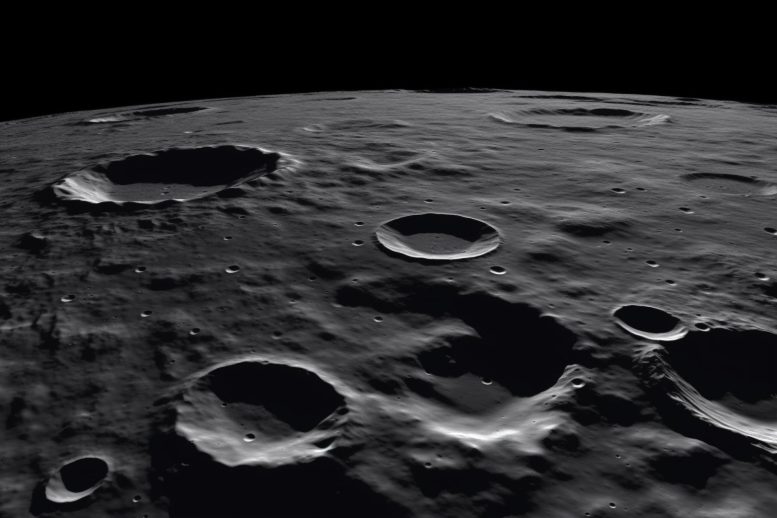
    Moon Surface Art Concept
    New research suggests that the Moon’s shadowed regions are about 3.4 billion years old and may have young water ice deposits. This information is crucial for future lunar explorations and resource planning.

    A new study reveals that the Moon’s permanently shadowed regions are younger than previously estimated.

    A team including Southwest Research Institute’s Dr. Raluca Rufu recently determined that the majority of the Moon’s constantly shaded areas (PSRs) are approximately 3.4 billion years old at most and can contain relatively young deposits of water ice.

    Water resources are considered key for sustainable exploration of the Moon and beyond, but these findings indicate that previous estimations of ice trapped in cold areas might have been overstated.

    Lunar Shadows and Ices

    The current tilt of the Moon’s spin axis combined with its orbital inclination — the angle to Earth’s orbital plane — and the Sun’s low angle creates permanent shadows at its poles. PSRs are some of the coldest spots in the solar system, allowing them to trap volatile chemicals, including water ice, that would immediately transform directly from a solid to a gas in the harsh, airless sunshine that falls in most other places on the Moon.
    Lunar PSRS South Polar Region
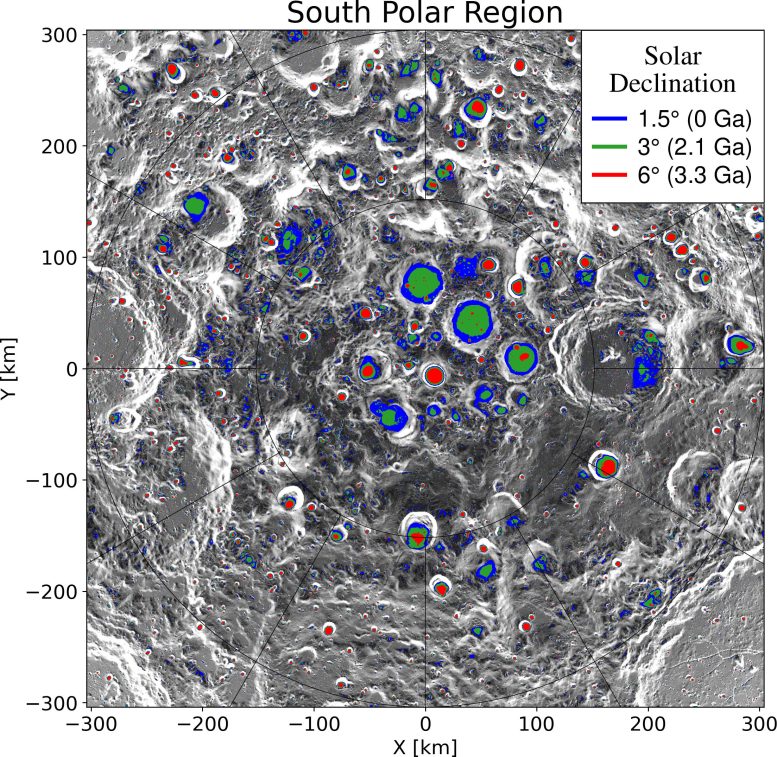
    The scientists used AstroGeo22 and LOLA height measurements to calculate the age of the Moon’s permanently shadowed regions near its poles. Colored patches show the extent of PSRs 3.3 billion years ago (red), 2.1 billion years ago (green), and close to present-day (blue) with current topography. These findings suggest that current estimates for cold-trapped ices are too high. Credit: Schörghofer/Rufu (2023)

    “We think the Earth-Moon system formed following a giant impact between early Earth and another protoplanet,” said Rufu, a Sagan Fellow who is the second author of a Science Advances paper. “The Moon formed from the impact-generated debris disk, migrating away from Earth over time. Around 4.1 billion years ago the Moon experienced a major spin axis reorientation when its tilt reached high angles before it damped down to the configuration we see today. As the axial tilt decreased, PSRs appeared at the poles and grew over time.”

    Tools and Historical Analysis

    The team used AstroGeo22, a new Earth-Moon evolution simulation tool, to calculate the Moon’s axial tilt over time. Together with surface height measurements from the Lunar Orbital Altimeter Laser data (LOLA), the team estimated the evolution of the shadowed areas over time.

    “The time evolution of the Moon-Earth distance remained an unsolved problem for half a century,” Rufu said. “However, these new geological proxies for the history of the Earth-Moon system allow us to calculate the Moon’s axial tilt and the extent of PSRs over time.”
    Shadows at Moon's South Pole
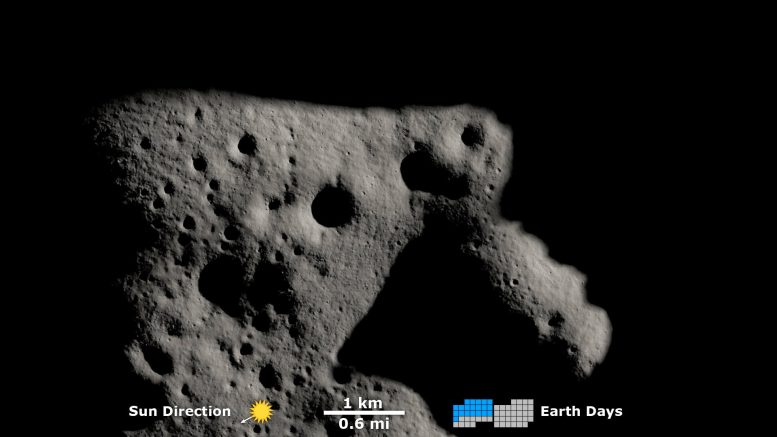
    At the Moon’s poles and with the Sun at such a low angle, sunlight never reaches the floors of some deep craters. These PSRs are some of the coldest spots in the solar system, trapping volatile chemicals including water ice. New research indicates these regions are not as old as originally thought, so current estimates of water ice on the Moon may be too high. Credit:
    NASA’s Scientific Visualization Studio

    In 2009, NASA crashed the two-ton Atlas-Centaur rocket body, part of the Lunar Crater Observation and Sensing Satellite (LCROSS), near the south pole of the Moon. It struck the floor of the Cabeus crater, creating a plume of debris examined for the presence of water and other chemicals in the lunar regolith. A shepherding satellite traveling four minutes behind the Centaur and several Earth-orbiting satellites, including the Hubble Space Telescope, monitored the impact.

    Recent Discoveries and Future Exploration

    “Our work suggests that Cabeus crater became a PSR less than a billion years ago. The various volatiles detected in the plume created by LCROSS indicate that ice-trapping continued into relatively recent times,” said Norbert Schörghofer, the lead author of this paper from the Planetary Science Institute. “Impacts and outgassing are potential sources of water but peaked early in lunar history, when the present-day PSRs did not yet exist. The age of PSRs largely determines the amount of water ice that could be trapped in the lunar polar regions. Information about the abundance of water ice in PSRs is particularly important in planning for upcoming crewed and uncrewed missions to the Moon searching for water.”

    This key resource can be used to create air and rocket fuel and sustain human habitation. NASA and other entities plan to send rovers and humans to characterize the water ice within PSRs.

    Reference: “Past extent of lunar permanently shadowed areas” by Norbert Schörghofer and Raluca Rufu, 13 September 2023, Science Advances.
    DOI: 10.1126/sciadv.adh4302

    Never miss a breakthrough: Join the SciTechDaily newsletter.
    Follow us on Google and Google News.

    Astronomy Moon Southwest Research Institute Water
    Share. Facebook Twitter Pinterest LinkedIn Email Reddit

    Related Articles

    Crystalline Quest: The International Pursuit of Lunar Ice Deposits

    For the First Time: Water Molecules Have Been Discovered on an Asteroid’s Surface

    Hidden Pockets of Water Could Be Common on the Surface of the Moon

    New Study Reveals Amount of Water Present in the Moon May Have Been Overestimated

    Study Finds a Mixture of Both Deep and Shallow Heating on Io

    Hubble to Test Technique of Using the Moon as a Mirror

    A Closer Look at Titan’s Chemical Production

    Atmosphere of Super-Earth GJ1214b Possibly Includes Abundant Water Vapor

    NASA’s GRAIL Mission Returns Video From Far Side of the Moon

    Leave A Reply Cancel Reply

    • Facebook
    • Twitter
    • Pinterest
    • YouTube

    Don't Miss a Discovery

    Subscribe for the Latest in Science & Tech!

    Trending News

    The Universe Is Expanding Too Fast and Scientists Can’t Explain Why

    “Like Liquid Metal”: Scientists Create Strange Shape-Shifting Material

    Early Warning Signals of Esophageal Cancer May Be Hiding in Plain Sight

    Common Blood Pressure Drug Shows Surprising Power Against Deadly Antibiotic-Resistant Superbug

    Scientists Uncover Dangerous Connection Between Serotonin and Heart Valve Disease

    Scientists Discover a “Protector” Protein That Could Help Reverse Hair Loss

    Bone-Strengthening Discovery Could Reverse Osteoporosis

    Scientists Uncover Hidden Trigger Behind Stem Cell Aging

    Follow SciTechDaily
    • Facebook
    • Twitter
    • YouTube
    • Pinterest
    • Newsletter
    • RSS
    SciTech News
    • Biology News
    • Chemistry News
    • Earth News
    • Health News
    • Physics News
    • Science News
    • Space News
    • Technology News
    Recent Posts
    • Why Popular Diabetes Drugs Like Ozempic Don’t Work for Everyone: The “Genetic Glitch”
    • Scientists Create Improved Insulin Cells That Reverse Diabetes in Mice
    • Scientists Stunned After Finding Plant Thought Extinct for 60 Years
    • A Common Diabetes Drug May Hold the Key to Stopping HIV From Coming Back
    • Ancient “Syphilis-Like” Disease in Vietnam Challenges Key Scientific Assumptions
    Copyright © 1998 - 2026 SciTechDaily. All Rights Reserved.
    • Science News
    • About
    • Contact
    • Editorial Board
    • Privacy Policy
    • Terms of Use

    Type above and press Enter to search. Press Esc to cancel.