
Close Menu
    Facebook X (Twitter) Instagram
    SciTechDaily
    • Biology
    • Chemistry
    • Earth
    • Health
    • Physics
    • Science
    • Space
    • Technology
    Facebook X (Twitter) Pinterest YouTube RSS
    SciTechDaily
    Home»Space»A Galactic Traffic Jam in “The Cup” Over 60 Million Light-Years Away
    Space

    A Galactic Traffic Jam in “The Cup” Over 60 Million Light-Years Away

    By ESA/HubbleMarch 5, 2020No Comments2 Mins Read
    Facebook Twitter Pinterest Telegram LinkedIn WhatsApp Email Reddit
    Share
    Facebook Twitter LinkedIn Pinterest Telegram Email Reddit
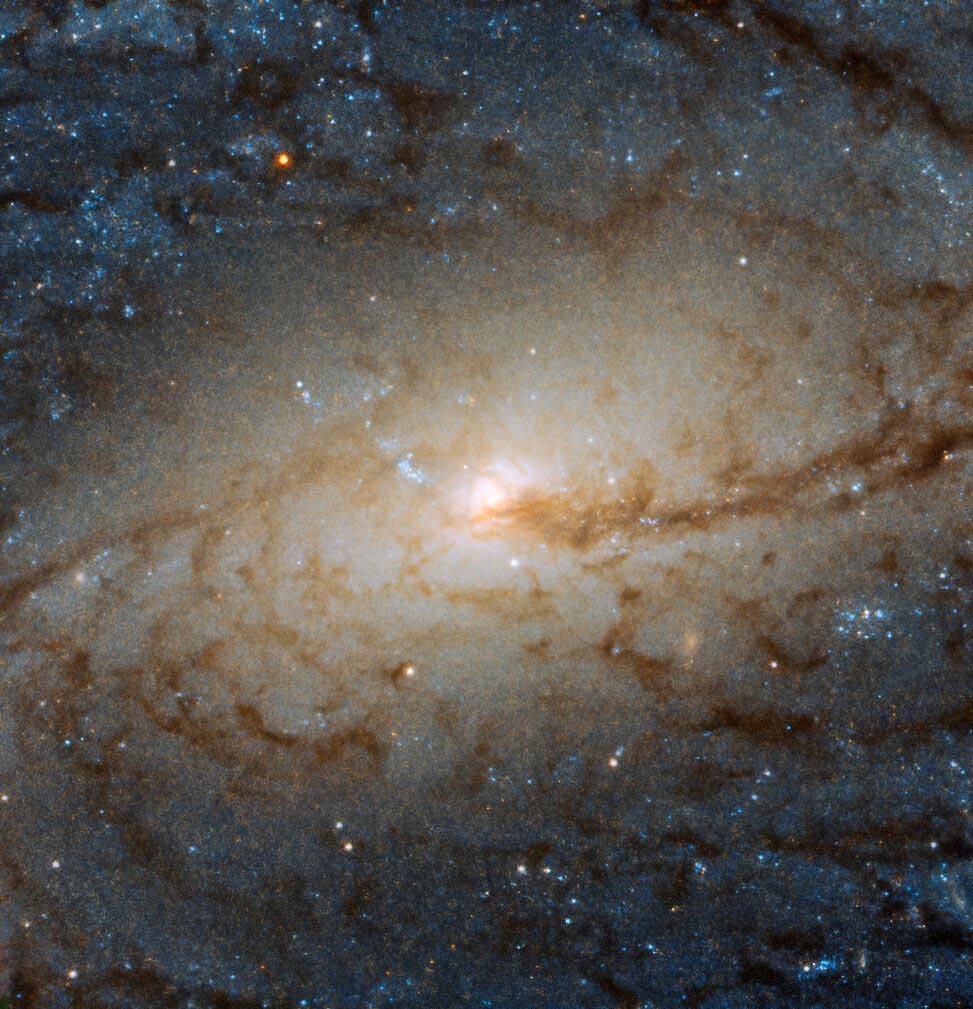
    Barred Spiral Galaxy NGC 3887
    The barred spiral galaxy NGC 3887, seen here as viewed by the Wide Field Camera 3 aboard the NASA/ESA Hubble Space Telescope, lies over 60 million light-years away from us in the southern constellation of Crater (The Cup). Credit: ESA/Hubble & NASA, P. Erwin et al.

    The barred spiral galaxy NGC 3887, seen here as viewed by the Wide Field Camera 3 aboard the NASA/ESA Hubble Space Telescope, lies over 60  million light-years away from us in the southern constellation of Crater (The Cup); it was discovered on December 31, 1785, by the German/British astronomer William Herschel.

    Its orientation to us, while not exactly face-on, allows us to see NGC 3887’s spiral arms and central bulge in detail, making it an ideal target for studying a spiral galaxy’s winding arms and the stars within them.

    The very existence of spiral arms was for a long time a problem for astronomers. The arms emanate from a spinning core and should therefore become wound up ever more tightly, causing them to eventually disappear after a (cosmologically) short amount of time. It was only in the 1960s that astronomers came up with the solution to this winding problem; rather than behaving like rigid structures, spiral arms are in fact areas of greater density in a galaxy’s disc, with dynamics similar to those of a traffic jam. The density of cars moving through a traffic jam increases at the center of the jam, where they move more slowly. Spiral arms function in a similar way; as gas and dust move through the density waves they become compressed and linger, before moving out of them again.

    Never miss a breakthrough: Join the SciTechDaily newsletter.
    Follow us on Google and Google News.

    Astronomy European Space Agency Hubble Space Telescope NASA
    Share. Facebook Twitter Pinterest LinkedIn Email Reddit

    Related Articles

    Hubble’s Newest Discovery Isn’t a Star, It’s a Window Into the Dark Universe

    This Nearby Galaxy Shows How Frozen Clouds Ignite Into Stars

    This Chaotic Spiral Galaxy Is Still Recovering From a Cosmic Collision

    This Strange Spiral Galaxy Is Hiding a Massive Black Hole

    Hubble Zooms In on a Galaxy That Maps the Universe’s Expansion

    Hubble Captures a Dazzling Spiral Galaxy Alive With Birth and Destruction

    Hubble Spots a Glowing “Ring of Fire” in a Distant Spiral Galaxy

    Dust, Light & Ancient Collisions: The Sombrero Galaxy Like You’ve Never Seen It

    Star Formation in Motion: Hubble Reveals Spiraling Stars and Sculpted Nebulae

    Leave A Reply Cancel Reply

    • Facebook
    • Twitter
    • Pinterest
    • YouTube

    Don't Miss a Discovery

    Subscribe for the Latest in Science & Tech!

    Trending News

    JWST Finds a “Star” 100 Billion Times Brighter Than Any Star Should Be

    Scientists Find a Hidden Biological Link Across Different Forms of Autism

    Astronomers Discover a Ghostly River of Stars That Could Reveal Dark Matter

    Why Is Colorectal Cancer Rising in People Under 50? New Clues Point to the Environment

    Quantum Fluctuations Break a Crystal’s Symmetry Rules

    Why Does an Irregular Heartbeat Strike 40 Years Early in Some People?

    Scientists Reveal How ADHD Could Fuel Creative Thinking

    Scientists Find Just 3 Minutes of Sprinting Can Transform Blood Chemistry

    Follow SciTechDaily
    • Facebook
    • Twitter
    • YouTube
    • Pinterest
    • Newsletter
    • RSS
    SciTech News
    • Biology News
    • Chemistry News
    • Earth News
    • Health News
    • Physics News
    • Science News
    • Space News
    • Technology News
    Recent Posts
    • NASA’s Artemis II Crew Flew Farther Than Any Humans Ever. Now They’re Being Honored
    • The Sun’s Corona Usually Looks White. In Spain, It Turned Gold
    • A SpaceX Falcon 9 Rocket Hit the Moon and Blasted Open a 60-Foot Crater
    • Does Vitamin C Really Prevent Colds? The Answer May Surprise You
    • Study Reveals Your Organs May Be Aging at Very Different Speeds
    Copyright © 1998 - 2026 SciTechDaily. All Rights Reserved.
    • Science News
    • About
    • Contact
    • Editorial Board
    • Privacy Policy
    • Terms of Use

    Type above and press Enter to search. Press Esc to cancel.