

A NASA-backed project seeks to develop a kilometer-long space structure capable of simulating Earth’s gravity through centrifugal force.
Artificial gravity is still a science fiction concept. However, coping with zero gravity causes a variety of issues among astronauts, ranging from bone degradation to vision loss. “Simulated gravity,” which employs a spinning device to produce a centrifugal force that has the same impact on the body as gravity, is an alternative route that might solve some of these issues. Still, it remains to be seen if this will fix the issues presented by a lack of gravity. Despite this, NASA appears to be interested in the concept, awarding a $600,000 NASA Institute for Advanced Concepts (NIAC) Phase II grant to a team from Carnegie Mellon University (CMU) and the University of Washington (UW) to develop a structure that can simulate full Earth gravity and be launched in a single rocket.
“Kilometer-Scale Space Structure from a Single Launch” which was accepted into the NIAC program last year, is the project in question. They finished a Phase I project last year in which they “analyze[d] a mission concept analogous to the Lunar Gateway” that could be deployed into a kilometer-long structure. The team, led by professor Zac Manchester of CMU and Jeffery Lipton of UW, was recently approved as 2022 NIAC fellows after meeting NASA’s objectives as part of that program.
This isn’t the first NIAC project addressing the idea of large structures in space, though. NextBigFuture reported in 2021 on around a dozen NIAC funded projects that would take advantage of new metamaterials to dramatically expand their size once in space. NASA isn’t alone in their support either – China’s National Science Foundation has supported efforts to develop a kilometer-sized object to the tune of $2.3 million.
Such large structures need large investment, but they also have large potential benefits. There are two options to reach Earth’s gravity using centrifugal forces. Either spin really, really fast, or have a really, really big axis of rotation. Unfortunately, humans, being the squishy bags of water that they are, don’t really like to spin super fast for long periods, as anyone who has ever gotten sick on a carnival ride can tell you. Science puts that rotational speed limit for discomfort at around 3 RPM. So, to rotate at less than 3 RPM and still have the benefit of a full Earth’s worth of simulated gravity, the structure itself must be a kilometer long.
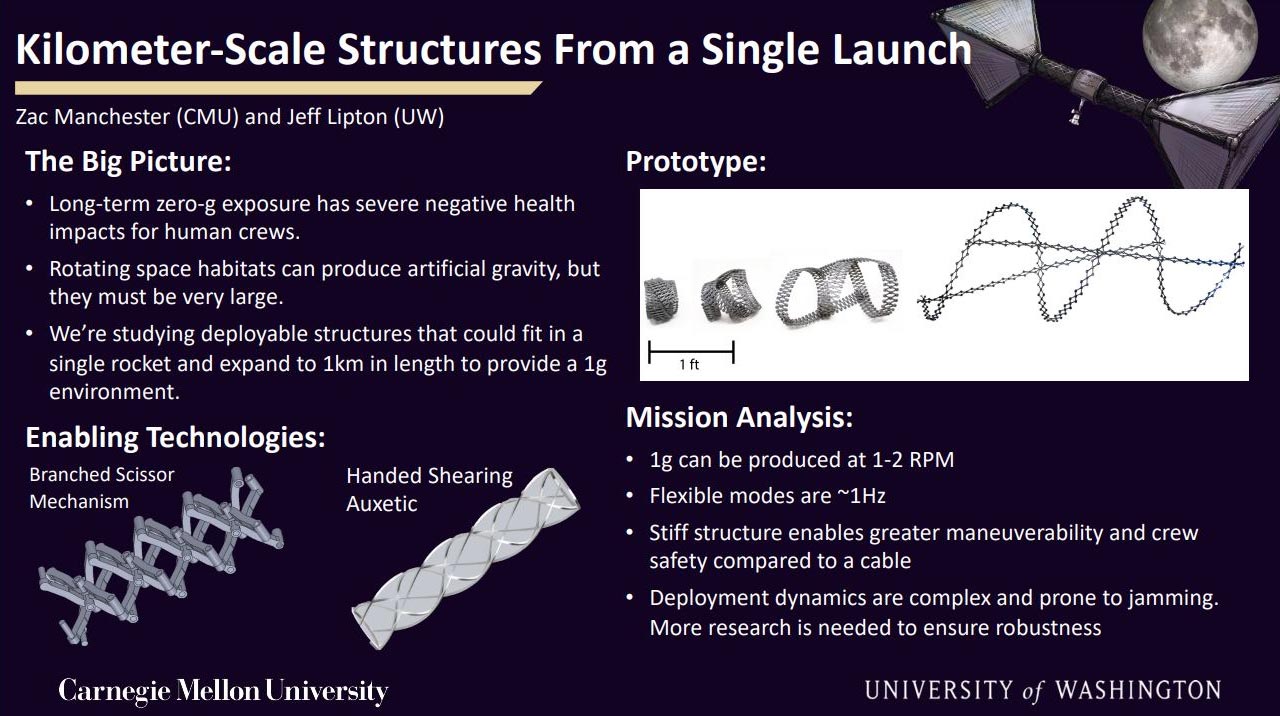
Fitting that much material in a single rocket launch so far has proven impossible. But, Dr. Manchester and his team think they have found a potential solution to the impossible problem – a “high-expansion-ratio deployable structure” or HERDS. HERDS themselves utilize two novel mechanical innovations – shearing auxetics and branched scissor mechanisms.
Shearing auxetics are a novel type of metamaterial that will expand when pulled in a chiral pattern. The level of chirality can also control the stiffness of the material. They seem to be gaining traction in robotic applications as linear actuators and grippers, but their use case in space has yet to be proven.
Video showing shearing auxetics in action. Credit: Lillian Chin YouTube Channel
Branched scissor mechanisms are another way to deploy a larger structure from a compact one. Originally developed by Youtuber and artist Henry Segerman, branched scissor mechanisms snap into much larger structures from more compact ones. You can even buy a demo kid yourself from Shapeways, but once again, the structures haven’t yet been used in space.
Video showcasing branched scissor mechanisms. Credit: Henry Segerman
Ideally, one or both of these systems would work to create the structure of a kilometer-scale space habitat capable of rotating at a speed that would sufficiently simulate Earth’s gravity. Drs. Manchester, Lipton and their team think they can utilize these technologies to create tubular structures that can expand up to 150 times their size when packaged in a rocket fairing. That’s an ambitious goal, but they have the time and some funding to work on it. At the end of the two-year NIAC study period, if the idea is well fleshed out enough, these new technologies might even have time to be integrated into the plans for the Lunar Gateway.
Adapted from an article originally published on Universe Today.
Never miss a breakthrough: Join the SciTechDaily newsletter.
Follow us on Google and Google News.
10 Comments
Perhaps a kilometer in diameter, not a kilometer long.
In 1970 Larry Niven wrote a book called “Ringworld”. This appears to embody the idea, if not the engineering of that tale. In theory it makes a lot of sense. . . . .
Getting that size structure on one launch takes genius. Artificial gravity a must now for stations and deep space probes
A while back I came up with this design, of the Lage floor space. However it has a flaw. When the floor space gets too large gravity moves off towards the corners. The floor then needs to be curved. However the curve also needs to be in relation to the distance between the other floor.
Then there is also the imbalance that can occur when moving things around on the floor. The result is an unstable platform much like the ISS.
There are of course better designs that are better in every way, better shielding from radiation,more robust, more practical and easier to implement. Also lend themselves to travel as well as creating artificial gravity using slow spin.
Also a lot less expensive.
Artificial gravity in space is essential for orbiting as well as long distance space travel.
Centripical force only affects substances/objects that have direct contact with the interior surface of the centrifuge while at rest. So, this will not work in space. Actually, the term “centripical force” is a misnomer.
There is, however an alternate way to simulate gravity and is a lot smaller and cheaper to implement. It can also double as an inertia compensator.
What’s wrong with a rope?
A long rope or a chain or a wire like the ones that are used in a crane or an elevator should work just fine. You could start setting in motion 2 shuttles connected close together and then lengthen the rope gradually. Some ocillations might occur, but should be possible to dampen.
Why struggle to launch it in a single launch? The ISS cost around $150 billion to build. Much of that was launch costs. In short order, however, we will have a launch system available that could put 100 tons in orbit 100 times for less than the cost of a single shuttle launch. It is time to start adjusting our thoughts to take advantage of an ability to get 100 tons to orbit for $10 million or less.
With that kind of capacity, we can build with strong, low-tech materials. If 100 launches could be had for $1 billion or less, then we should design something weighing around 10,000 tons that cost less than $10 billion to manufacture before launch. This gives us a proper target for the tech level to use. The rest of our space design should adjust to the new launch economics.
In other words, we need to be targeting less than 1/10th of the ISS cost with more than 20 times its weight and allowing for 1 gravity for the next LEO station. This is in the range of commercial funding and technological capabilities. There isn’t even a need for government involvement. Government can move their attention to deep space where the new launch capability should allow us to now not worry near as much about the weight of shielding.
Sure, I bet this magical artificial gravity space station could be launched with a single rocket… haha! Only in the fantasy land nonsense story in which it was desribed… First, space would have to exist for that to even be a thought worth having…. Second, have you seen the ISS in its most current and advanced state? It’s a joke. There’s no way we make a jump like that, even theoretically… In the minds of globe believing fundy’s is the only place something like this could ever exist… Space is Fake. Wake Up. Grow Up. Haha¡
Verbal Sin’s comment resonated with me, except for it’s resonance of futility and negativity. Yes, if we’re going to wait for the fantasy of ‘artificial gravity’s, let’s power it with fusion too! Agreed two launches with a kilometer of cable to separate them is a viable idea, but we can’t start it spinning until all it’s functions are built too — as in elevator between the two, with station at hub. See movie 2001, which dramatizes that very well. And if we’re going that far, let’s build the whole ring before we impose a realistic ‘artificial gravity’ upon it. Yes, we have the launch capacity now, thanks almost entirely to Elon Musk.
The other subject, “why do it at all?”, needs to be seen without wearing out rosy ‘sci-fi’ goggles. No, we’re not likely to become spacefarers bc earth is “IT” for us, for this solar system. But a command of the environment above atmosphere just might provide mankind means to patch over our manifest insults on the one we live in. Any study of Earth’s history of mass extinctions makes it clear Homo Sapiens is in deep, deep trouble, and we’ll need every advantage to avoid winking out forever.