
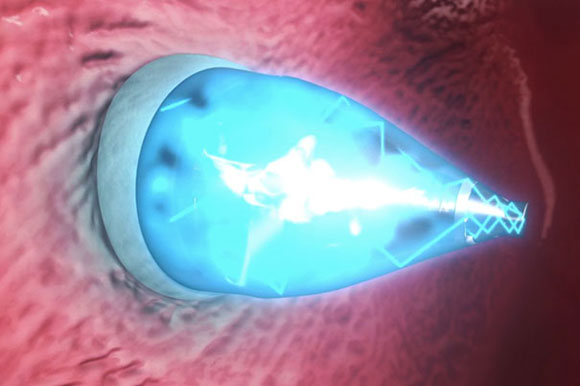
Using a catheter aided by UV light, researchers have developed a new technique to repair holes in the heart without surgery.
Harvard-affiliated researchers have designed a specialized catheter for fixing holes in the heart by using a biodegradable adhesive and patch. The team reported in the journal Science Translational Medicine that the catheter has been used successfully in animal studies to help close holes without requiring open-heart surgery.
Pedro del Nido, chief of cardiac surgery at Boston Children’s Hospital, the William E. Ladd Professor of Child Surgery at Harvard Medical School, and contributing author on the study, said the device represents a radical change in the way some kinds of cardiac defects are repaired. “In addition to avoiding open-heart surgery, this method avoids suturing into the heart tissue, because we’re just gluing something to it.”
Catheterizations are preferable to open-heart surgery because they don’t require stopping the heart, putting the patient on bypass, and cutting into the heart. The Heart Center at Boston Children’s is working toward the least invasive methods possible to correct heart defects, which are among the most common congenital defects.
The team members came from Boston Children’s, the Wyss Institute for Biologically Inspired Engineering at Harvard University, the Harvard John A. Paulson School of Engineering and Applied Sciences (SEAS), and the Karp Lab at Brigham and Women’s Hospital, which is a Harvard-affiliated hospital, as is Boston Children’s.
Last winter, news of the unique adhesive patch was published in the same journal as the latest report. This represented a large step forward in the quest to reduce complications associated with repairing heart defects. While medical devices that remain in the body may be jostled out of place or fail to cover the hole as the body grows, the patch allows the heart tissue to create its own closure, and then it dissolves.
To truly realize the patch’s potential, however, the research team sought a way to deliver the patch without open-heart surgery. Their catheter device utilizes UV-light technology and can be used to place the patch in a beating heart.
The catheter is inserted through a vein in the neck or groin and directed to the defect within the heart. Once the catheter is in place, the clinician opens two positioning balloons: one around the front end of the catheter, passing through the hole, and one on the other side of the heart wall. The clinician then deploys the patch and turns on the catheter’s UV light.
The light reflects off of the balloon’s shiny interior and activates the patch’s adhesive coating. As the glue cures, pressure from the positioning balloons on either side of the patch help secure it in place. Finally, both balloons are deflated, and the catheter is withdrawn. Over time, normal tissue growth resumes, and heart tissue grows over the patch. The patch itself dissolves when it is no longer needed.
“This really is a completely new platform for closing wounds or holes anywhere in the body,” said Conor Walsh, a contributing author of the study, a Wyss Institute core faculty member, an assistant professor of mechanical and biomedical engineering at SEAS, and founder of the Harvard Biodesign Lab at SEAS. “The device is a minimally invasive way to deliver a patch and then activate it using UV light, all within a matter of five minutes, and in an atraumatic way that doesn’t require a separate incision.”
Reference: “A light-reflecting balloon catheter for atraumatic tissue defect repair” by Ellen T. Roche, Assunta Fabozzo, Yuhan Lee, Panagiotis Polygerinos, Ingeborg Friehs, Lucia Schuster, William Whyte, Alejandra Maria Casar Berazaluce, Alejandra Bueno, Nora Lang, Maria J. N. Pereira, Eric Feins, Steven Wasserman, Eoin D. O’Cearbhaill, Nikolay V. Vasilyev, David J. Mooney, Jeffrey M. Karp, Pedro J. Del Nido and Conor J. Walsh, 23 September 2015, Science Translational Medicine.
DOI: 10.1126/scitranslmed.aaa2406
Never miss a breakthrough: Join the SciTechDaily newsletter.
Follow us on Google and Google News.