
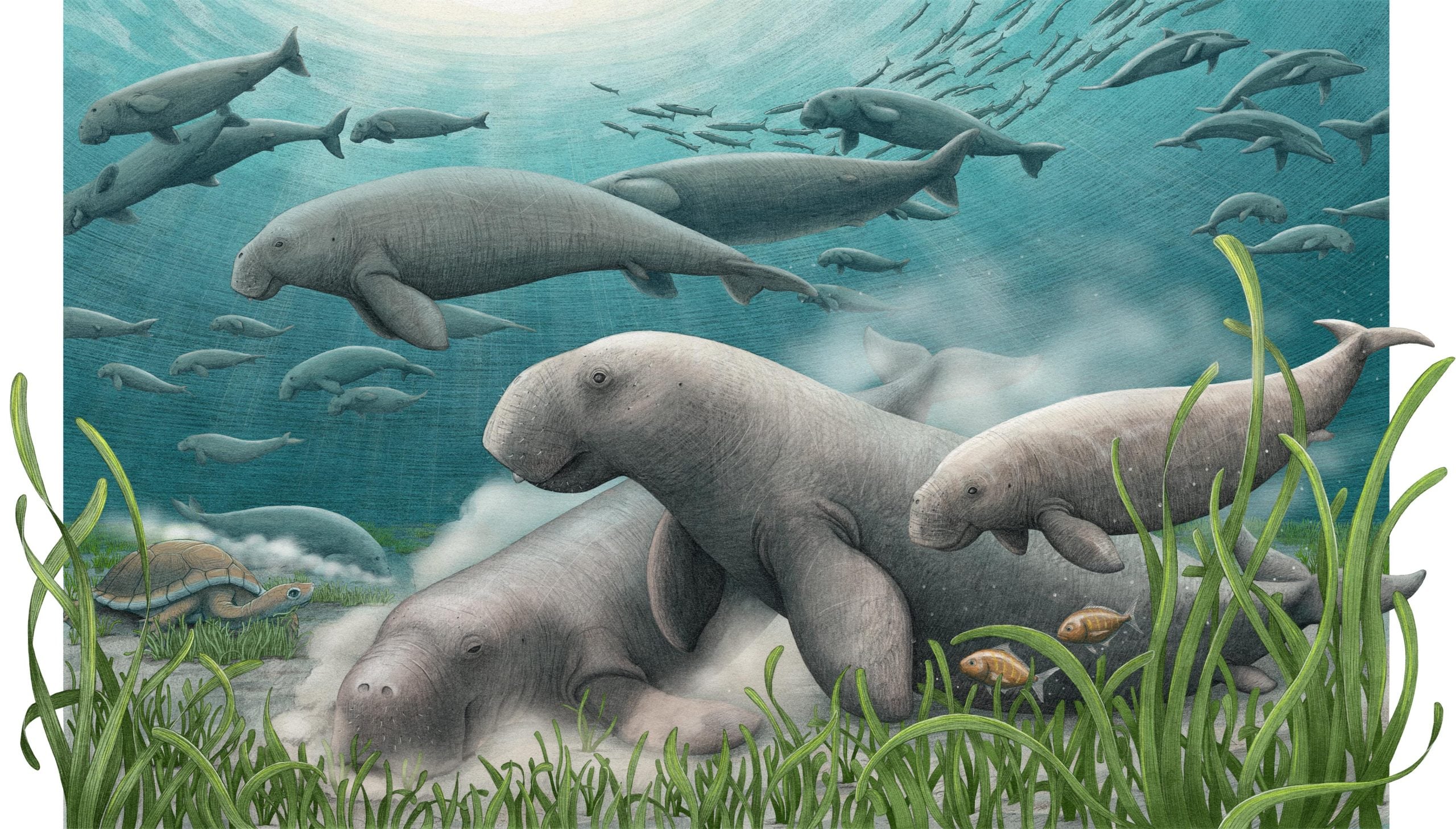
More than 20 million years ago, ancient sea cows shaped the Arabian Gulf’s seagrass meadows much like dugongs do today.
A vast fossil bonebed in Qatar—one of the richest ever found—reveals a newly discovered miniature species, Salwasiren qatarensis, and paints a picture of a thriving Miocene ecosystem filled with marine life. The discoveries highlight a long, unbroken lineage of seagrass “ecosystem engineers” and underscore how climate stress, habitat loss, and human impact threaten modern dugongs.
Dugongs and Their Long History in the Arabian Gulf
Today, the Arabian Gulf supports a large population of dugongs, marine mammals that resemble manatees and help maintain seagrass habitats by feeding and stirring up the seafloor. New fossil evidence from Qatar shows that ancient sea cows were performing similar ecological work more than 20 million years ago.
A study published today (December 10) in PeerJ by researchers from the Smithsonian’s National Museum of Natural History and Qatar Museums describes a newly identified fossil site and introduces a previously unknown species of sea cow. This species was significantly smaller than the dugongs that live in the region today.
“We discovered a distant relative of dugongs in rocks less than 10 miles away from a bay with seagrass meadows that make up their prime habitat today,” said Nicholas Pyenson, the curator of fossil marine mammals at the National Museum of Natural History, who helped lead the new study. “This part of the world has been prime sea cow habitat for the past 21 million years—it’s just that the sea cow role has been occupied by different species over time.”
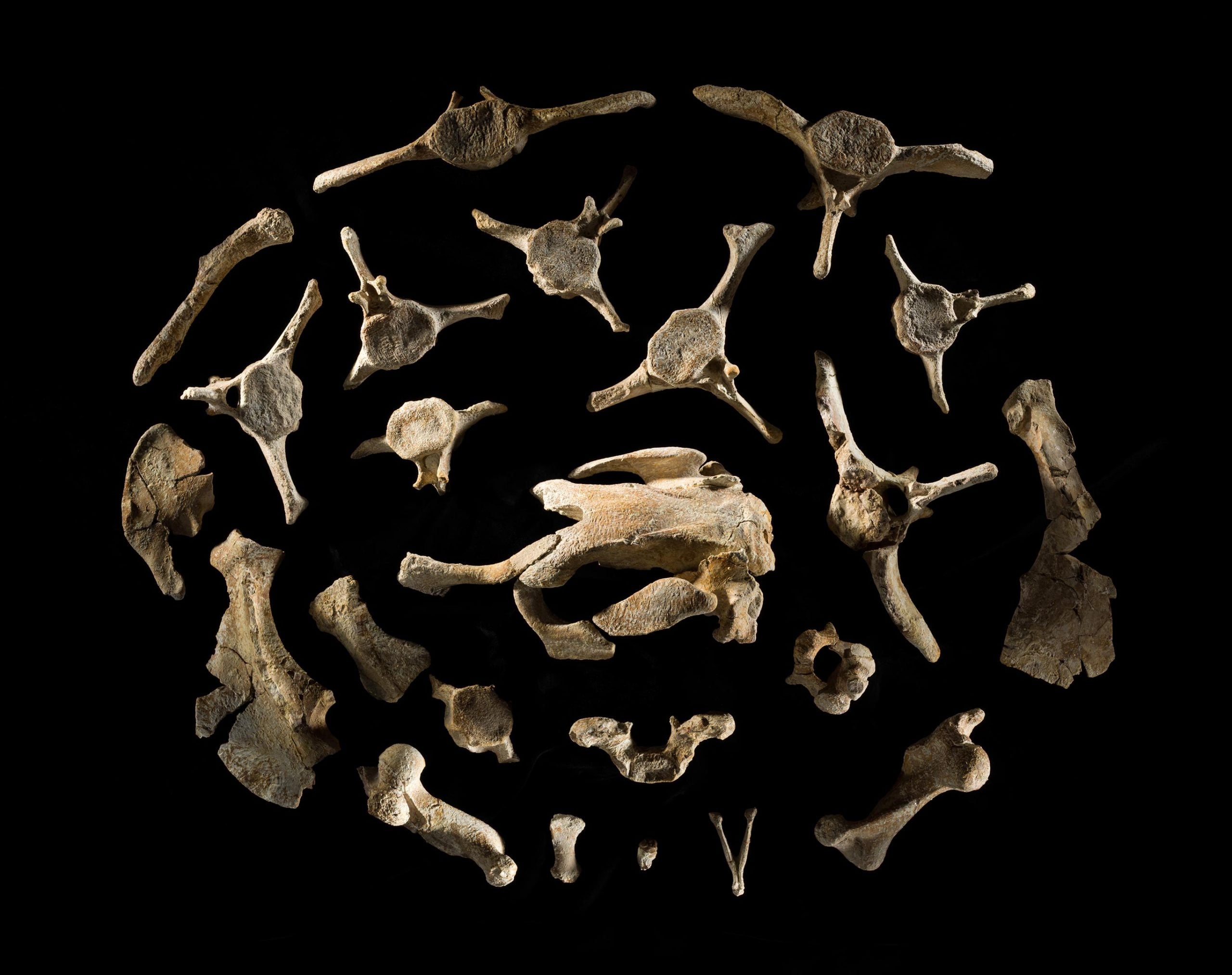
ARC.2023.23.008, Qatar Museums, Doha, State of Qatar. Photo by James Di Loreto, Smithsonian
Modern Dugongs and Their Traits
Dugongs (Dugong dugon) share a similar overall appearance with manatees, including a rounded body and downward-facing snout equipped with bristles for detecting food. Their most recognizable difference lies in the tail. Manatees have a broad, paddle-shaped tail, while dugongs have a fluked tail resembling that of a dolphin (however, dugongs and manatees are more closely related to elephants than they are to dolphins, whales, and porpoises).
These herbivores live across warm coastal areas from Western Africa through the Indo-Pacific and into northern Australia. The Arabian Gulf hosts the largest known single aggregation of dugongs, where they serve as important ecosystem engineers. As they feed, they carve shallow paths through seagrass beds, releasing nutrients trapped in sediments and supporting a wide range of marine life.
Past Abundance and Present Threats
Fossil records show that relatives of dugongs have been grazing on aquatic vegetation around the world for nearly 50 million years. Today, however, dugongs in the Gulf face increasing pressures. They are sometimes caught unintentionally by fishers, and their coastal habitats are disturbed by pollution and development. The seagrass meadows they depend on are also stressed by rising temperatures and salinity.
According to Ferhan Sakal, head of excavation and site management at Qatar Museums and a coauthor of the study, important clues about the long-term relationship between dugongs, seagrass, and Gulf environments can be found in the region’s fossil-rich rock layers.
“If we can learn from past records how the seagrass communities survived climate stress or other major disturbances like sea-level changes and salinity shifts, we might set goals for a better future of the Arabian Gulf,” he said.
A Fossil Record Preserved in the Desert
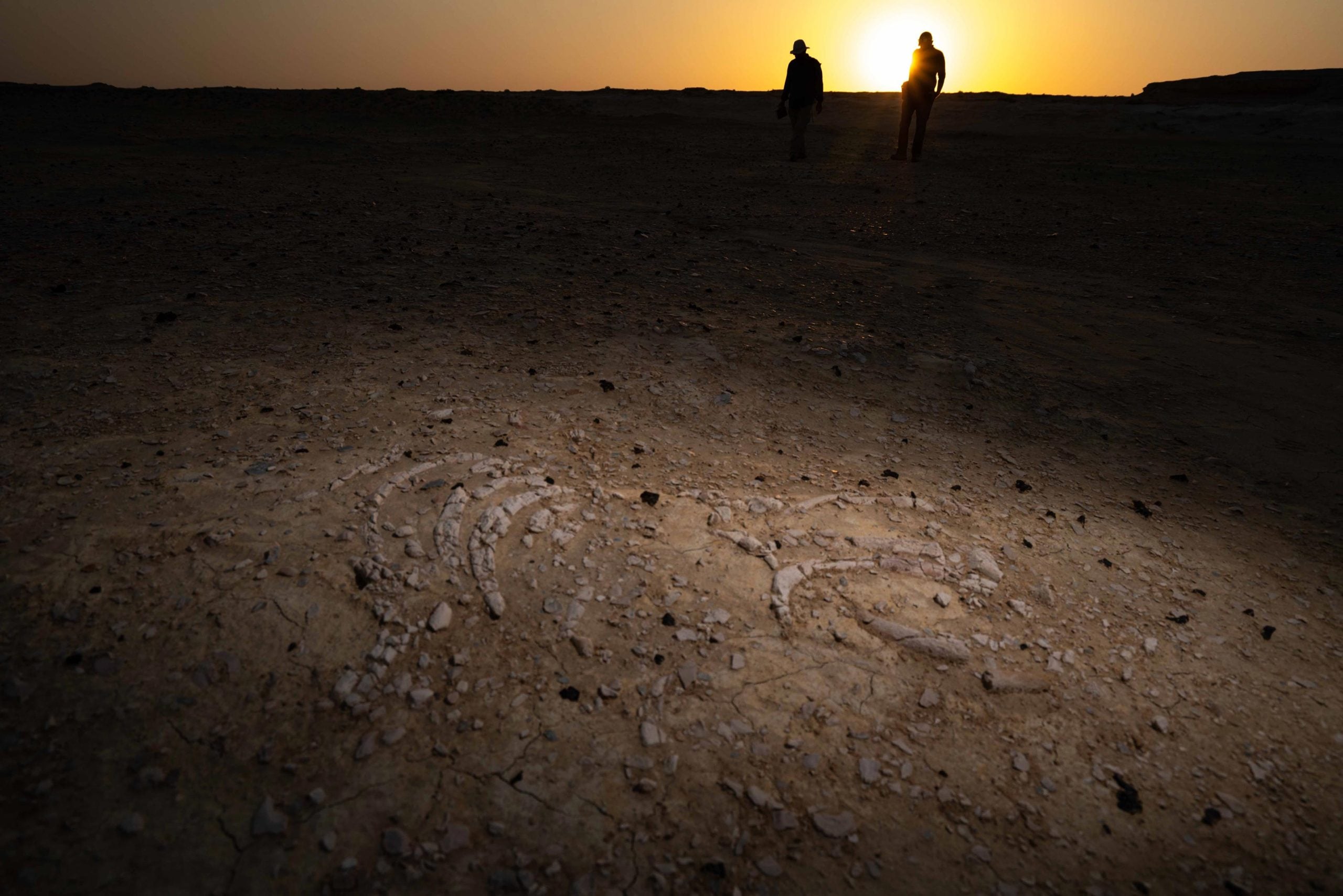
Because seagrass rarely fossilizes, scientists study ancient marine conditions by analyzing the bones of the herbivores that fed on it. Few places contain as many of these bones as Al Maszhabiya [AL mahz-HA-bee-yah], a fossil locality in southwestern Qatar. Geologists first noted the site in the 1970s during mining and petroleum surveys, when they found numerous bones they initially believed belonged to reptiles. When paleontologists revisited the site in the early 2000s, they recognized that the bones were actually from ancient sea cows.
“The area was called ‘dugong cemetery’ among the members of our authority,” Sakal said. “But at the time, we had no idea just how rich and vast the bonebed actually was.”
A Window Into an Ancient Marine World
After securing the necessary permits in 2023, Pyenson, Sakal, and their team carried out a detailed survey of Al Maszhabiya. Rock layers around the fossils indicate that the deposits date to the Early Miocene, around 21 million years ago. The site once represented a shallow marine habitat filled with sharks, fish resembling barracuda, prehistoric dolphins, and sea turtles.
It also supported an extensive sea cow population. The researchers documented more than 170 separate locations containing sea cow remains. According to Pyenson, this makes Al Maszhabiya the most abundant collection of fossil sea cow bones known anywhere. The site is comparable to Cerro Ballena in the Atacama Desert of Chile, where an ancient mass stranding of whales was preserved.
The fossils at Al Maszhabiya share similarities with modern dugong skeletons, but there are notable differences. Ancient sea cows from the site retained small hind limbs that modern dugongs and manatees have lost through evolution. Their snouts were straighter, and their tusks were smaller than those of living species.
Introducing a New Sea Cow Species
The team formally described the Al Maszhabiya fossils as a new species, Salwasiren qatarensis. The genus name “Salwasiren” references the Bay of Salwa, an area of the Gulf where dugongs live today. Although the Bay of Salwa extends across multiple national boundaries, the species name “qatarensis” honors the country where the fossils were found.
“It seemed only fitting to use the country’s name for the species as it clearly points to where the fossils were discovered,” Sakal said.
This species likely weighed around 250 pounds, roughly comparable to an adult panda or a heavyweight boxer, according to Pyenson. Despite this, it was still one of the smaller sea cow species known. By comparison, some modern dugongs can weigh nearly eight times as much.
Seagrass Ecosystem Engineers Across Deep Time
The abundance of fossils at Al Maszhabiya suggests that lush seagrass meadows existed in the region more than 20 million years ago, during a period when the Gulf was a center of marine biodiversity. Sea cows likely played a central role in maintaining these underwater meadows.
“The density of the Al Maszhabiya bonebed gives us a big clue that Salwasiren played the role of a seagrass ecosystem engineer in the Early Miocene the way that dugongs do today,” Pyenson said. “There’s been a full replacement of the evolutionary actors but not their ecological roles.”
It is also possible that Salwasiren shared its habitat with other sea cow species. Pyenson noted that fossils of multiple species often appear together, raising the possibility that more species could eventually be identified from the Al Maszhabiya deposits.
Protecting a Significant Fossil Heritage Site
Sakal and colleagues hope that continued collaboration between Qatar Museums and the Smithsonian will lead to further discoveries in and around Al Maszhabiya. Their first priority, however, is safeguarding the site itself. They plan to nominate the area for recognition as a UNESCO World Heritage site.
“The most important part of our collaboration is ensuring that we provide the best possible protection and management for these sites, so we can preserve them for future generations,” Sakal said.
“Dugongs are an integral part of our heritage, not only as a living presence in our waters today, but also in the archaeological record that connects us to generations past,” said Faisal Al Naimi, study coauthor and director of the Archaeology Department at Qatar Museums, referencing the abundant zooarchaeological sites with dugong bones throughout the Gulf. “The findings at Al Maszhabiya remind us that this heritage is not confined to memory or tradition alone, but extends deep into geologic time, reinforcing the timeless relationship between our people and the natural world. In preserving and studying these remarkable creatures, we are also safeguarding a narrative that speaks to our nation’s identity, resilience and enduring connection to the sea.”
Bringing Fossils to the Public Through Digital Access
To ensure long-term accessibility of their findings, Pyenson and Sakal partnered with the Smithsonian’s Digitization Program Office to create high-resolution digital scans of several fossil sites and of the fossil skull, vertebrae, tooth, and other skeletal elements from the newly described species. These 3D models are available on the open-source Smithsonian Voyager platform and include educational features such as interactive explanations of the research and a virtual tour of the excavation process.
Reference: “High abundance of Early Miocene sea cows from Qatar shows repeated evolution of seagrass ecosystem engineers in Eastern Tethys” by Nicholas D. Pyenson, Ferhan Sakal, Jacques LeBlanc, Jon Blundell, Katherine D. Klim, Christopher D. Marshall, Jorge Velez-Juarbe, Katherine Wolfe and Faisal Al-Naimi, 10 December 2025, PeerJ.
DOI: 10.7717/peerj.20030
In addition to Pyenson and Sakal, the study includes authors affiliated with the Smithsonian’s Digitization Program Office; the Stone Ridge School of the Sacred Heart; Texas A&M University at Galveston; Texas A&M University, College Station; and the Natural History Museum of Los Angeles County.
This research was supported by a collaborative agreement between the Smithsonian Institution and Qatar Museums and by funding from the National Museum of Natural History and the Qatar National Research Fund.
Never miss a breakthrough: Join the SciTechDaily newsletter.
Follow us on Google and Google News.
1 Comment
I am very much tempted to unsubscribe your Sci Tech Daily. It is because, even though international bodies such as UN or tother international bodies have agreed to accept that the gulf in Middle East is Persian Gulf and not Arabian Gulf, your article about fossils found in that gulf refers to it as Arabian gulf. Why don’t you change Indian Ocean to African Ocean, after all they have the same amount of coast line or even change the Atlantic Ocean to American Ocean as it has more coast line with America than any other country and possibly make Mr Trump a very happy man, he is already trying for Gulf of Panama!!!!!