
A new technique using tree-ring carbon data and historical records uncovered a solar event from 1200–1201 CE, offering insights into past solar activity and improving space weather predictions.
On Earth, intense solar activity often shows up as colorful auroras that appear harmless. Beyond the protection of our planet’s magnetic field, however, the Sun can become far more dangerous, releasing powerful flares and massive bursts of charged particles.
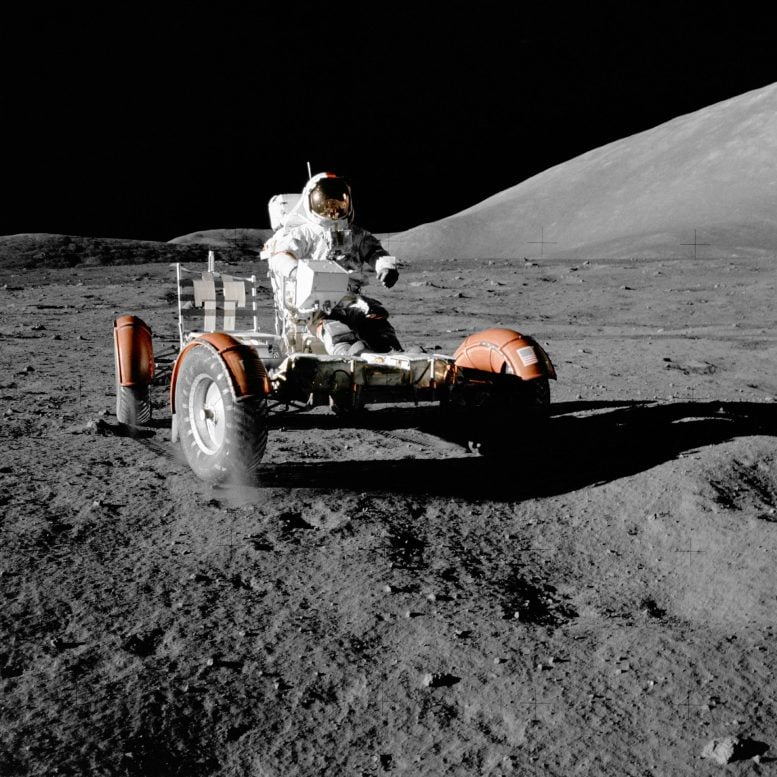
These eruptions can lead to solar proton events, or SPEs, where high-energy particles race toward Earth at speeds reaching 90% of the speed of light. In 1972, a series of SPEs occurred between the Apollo 16 and Apollo 17 missions.
If astronauts had been in space at the time, they would have faced potentially fatal radiation exposure. As future missions aim to return humans to the Moon, understanding these unpredictable events is increasingly important.
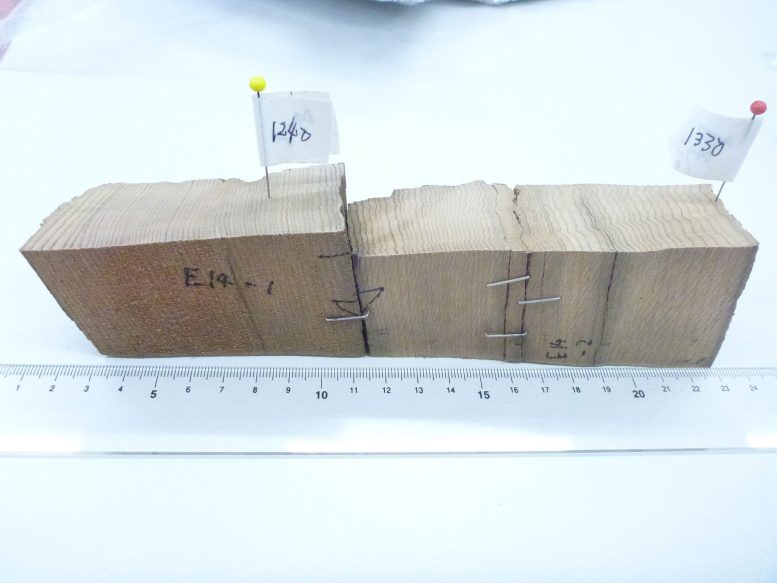
Researchers at the Okinawa Institute of Science and Technology (OIST) have developed a new way to detect past SPEs. Their approach uses medieval records to guide highly precise carbon-14 analysis of buried asunaro trees in northern Japan.
By combining these methods, the team identified an SPE that took place between the winter of 1200 and the spring of 1201 CE, a period of intense solar activity. The results were published in the Proceedings of the Japan Academy, Series B.
Detecting Sub-Extreme Solar Proton Events
Professor Hiroko Miyahara from the OIST Solar-Terrestrial Environment and Climate Unit explains, “Previous studies on historical SPEs have focused on rare, extremely powerful events. Our paper provides a basis for detecting sub-extreme SPEs—events that occur more frequently and are around 10-30% of the size of the most extreme cases, but still hazardous. Sub-extreme SPEs are more challenging to detect, but our method now allows us to efficiently identify them and better understand the conditions under which they are more likely to occur.”
Most of the high-energy protons produced during SPEs are blocked by Earth’s magnetic field. Near the poles, where magnetic field lines open into space, or during especially strong events, some particles can penetrate the atmosphere. When they collide with atmospheric gases, they create carbon-14, which spreads through the atmosphere and becomes part of living organisms.
Scientists can track past solar activity by measuring carbon-14 levels in preserved organic material such as buried trees. This method can reveal changes over the past 10,000 years. Thanks to highly precise techniques developed over more than a decade, researchers can now detect smaller variations that were previously invisible, making it possible to identify sub-extreme SPEs.
Combining Historical Records and Scientific Analysis
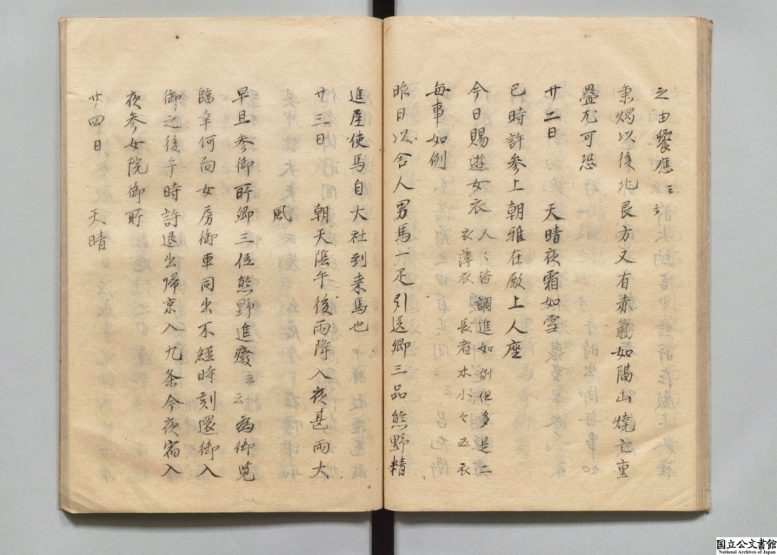
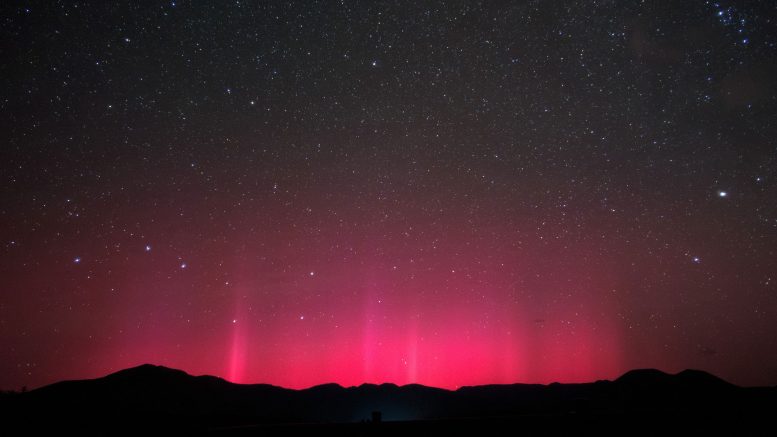
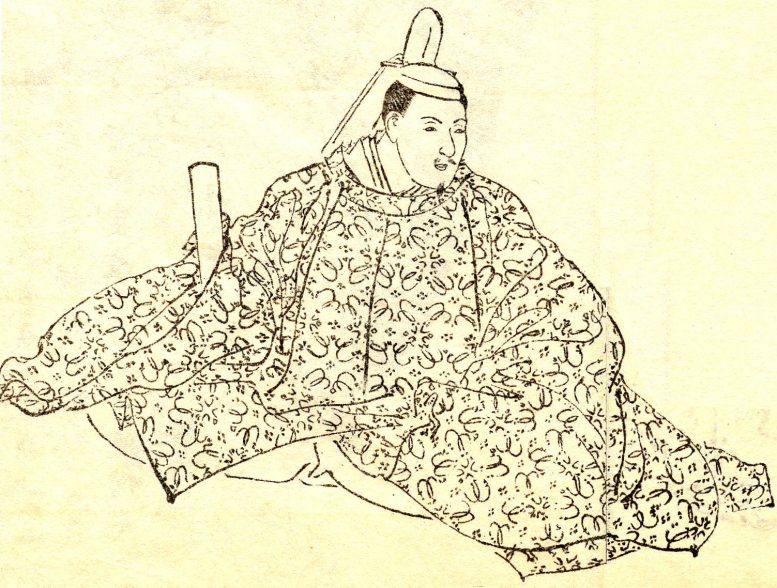
Because this high-precision method takes significant time and effort, the team first needed clues about when to search. They found one in Meigetsuki, the diary of Japanese courtier and poet Fujiwara no Teika (1162–1241), who recorded seeing “red lights in the northern sky over Kyoto” in February 1204 CE.
Although SPEs do not directly cause auroras, they often occur alongside solar activity that does. This helped researchers narrow their focus. They analyzed carbon-14 levels in asunaro wood recovered from Aomori Prefecture and discovered spikes that point to a sub-extreme SPE.
Using dendroclimatology, a method that compares tree ring growth patterns linked to climate, the team dated the event to between the winter of 1200 and the spring of 1201 CE. This timeframe aligns with reports from China describing a rare low-latitude red aurora.
Reconstructing Solar Cycles and Space Weather Risks
“The high-precision data not only allowed us to accurately date sub-extreme solar proton events, but it also lets us clearly reconstruct the solar cycles of the period,” adds Miyahara. “Today, the Sun’s activity fluctuates over eleven-year-long cycles, but we’ve found that the cycle was just seven to eight years long back then, indicating a very active Sun. The SPE we have dated occurred at the peak of one of these cycles.”
The findings help fill important gaps in the historical record of solar activity and improve understanding of hazardous space weather. Miyahara notes that carbon-14 analysis alone is not enough.
“Historical literature provides a candidate time window, and dendroclimatology enables direct intercomparison between detected SPE and reports of sunspots and auroras recorded in literature. Integrated approaches like these are necessary to accurately reconstruct past solar activity, helping us better understand the characteristics of extreme space weather,” concludes Miyahara. “For example, while the SPE we found occurred near the peak of the solar cycle, some of the prolonged low-latitude aurora recorded in the literature seems to fall near the minimum of our reconstructed solar cycle. This is unexpected, and we’re excited to look further into what solar conditions could cause this.”
Reference: “Extremely active Sun from 1190 to 1220 in the Medieval Period: Intercomparison of historical records and tree-ring carbon-14” by Hiroko Miyahara, Ryuho Kataoka, Kazuaki Yamamoto, Fuyuki Tokanai, Toru Moriya, Mirei Takeyama, Hirohisa Sakurai, Motonari Ohyama, Kazuho Horiuchi, and Hideyuki Hotta, 10 April 2026, Proceedings of the Japan Academy Series B.
DOI:10.2183/pjab.102.011
This study was funded by the Japan Society for the Promotion of Science.
Never miss a breakthrough: Join the SciTechDaily newsletter.
Follow us on Google and Google News.
2 Comments
Historiography comment here: 1190-1200 is absolutely NOT in the “Edo” period specifically. That wouldn’t happen until the 1600ish; Edo reaching prominence enough to have a period named after it wouldn’t happen for 500 years.
The period of this diary comes from a Kamakura period source. There’s still technically /A/ shogunate system, but it’s not /the/ specific (Tokugawa) shogunate most people are associated with (i.e. the late Sengoku into Edo period a couple centuries after).
Whoopsie, made my own typo. Corrected here with a little extra detail for anyone caring:
“That wouldn’t happen until the 1600ish; Edo reaching prominence enough to have a period named after it wouldn’t happen for ~400 years after the Tokugawa Shogunate solidifies their control over post-Sengoku era Japan and moves the capital from Kyoto to Edo (someday Tokyo).”