

A massive quake in Myanmar revealed the Sagaing Fault can rupture far beyond expectations.
Caltech scientists, using cutting-edge satellite imaging, showed the fault slipped over 500 kilometers—reshaping our understanding of earthquake cycles. The study warns that faults like the San Andreas could also produce unprecedented, unpredictable quakes.
Earthquake Strikes Myanmar in 2025
On March 28, 2025, a magnitude 7.7 earthquake struck Myanmar along the Sagaing Fault, leaving thousands dead and causing massive destruction across the region. Researchers at Caltech have now examined this event in detail, using satellite imagery to track how the fault moved. Their findings suggest that strike–slip faults such as the Sagaing and California’s San Andreas are capable of producing quakes that are not only unlike those recorded in the past but may also reach even greater magnitudes.
The work was led in the laboratory of Jean-Philippe Avouac, the Earle C. Anthony Professor of Geology and Mechanical and Civil Engineering and director of the Center for Geomechanics and the Mitigation of Geohazards. The paper, published August 11 in the Proceedings of the National Academy of Sciences, lists postdoctoral scholar Solène Antoine as its lead author.
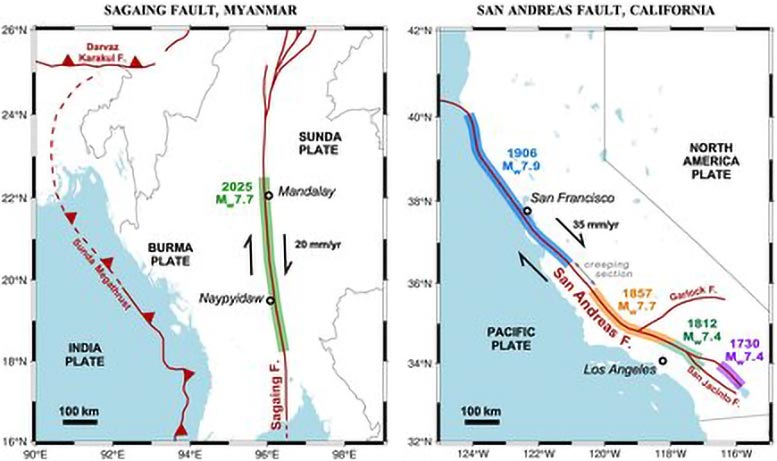
Sagaing Fault and San Andreas Connections
The Sagaing Fault cuts through Myanmar in a mostly straight north–south line. Over time, its two sides grind slowly in opposite directions, building stress along the boundary. When that stress finally overcomes resistance, the fault slips suddenly, releasing energy as an earthquake. Because both the Sagaing and San Andreas faults are long, relatively straight strike–slip systems stretching hundreds of kilometers, the Myanmar quake offers important clues about what could one day happen in California.
“This earthquake turned out to be an ideal case to apply image correlation methods [techniques to compare images before and after a geological event] that were developed by our research group,” Antoine says. “They allow us to measure ground displacements at the fault, where the alternative method, radar interferometry, is blind due to phenomenon like decorrelation [a process to decouple signals] and limited sensitivity to north–south displacements.”

Seismic Gap Hypothesis Tested
Based on studies of historic earthquakes along the Sagaing fault, researchers anticipated that a large earthquake would occur on a 300-kilometer section where no large earthquakes had occurred since 1839. This theory is known as the seismic gap hypothesis: Stuck sections of a fault where there has not been movement are expected to slip to “catch up.” While this section did indeed rupture during the 2025 quake, the fault actually slipped along a total of more than 500 kilometers, indicating that the fault did indeed make up the deficit of slip and more.
In the new study, the team used correlation of satellite optical and radar imagery of the fault—a technique originally developed in the Avouac laboratory and now widely used in seismology—and its surroundings to determine that the 500-kilometer section shifted a net of 3 meters after the quake, that is, the eastern side moved south by 3 meters relative to the western side.
Rethinking Earthquake Forecasting Models
Current models used for seismic hazard assessment are mostly based on earthquake statistics and are time independent, meaning they can only give probabilities of an earthquake during a chosen timespan. For example, these models might estimate, for any given 30-year period and particular area, the probability that an earthquake would exceed a chosen magnitude. However, in order to make truly informed estimates of potential seismic hazards for specific time periods—say, the next 30 years—it is crucial for models to take into account how recently a fault has slipped, where the slip occurred, and by how much.
“The study shows that future earthquakes might not simply repeat past known earthquakes,” Avouac says. “Successive ruptures of a given fault, even as simple as the Sagaing or the San Andreas faults, can be very different and can release even more than the deficit of slip since the last event. In addition, historical records are generally far too short for statistical models to represent the full range of possible earthquakes and eventual patterns in earthquake recurrence. Physics-based models provide an alternative approach with the advantage that they could, in principle, be tuned to observations and used for time-dependent forecasts.”
The paper is titled “The 2025 Mw7.7 Mandalay, Myanmar, earthquake reveals complex earthquake cycle with clustering and variable segmentation on Sagaing fault.”
Reference: “The 2025 Mw7.7 Mandalay, Myanmar, earthquake reveals a complex earthquake cycle with clustering and variable segmentation on the Sagaing Fault” by Solene L. Antoine, Rajani Shrestha, Chris Milliner, Kyungjae Im, Chris Rollins, Kang Wang, Kejie Chen and Jean-Philippe Avouac, 11 August 2025, Proceedings of the National Academy of Sciences.
DOI: 10.1073/pnas.2514378122
In addition to Antoine and Avouac, Caltech co-authors are graduate student Rajani Shrestha, postdoctoral scholar Chris Milliner, and senior research scientist Kyungjae Im. Additional co-authors are Chris Rollins (PhD ’18) of GNS Science Te Pu Ao in New Zealand, Kang Wang of EarthScope Consortium Inc., and Kejie Chen of Southern University of Science and Technology in China. Funding was provided by the Center for Geomechanics and Mitigation of Geohazards, the Statewide California Earthquake Center, the National Science Foundation, and the US Geological Survey.
Never miss a breakthrough: Join the SciTechDaily newsletter.
Follow us on Google and Google News.
2 Comments
Fascinating. If it occurs in Cali, they’ll blame 45/47/48. Then they’ll all loot each other, and we’ll laugh. Since they cannot rebuild from a brush fire in a wealthy area, the odds of them rebuilding that former state in its urban core are remote.
They’ll ask for help, beg for help. Cannot wait. Sorry, but I really can’t. I know, I’m bad to think that way
Yes, you are taking about children. You are not bad, just making choices that are counterproductive.