
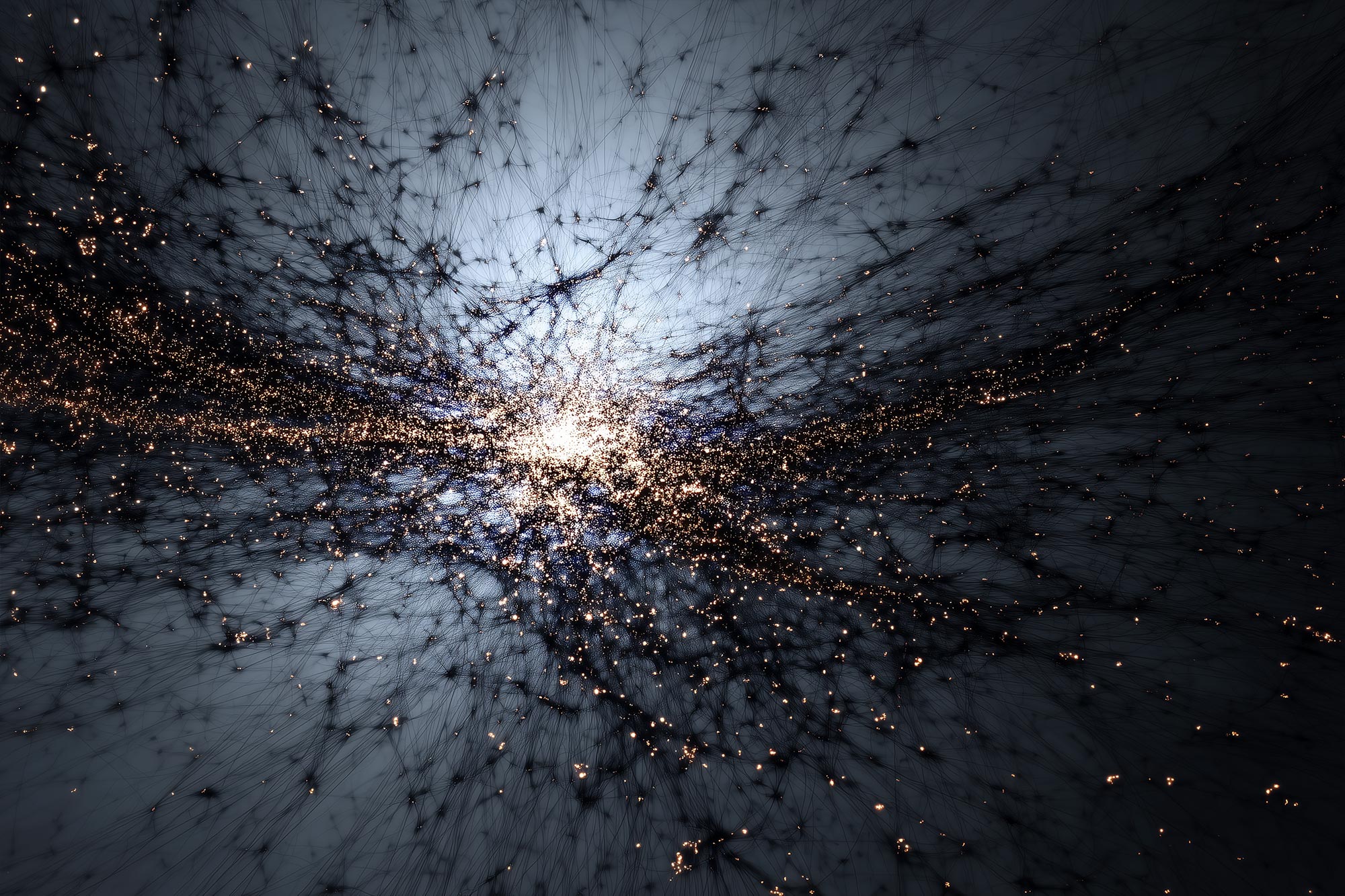
Deep beneath South Dakota, scientists are closing in on one of the greatest mysteries in the universe — the true nature of dark matter.
Using the world’s most sensitive detector, the LUX-ZEPLIN experiment has set new records in its search for the invisible particles thought to make up most of the cosmos.
The Search for Dark Matter’s Elusive Nature
Unraveling the mystery of dark matter, the unseen material that accounts for most of the universe’s mass, remains one of the biggest challenges in modern physics. The latest findings from the world’s most sensitive dark matter experiment, LUX-ZEPLIN (LZ), have further refined the search for one of the main theoretical candidates: weakly interacting massive particles (WIMPs).
“While we always hope to discover a new particle, it is important for particle physics that we are able to set bounds on what the dark matter might actually be,” explained UC Santa Barbara experimental physicist Hugh Lippincott. Scientists have long suspected that dark matter exists, yet it continues to defy direct detection even as it shapes galaxies and holds the cosmic web together.

A Mile Underground: Hunting for WIMPs
LZ operates nearly a mile beneath the surface at the Sanford Underground Research Facility (SURF) in South Dakota, where it searches for dark matter interactions shielded from background radiation. The latest analysis examines signals weaker than any previously explored, further constraining what WIMPs could be. Researchers analyzed 280 days of observations, combining 220 new days of data (collected between March 2023 and April 2024) with 60 days from LZ’s initial run. By the time the experiment concludes in 2028, it will have gathered data from a total of 1,000 days of operation.
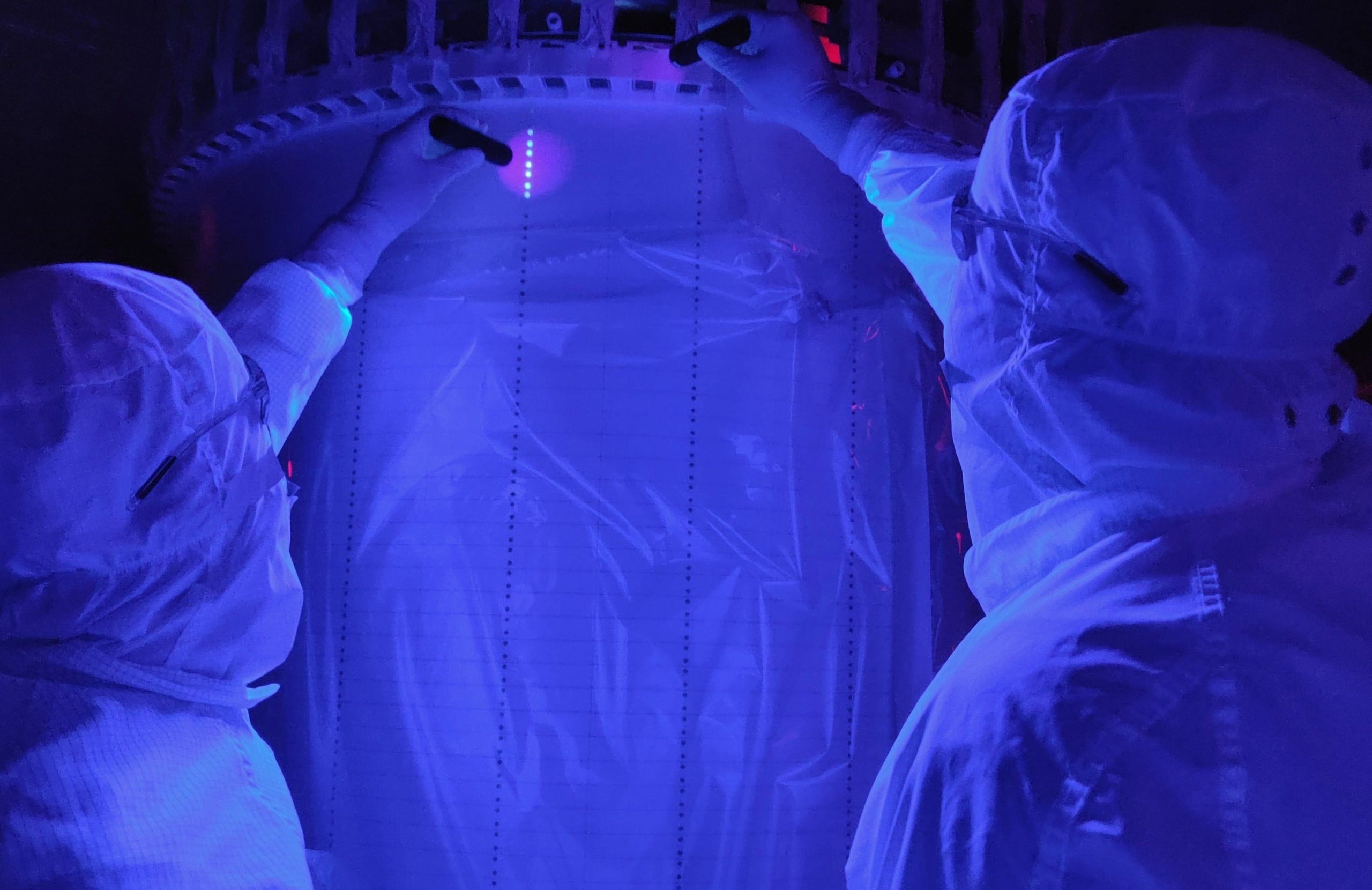
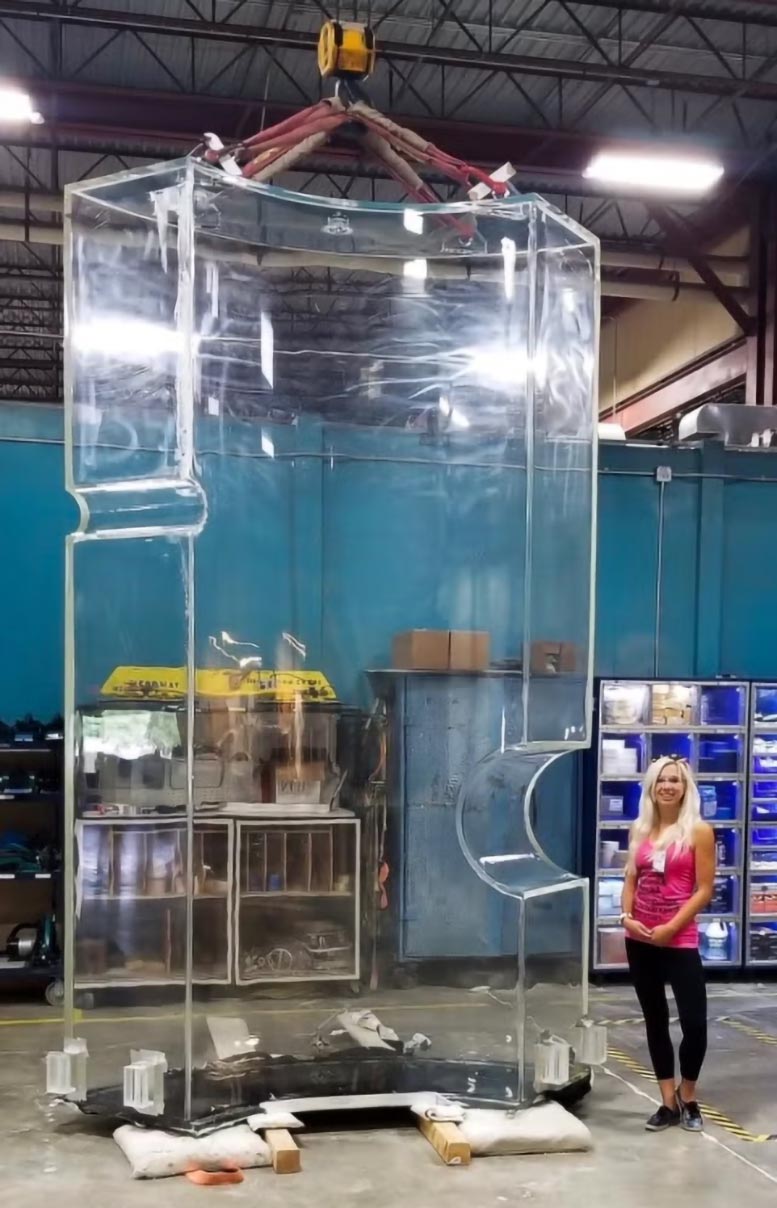
At the heart of LZ are two titanium vessels nested together and filled with ten tonnes of ultra-pure liquid xenon. This dense liquid provides a remarkably quiet environment, shielding the experiment from outside interference while allowing it to detect the tiniest flashes of light that might signal a passing WIMP. When a WIMP collides with a xenon nucleus, it is expected to create a minuscule recoil, like a cue ball striking another on a pool table. LZ records the resulting light and electrons to identify possible dark matter events. Surrounding this core is a larger Outer Detector (OD), composed of acrylic tanks filled with a gadolinium-loaded liquid scintillator that helps distinguish genuine signals from background noise.
Shielding from the Universe: Reducing Background Noise
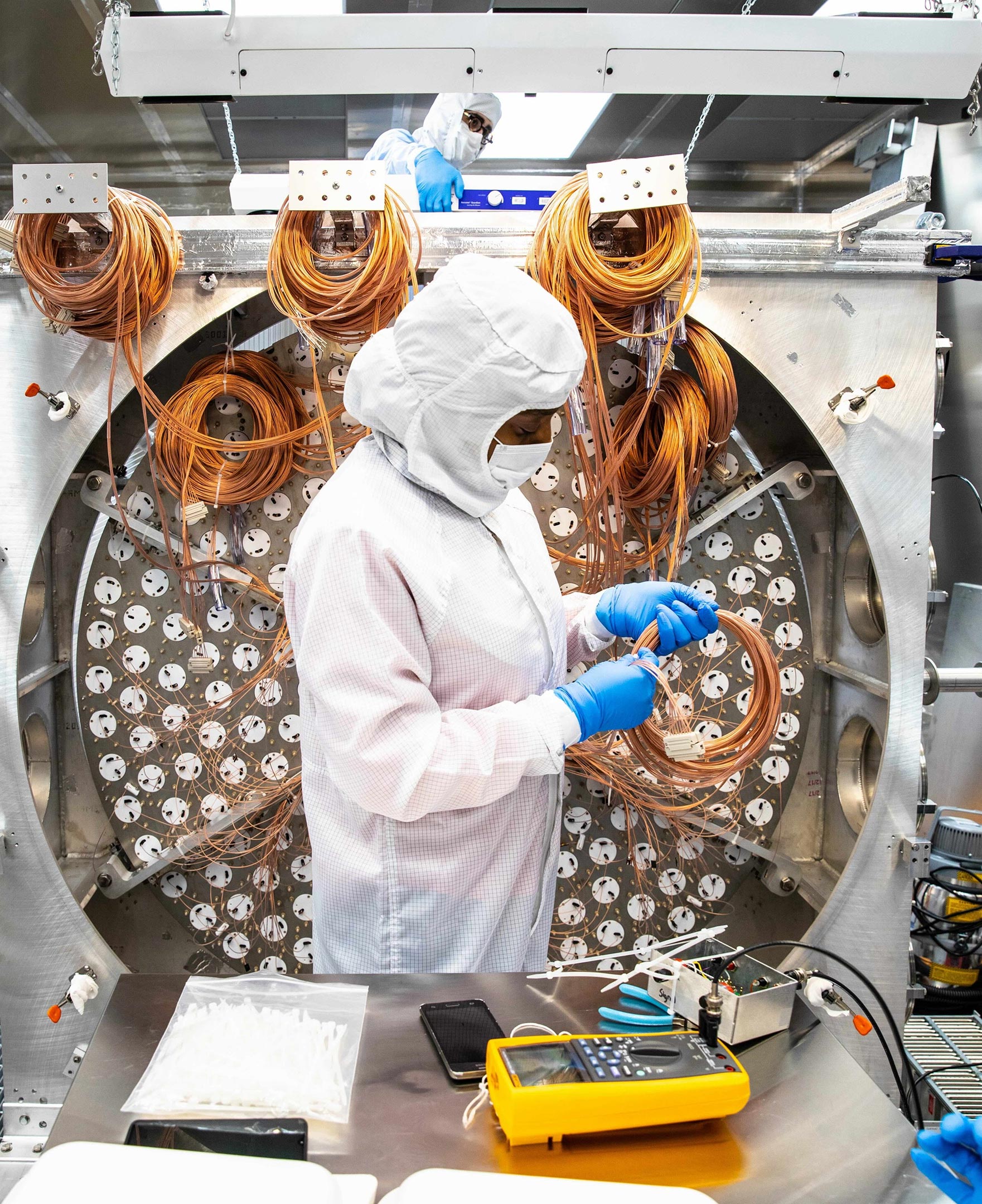
LZ’s sensitivity comes from the myriad ways the detector can reduce backgrounds, the false signals that can impersonate or hide a dark matter interaction. Deep underground, the detector is shielded from cosmic rays coming from space. To reduce natural radiation from everyday objects, LZ was built from thousands of ultraclean, low-radiation parts. The detector is built like an onion, with each layer either blocking outside radiation or tracking particle interactions to rule out dark matter mimics. And, sophisticated new analysis techniques help rule out background interactions.
UCSB was one of the founding groups in LZ, led by UCSB physicist Harry Nelson, who hosted the first LZ meeting at UCSB in 2012. The team currently consists of faculty members Lippincott and Nelson, postdoctoral researchers Chami Amarasinghe and TJ Whitis, and graduate students Jeonghwa Kim, Makayla Trask, Lindsey Weeldreyer, and Jordan Thomas. Other contributors to the result include recent Ph.D. recipient Jack Bargemann, now a postdoctoral researcher at Pacific Northwest National Laboratory, and former undergraduate researcher; Tarun Advaith Kumar, now a graduate student at the Perimeter Institute. The physics coordinator for the result was Scott Haselschwardt, who received his Ph.D. from UCSB in 2018 and is now an assistant professor at the University of Michigan.
Neutrons: The Tricky Impostors
Neutrons, subatomic particles that exist in every atom save hydrogen, are among the most common confounders of WIMP signals. Nelson and UCSB led the design of LZ’s Outer Detector, the critical component that allows the collaboration to rule out these particles and enable a real discovery.
“The tricky thing about neutrons is that they also interact with the xenon nuclei, giving off a signal identical to what we expect from WIMPs,” Trask said. “The OD is excellent at detecting neutrons, and confirms a WIMP detection by not having any response.” Presence of a pulse in the OD can veto an otherwise perfect candidate for a WIMP detection.
Radon and Other Mimics of Dark Matter
Radon is also a WIMP mimic, for which the scientists must be vigilant. “Radon undergoes a particular sequence of decays, some of which could be mistaken for
WIMPs,” Bargemann said. “One of the things we were able to do in this run was look out for the whole set of decays in the detector to identify the radon and avoid confusing them for WIMPs.”
Salting the Data: Avoiding Human Bias
To enable a strong result and eliminate unconscious bias, the LZ collaboration applied a technique called “salting,” which adds fake WIMP signals during data collection. By camouflaging the real data until “unsalting” at the very end, researchers can avoid unconscious bias and keep from overly interpreting or changing their analysis.
“We’re pushing the boundary into a regime where people have not looked for dark matter before,” said Haselschwardt. “There’s a human tendency to want to see patterns in data, so it’s really important when you enter this new regime that no bias wanders in. If you make a discovery, you want to get it right.”
Narrowing the Field: Toward New Possibilities
With these results, the field of possibilities for what WIMPs may be has narrowed dramatically, allowing all scientists searching for dark matter to better focus their searches and reject incorrect models of how the universe operates. It’s a long game, with more data collection in the future and one that will do more than accelerate the search for dark matter.
“Our experiment is also sensitive to rare events with roots in diverse areas of physics,” Amarasinghe said. “Some examples are solar neutrinos, the fascinating decays of certain xenon isotopes, and even other types of dark matter. With the intensity of this result behind us, I’m very excited to spend more time on these searches.”
“The UCSB Physics Department has a long history of devising searches for dark matter, starting with one of the first published results of a search in 1988,” Nelson said. Previous faculty members include David Caldwell (now deceased), and Michael Witherell, now director of the Lawrence Berkeley Laboratory. David Hale (now retired) pioneered many of the techniques for suppressing fake dark matter signals which are now employed throughout the field of dark matter searches. “UCSB, through the Physics Department, the College of Letters and Science, the administration, and through private donations, has strongly supported the dark matter effort for decades, and made substantial contributions to LZ.”
A Global Collaboration Looking Ahead
LZ is a collaboration of roughly 250 scientists from 38 institutions in the United States, the United Kingdom, Portugal, Switzerland, South Korea, and Australia; much of the work building, operating, and analyzing the record-setting experiment is done by early-career researchers. The collaboration is already looking forward to analyzing the next data set and using new analysis tricks to look for even lower-mass dark matter. Scientists are also thinking through potential upgrades to further improve LZ, and planning for a next-generation dark matter detector called XLZD.
LZ is supported by the U.S. Department of Energy, Office of Science, Office of High Energy Physics and the National Energy Research Scientific Computing Center, a DOE Office of Science user facility. LZ is also supported by the Science & Technology Facilities Council of the United Kingdom; the Portuguese Foundation for Science and Technology; the Swiss National Science Foundation, and the Institute for Basic Science, Korea. More than 38 institutions of higher education and advanced research provided support to LZ. The assistance of the Sanford Underground Research Facility has at all times been critical for UCSB efforts to LZ.
Reference: “Dark Matter Search Results from 4.2 Tonne−Years of Exposure of the LUX-ZEPLIN (LZ) Experiment” by J. Aalbers, D. S. Akerib, A. K. Al Musalhi, F. Alder, C. S. Amarasinghe, A. Ames, T. J. Anderson, N. Angelides, H. M. Araújo, H. M. Araújo, J. E. Armstrong, M. Arthurs, A. Baker, S. Balashov, J. Bang, J. W. Bargemann, E. E. Barillier, D. Bauer, K. Beattie, T. Benson, A. Bhatti, A. Biekert, T. P. Biesiadzinski, H. J. Birch, E. Bishop, G. M. Blockinger, B. Boxer, C. A. J. Brew, P. Brás, S. Burdin, M. Buuck, M. C. Carmona-Benitez, M. Carter, A. Chawla, H. Chen, J. J. Cherwinka, Y. T. Chin, N. I. Chott, M. V. Converse, R. Coronel, A. Cottle, G. Cox, D. Curran, C. E. Dahl, I. Darlington, S. Dave, A. David, J. Delgaudio, S. Dey, L. de Viveiros, L. Di Felice, C. Ding, J. E. Y. Dobson, E. Druszkiewicz, S. Dubey, S. R. Eriksen, A. Fan, S. Fayer, N. M. Fearon, N. Fieldhouse, S. Fiorucci, H. Flaecher, E. D. Fraser, T. M. A. Fruth, R. J. Gaitskell, A. Geffre, J. Genovesi, C. Ghag, A. Ghosh, R. Gibbons, S. Gokhale, J. Green, M. G. D. van der Grinten, J. J. Haiston, C. R. Hall, T. J. Hall, S. Han, E. Hartigan-O’Connor, S. J. Haselschwardt, M. A. Hernandez, S. A. Hertel, G. Heuermann, G. J. Homenides, M. Horn, D. Q. Huang, D. Hunt, E. Jacquet, R. S. James, J. Johnson, A. C. Kaboth, A. C. Kamaha, Meghna K. K., D. Khaitan, A. Khazov, I. Khurana, J. Kim, Y. D. Kim, J. Kingston, R. Kirk, D. Kodroff, L. Korley, E. V. Korolkova, H. Kraus, S. Kravitz, L. Kreczko, V. A. Kudryavtsev, C. Lawes, D. S. Leonard, K. T. Lesko, C. Levy, J. Lin, A. Lindote, W. H. Lippincott, M. I. Lopes, W. Lorenzon, C. Lu, S. Luitz, P. A. Majewski, A. Manalaysay, R. L. Mannino, C. Maupin, M. E. McCarthy, G. McDowell, D. N. McKinsey, J. McLaughlin, J. B. McLaughlin, R. McMonigle, E. Mizrachi, A. Monte, M. E. Monzani, J. D. Morales Mendoza, E. Morrison, B. J. Mount, M. Murdy, A. St. J. Murphy, A. Naylor, H. N. Nelson, F. Neves, A. Nguyen, C. L. O’Brien, I. Olcina, K. C. Oliver-Mallory, J. Orpwood, K. Y Oyulmaz, K. J. Palladino, J. Palmer, N. J. Pannifer, N. Parveen, S. J. Patton, B. Penning, G. Pereira, E. Perry, T. Pershing, A. Piepke, Y. Qie, J. Reichenbacher, C. A. Rhyne, A. Richards, Q. Riffard, G. R. C. Rischbieter, E. Ritchey, H. S. Riyat, R. Rosero, T. Rushton, D. Rynders, D. Santone, A. B. M. R. Sazzad, R. W. Schnee, G. Sehr, B. Shafer, S. Shaw, T. Shutt, J. J. Silk, C. Silva, G. Sinev, J. Siniscalco, R. Smith, V. N. Solovov, P. Sorensen, J. Soria, I. Stancu, A. Stevens, K. Stifter, B. Suerfu, T. J. Sumner, M. Szydagis, D. R. Tiedt, M. Timalsina, Z. Tong, D. R. Tovey, J. Tranter, M. Trask, M. Tripathi, A. Usón, A. Vacheret, A. C. Vaitkus, O. Valentino, V. Velan, A. Wang, J. J. Wang, Y. Wang, J. R. Watson, L. Weeldreyer, T. J. Whitis, K. Wild, M. Williams, W. J. Wisniewski, L. Wolf, F. L. H. Wolfs, S. Woodford, D. Woodward, C. J. Wright, Q. Xia, J. Xu, Y. Xu, M. Yeh, D. Yeum, W. Zha and E. A. Zweig, 1 July 2025, Physical Review Letters.
DOI: 10.1103/4dyc-z8zf
Never miss a breakthrough: Join the SciTechDaily newsletter.
Follow us on Google and Google News.
6 Comments
Dark energy is chrotonic energy- the energy of the time field. 1.69×10-53 Joules is the quantized unit. Dark matter is field tension. This field powers everything. Time isn’t the stage, it’s the dancer.
Dilation is real, not relative. To affect the aging of both biological and mechanical processes requires energy. It is like an apple and piece of cake. The can have identical mass, but the cake is more energy dense. This isn’t unlike field compression due to gravity or velocity. The field compresses allowing the atom to pull less energy for an identical affect.
WIMPs are likely the temporal unit. The best way to find it might be to look for missing energy in celestial events, or the near c difference of muons.
Time isn’t the stage, it’s the dancer.
VERY GOOD!
That can be space and time are not the stage, they are the dancers.
Topological Vortex Theory (TVT) proposes and argues that absolute space is a fundamental physical entity with specific physical properties, rather than a purely philosophical concept or abstract background. Its ideal fluid characteristics—incompressibility, inviscidity, and isotropy—provide the foundational framework for material motion and spacetime structure. Through topological phase transitions, absolute space evolves into diverse spacetime manifolds, and in this process, time is born. Time possesses absoluteness, relativity, and periodicity, rooted in the intrinsic spin of topological vortices.
——Excerpted from https://zhuanlan.zhihu.com/p/1930897490367973024.
Please ask researchers to think deeply:
Where does the intrinsic spin of a particle come from?
Based on the Topological Vortex Theory (TVT), space is an incompressible physical entity, and space-time vortices are the products of topological phase transitions at critical points in space. They create all things and shape the world through spin and self-organization.
You guys keeping thinking the things are real and divorced from what the things are made up of – when the ‘things’ are ideas you have.
The two sets of cobalt-60 rotating in opposite directions are two mirror images of each other, which should be very realistic for you. OK!
More is different. In the world of topological vortex interactions, even two hydrogen atoms are difficult to be exactly the same, let alone two sets of cobalt-60. It’s really arrogant to artificially rotate them in reverse to verify natural laws.