
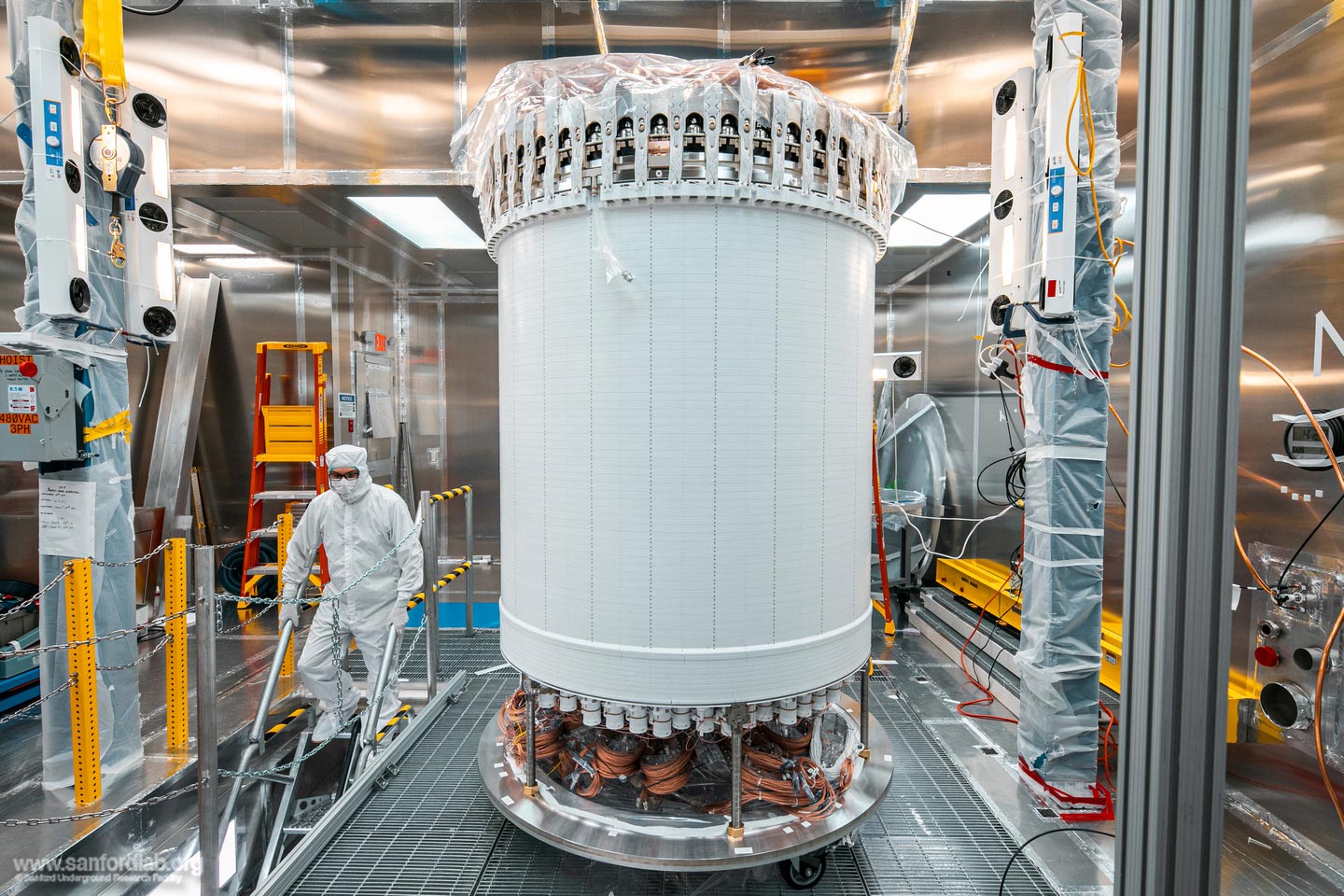
New results from the world’s most sensitive dark matter detector put the best-ever limits on particles called WIMPs, a leading candidate for what makes up our universe’s invisible mass.
- With 280 days of data, the LUX-ZEPLIN (LZ) collaboration has made a world-leading search for weakly interacting massive particles (WIMPs) in areas no experiment has probed before.
- The new result is nearly five times better than the previous world’s best published result and finds no evidence of WIMPs above a mass of 9 GeV/c2.
- Researchers have only scratched the surface of what LZ can do. With the detector’s exceptional sensitivity and their advanced analysis techniques, the collaboration is primed to discover dark matter if it exists within the experiment’s reach and to explore other rare physics phenomena.
Dark Matter and LUX-ZEPLIN (LZ)
Figuring out the nature of dark matter, the invisible substance that makes up most of the mass in our universe, is one of the greatest puzzles in physics. New results from the world’s most sensitive dark matter detector, LUX-ZEPLIN (LZ), have narrowed down possibilities for one of the leading dark matter candidates: weakly interacting massive particles, or WIMPs.
LZ, led by the Department of Energy’s Lawrence Berkeley National Laboratory (Berkeley Lab), hunts for dark matter from a cavern nearly one mile underground at the Sanford Underground Research Facility in South Dakota. The experiment’s new results explore weaker dark matter interactions than ever searched before and further limit what WIMPs could be.
Achievements and Constraints of LZ
“These are new world-leading constraints by a sizable margin on dark matter and WIMPs,” said Chamkaur Ghag, spokesperson for LZ and a professor at University College London (UCL). He noted that the detector and analysis techniques are performing even better than the collaboration expected. “If WIMPs had been within the region we searched, we’d have been able to robustly say something about them. We know we have the sensitivity and tools to see whether they’re there as we search lower energies and accrue the bulk of this experiment’s lifetime.”
The collaboration found no evidence of WIMPs above a mass of 9 gigaelectronvolts/c2 (GeV/c2). (For comparison, the mass of a proton is slightly less than 1 GeV/c2.) The experiment’s sensitivity to faint interactions helps researchers reject potential WIMP dark matter models that don’t fit the data, leaving significantly fewer places for WIMPs to hide. The new results were presented at two physics conferences on August 26: TeV Particle Astrophysics 2024 in Chicago, Illinois, and LIDINE 2024 in São Paulo, Brazil. A scientific paper will be published in the coming weeks.
Deep Dive into LZ’s Experimental Approach
The results analyze 280 days’ worth of data: a new set of 220 days (collected between March 2023 and April 2024) combined with 60 earlier days from LZ’s first run. The experiment plans to collect 1,000 days’ worth of data before it ends in 2028.
“If you think of the search for dark matter like looking for buried treasure, we’ve dug almost five times deeper than anyone else has in the past,” said Scott Kravitz, LZ’s deputy physics coordinator and a professor at the University of Texas at Austin. “That’s something you don’t do with a million shovels – you do it by inventing a new tool.”
Innovations and Techniques in Dark Matter Detection
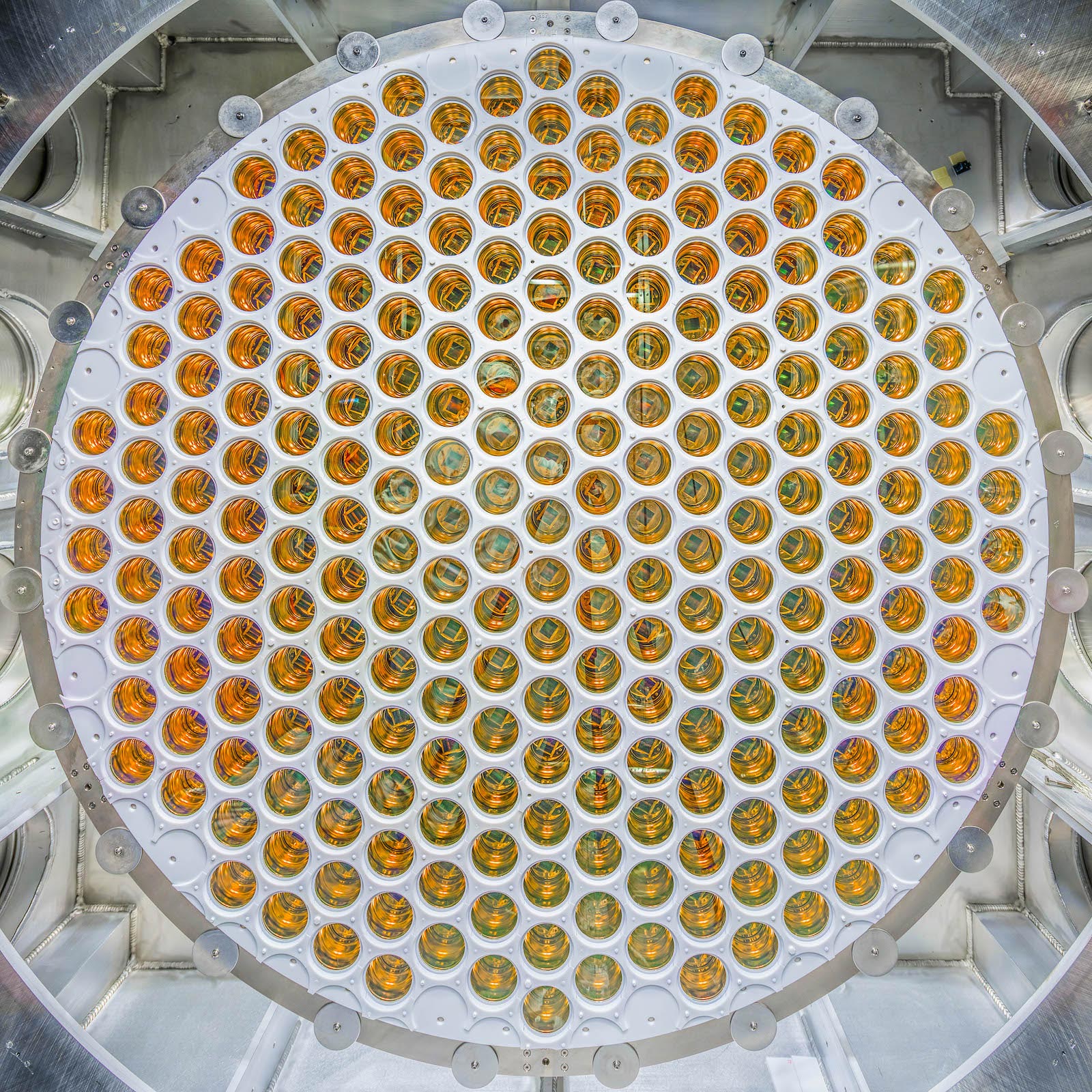
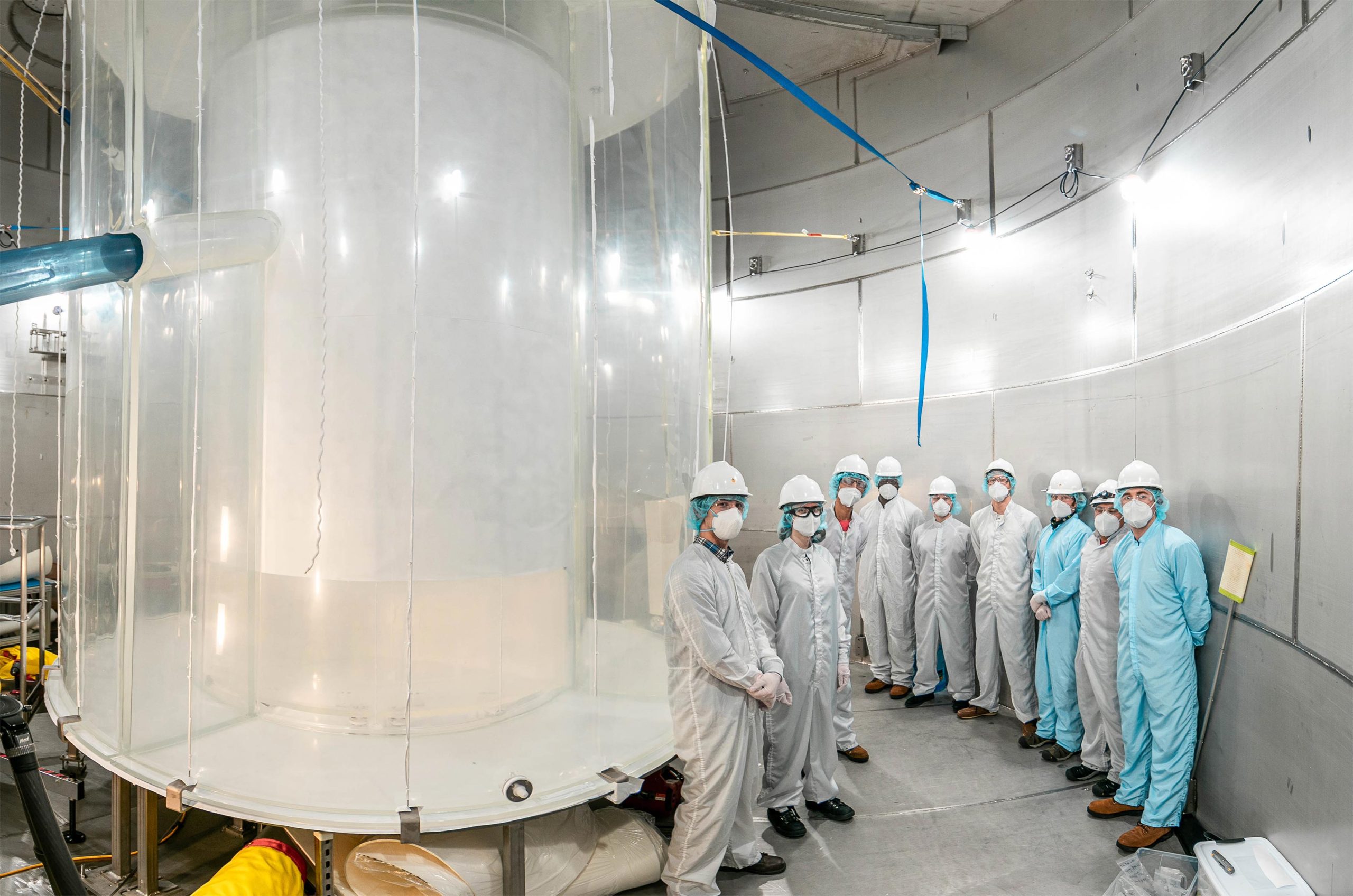
LZ’s sensitivity comes from the myriad ways the detector can reduce backgrounds, the false signals that can impersonate or hide a dark matter interaction. Deep underground, the detector is shielded from cosmic rays coming from space. To reduce natural radiation from everyday objects, LZ was built from thousands of ultraclean, low-radiation parts. The detector is built like an onion, with each layer either blocking outside radiation or tracking particle interactions to rule out dark matter mimics. And sophisticated new analysis techniques help rule out background interactions, particularly those from the most common culprit: radon.
This result is also the first time that LZ has applied “salting” – a technique that adds fake WIMP signals during data collection. By camouflaging the real data until “unsalting” at the very end, researchers can avoid unconscious bias and keep from overly interpreting or changing their analysis.
“We’re pushing the boundary into a regime where people have not looked for dark matter before,” said Scott Haselschwardt, the LZ physics coordinator and a recent Chamberlain Fellow at Berkeley Lab who is now an assistant professor at the University of Michigan. “There’s a human tendency to want to see patterns in data, so it’s really important when you enter this new regime that no bias wanders in. If you make a discovery, you want to get it right.”
The Significance of Dark Matter
Dark matter, so named because it does not emit, reflect, or absorb light, is estimated to make up 85% of the mass in the universe but has never been directly detected, though it has left its fingerprints on multiple astronomical observations. We wouldn’t exist without this mysterious yet fundamental piece of the universe; dark matter’s mass contributes to the gravitational attraction that helps galaxies form and stay together.
LZ uses 10 tonnes of liquid xenon to provide a dense, transparent material for dark matter particles to potentially bump into. The hope is for a WIMP to knock into a xenon nucleus, causing it to move, much like a hit from a cue ball in a game of pool. By collecting the light and electrons emitted during interactions, LZ captures potential WIMP signals alongside other data.
“We’ve demonstrated how strong we are as a WIMP search machine, and we’re going to keep running and getting even better – but there’s lots of other things we can do with this detector,” said Amy Cottle, lead on the WIMP search effort and an assistant professor at UCL. “The next stage is using these data to look at other interesting and rare physics processes, like rare decays of xenon atoms, neutrinoless double beta decay, boron-8 neutrinos from the sun, and other beyond-the-Standard-Model physics. And this is in addition to probing some of the most interesting and previously inaccessible dark matter models from the last 20 years.”
Future Directions and Collaborative Efforts
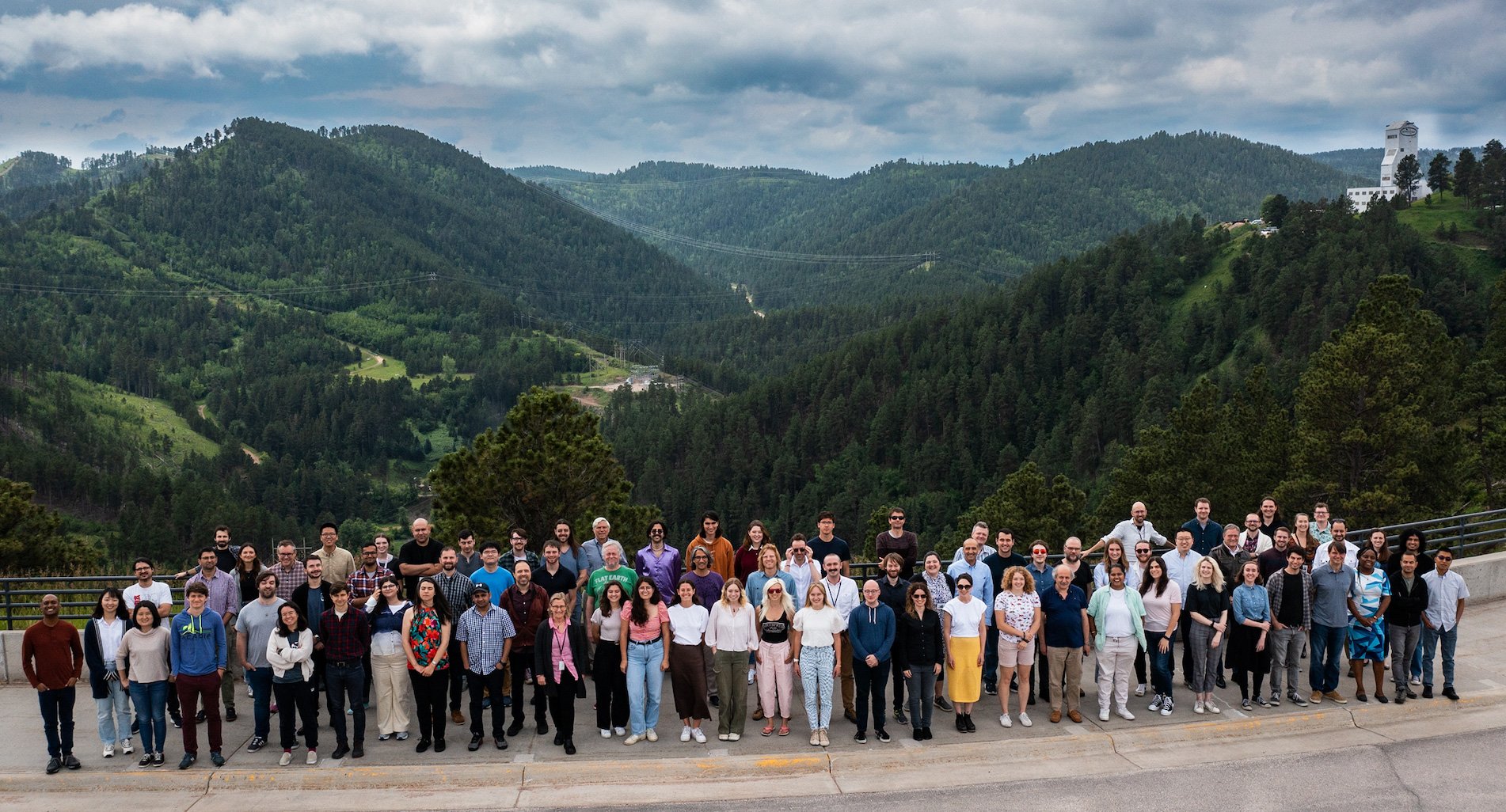
LZ is a collaboration of roughly 250 scientists and engineers from 38 institutions in the United States, United Kingdom, Portugal, Switzerland, South Korea, and Australia; much of the work building, operating, and analyzing the record-setting experiment is done by early career researchers. The collaboration is already looking forward to analyzing the next data set and using new analysis tricks to look for even lower-mass dark matter. Scientists are also thinking through potential upgrades to further improve LZ, and planning for a next-generation dark matter detector called XLZD.
“Our ability to search for dark matter is improving at a rate faster than Moore’s Law,” Kravitz said. “If you look at an exponential curve, everything before now is nothing. Just wait until you see what comes next.”
Meeting: TeV Particle Astrophysics 2024
LZ is supported by the U.S. Department of Energy, Office of Science, Office of High Energy Physics and the National Energy Research Scientific Computing Center, a DOE Office of Science user facility. LZ is also supported by the Science & Technology Facilities Council of the United Kingdom; the Portuguese Foundation for Science and Technology; the Swiss National Science Foundation, and the Institute for Basic Science, Korea. Over 38 institutions of higher education and advanced research provided support to LZ. The LZ collaboration acknowledges the assistance of the Sanford Underground Research Facility.
Never miss a breakthrough: Join the SciTechDaily newsletter.
Follow us on Google and Google News.
26 Comments
Closing In on Dark Matter: LUX-ZEPLIN Time Projection Chamber Sets New Limits.
VERY GOOD!!!
Please ask researchers to think deeply:
What is the theoretical basis of dark matter?
Scientific research guided by correct theories can help humanity avoid detours, failures, and pomposity. Please witness the exemplary collaboration between theoretical physicists and experimentalists (https://scitechdaily.com/microscope-spacecrafts-most-precise-test-of-key-component-of-the-theory-of-general-relativity/#comment-854286). Some people in contemporary physics has always lived in a self righteous children’s story world. Whose values have been overturned by such a comical and ridiculous reality?
From Physical Review Letters (PRL), to Nature, and Science, even the Proceedings of the National Academy of Sciences (PNAS), the so-called academic journals firmly believe that two high-dimensional spacetime objects (such as two sets of cobalt-60) rotating in opposite directions can be transformed into two objects that mirror each other, and that the asymmetry between the amount of created matter and antimatter led to the matter-dominated Universe as we know it today.
Does the facts tell the so-called academic journals that two sets of cobalt-60 rotating in opposite directions can be transformed into two objects that mirror each other? Does mathematics tell the so-called academic journals that matter and antimatter are asymmetric? When physics no longer believes in facts and mathematics, it is no different from theology.
Naked walkers never consider themselves ugly, but rather consider themselves cool.
Space has physical properties of zero viscosity and absolute incompressibility. Zero viscosity and absolute incompressibility are physical characteristics of ideal fluids. The space with ideal fluid physical characteristics forms vortices via topological phase transitions, which is not difficult to understand mathematically. Once the topological vortex is formed, it occupies space and maintains its presence in time. This is the transition from chaos to order via two bidirectional coupled continuous chaotic systems.
From cosmic accretion disks to particle spins, topological vortex fractal structures are ubiquitous. Symmetry of topological vortex can be used to explore particle behavior under spatial, temporal, and quantum reversals, involving gravitation, discrete and continuous changes. It underpins the consistency of natural laws and experiment reproducibility.
The physical phenomena observed in scientific experiments are always just appearances, not the natural essence of things. The natural essence of things needs to be extracted and sublimated based on natural phenomena via mathematical theories. Mathematics is the main environment for modeling problems in other areas. Observations and experiments, theory, and modeling reinforce each other and together lead to our understanding of physical phenomena. After understanding and mastering the natural essence of things, humans can predict more possible natural phenomena, and even manipulate and implement them.
In Jeremiah 23:24 God asks the young prophet the redundant question, “Do I not fill heaven and Earth?”
I can’t claim to know very much about theoretical physics in particular, but I find science fascinating and I enjoy reading scientific articles in my free time. I do find it interesting whenever I read seemingly contradicting news headlines referring to dark matter and current scientific studies regarding it. I believe it probably isn’t going too far to say that modern science has a habit of treating long held theories as fact—but I may disagree with radicalists when I say that this probably isn’t the end of the world. It isn’t as if we are applying concepts from theoretical physics to more concrete fields of science, without first rigorously applying the scientific method and allowing for new discoveries over time. I think it’s good that theoretical physicists and those studying closely related fields of science are able to pursue large-scale experiments like this, even if some may take issue with the fact that the basis for the study has not yet been proven without a shadow of a doubt. Until such an experiment happens to disprove a theory like the existence and properties of dark matter, theoretical physics is absolutely necessary for the furthering of discoveries in the field of physics.
Very good! May I ask a few questions:
1. How do you distinguish between science and pseudoscience?
2. How do you understand classical physics and quantum physics?
3. How do you determine the scientificity of the reading material you have chosen?
4. How do you view this short article (https://scitechdaily.com/microscope-spacecrafts-most-precise-test-of-key-component-of-the-theory-of-general-relativity/#comment-854286)?
Answer to question 1: when Bao-hua zhang posts something, I know that it is 100% pseudo-science mumbo-jumbo.
Answer correctly. 100 points.
The perfect spokesperson for Physical Review.
It is demonstrably going too far to say that modern science has a habit of treating long held theories as fact, as science works,
And dark matter has been observed and theory supported in tests of both repeatedly and far above the 5 sigma limit that physicists agree is “beyond reasonable doubt”. No science will ever “prove” – that is for mathematics – something “without a shadow of a doubt”, that is not how we statistically quantify observations and hypothesis tests. But again, it works.
Thanks for treating us to another vomit puddle of your schizophrenic word salad. Go peddle your pseudo-science elsewhere.
Truly outstanding talents and representatives cultivated by Physical Review. First class morality. First class intelligence. First class academic leadership.
Matter-antimatter asymmetry has nothing to do with the existence and nature of dark matter, which is a well tested fact and – as part of the dark ebergy-dark matter (LCDM) cosmology a well tested theory.
Your speculations on space are demonstrably wrong, space is gravitationally stiff but not incompressible or we would not observe gravitational waves. And we don’t see “topological vortex fractal structures” existing in nature, just in your unsupportable comments.
It can be certain that the things you don’t see in nature far exceed what you can see.
Please think deeply:
1. Didn’t you see that it must be a scientific reason?
2. Is not feeling it or not hearing it also a scientific reason?
3. If humans lack sensation, perception, and hearing, or perish, would the universe cease to exist?
Your declarations and actions are using facts to illustrate that Physical Review and their so-called academic publications are destroying science.
Low dimensional spacetime matter is the substructure of high-dimensional spacetime matter. Topological vortices and their antivortices have identical spatiotemporal structures. The synchronous effect of countless topological vortex fractal structures makes spatiotemporal motion more complex. Symmetry is mainly manifested between topological vortices and their antivortices, rather than between the high-dimensional spacetime objects formed by their interactions. In theory, it is difficult for two protein molecules, two atoms, or even any observable high-dimensional spacetime objects to be absolutely identical or symmetrical.
To deny the scientificity of low dimensional spacetime matter is essentially to deny the value of mathematics to science.
In Jeremiah 23:24 God asks the young Prophet,”Do I not fill heaven and Earth?”
I’m not sure why you spam a science site with excerpts from the mythological texts of your personal choice of organized superstition. It would be kinder to science readers to not do so.
But I would like to point out that the topic is ill chosen, dark matter is part of the dark matter-dark energy cosmology that has since 2016 robustly and beyond reasonable doubt shown that the space expansion process that produces the universe is entirely natural. Hence your type of spammed proposed magic, or any type of magic, does not exist.
In 2012 for less than US $25 I reinvented the wheel making it wooden and rectangular and uploaded a video demonstrating that, regardless of material or shape, rotation intensifies radiating locally generated pulsing angular lines of gravity force to make my ‘wheel’ move in predictable ways, already dogmatized with archaic labels that only identify what motions are being observed, without explaining them. I think the biggest lesson to be learned from the experiment is just how far backwards in time huge grants can take professional researchers. “1Gravity:” https://odysee.com/@charlesgshaver:d/1Gravity:8
I guess nobody visits your pathetic website, so you have to do these shameless plugs?
I agree TheHeck with you above but, as before I believe, you may be academically qualified to make that statement but not nearly insightful enough. And, I don’t derive any income from my ‘pathetic’ video channel. Lastly, for now, prove me wrong if you/your profession can.
Your comment has nothing to do with the existence and nature of dark matter, which is a well tested fact and – as part of the dark ebergy-dark matter (LCDM) cosmology a well tested theory.
Unless you propose a new theory of gravity that can predict all what we see in general relativity and more (to be the replacement). It is *you* who must show (not “prove”) that you are correct, in peer reviewed physics publications.
Can peer review represent science?
You have been waving the ugliest fig leaf in the history of science.
I mostly agree with your comments to Joyce but when it comes to gravity I don’t believe I have any peers, partly because I dropped-out of community college in 1973 to not become one of ‘them.’
As a primarily diagnostic industrial electrician mostly troubleshooting breakdowns on production shifts spanning some thirty years, from relay logic and manual motor starters to PLCs and stepper motors until retiring two decades early on externally imposed disability, similar to the so-called “science” of dark matter, dark energy and gravity waves I’ve seen industrial computers develop self-replicating ‘glitches’ (e.g., not as well protected from thunderstorms as intended) which would often require a ‘power-down-reset’ before performing reliably again. As part of observing the current glitches in cosmology, I found concurrent with LIGO detecting their first alleged “gravity wave” there was a volcanic eruption on a Japanese island; wrote them, no reply.
There appears to be an unwritten law in higher education that the findings/opinions of blue-collar and lay people don’t count. Einstein may have been a genius when it came to matter and energy but he got it wrong about gravity, probably because of the initial glitch that accompanied misinterpretation of the first double-slit experiments; duality. So-called “modern” science has done a marvelous job of building upon that self-replicating glitch but it’s about time for a reset in the form of a truly scientifically objective review of duality, dark matter, dark energy and gravity waves. Pick up a wheel with an extended axle, spin it and ‘feel the pull.’ It’s real, it’s reliable and a lot less costly to prove. Finding time and again I’m not eligible as a lone-lay-investigator for any huge research grants, I accidentally discovered the true nature of gravity in 2009 but took until 2012 to devise my first experiments and upload my first video. Again, prove me wrong, if you can. Anecdotally, genius is discovered, not learned.
Please witness the exemplary collaboration between theoretical physicists and experimentalists (https://scitechdaily.com/microscope-spacecrafts-most-precise-test-of-key-component-of-the-theory-of-general-relativity/#comment-854286).
TheHeck, best wishes to you.
It is the existence of a highly intelligent group like you that has enabled pseudo academic publications like Physics Review to dominate for half a century and continue to do so.
It’s Physical Review, not Physics Review.
The Moore Law analog is partly comforting, else these experiments are somewhat frustrating by now. As xenon experiments tend to stop at several GeV/c^2 they don’t probe the neutrino sector with the sterile WIMP candidates at 1-2 MeV/c^2. (Set by interactions with gravity and time to have galaxies, unless they are somehow protected like the Higgs sector.)
In that sense these experiments looks like the LEP experiment that could exclude Higgs masses just shy of the actual mass. I’m happy with massive supersymmetry WIMP exclusion here (and partly in LHC and electron sphericity experiments). But it is also frustrating, I wish they came up with experiments that directly target the least extended – so perhaps most likely – Standard Model candidate. Instead general experiments target everything else, much lighter axion and much heavier supersymmetry candidates, both possible but less likely (as axions are now too light for cosmology and supersymmetry now too massive for accelerators).
Your knowledge of physics is indeed profound. I had seen you have been waving the Peer Review -that is one of the ugliest fig leaf in the history of science.
Please witness the exemplary collaboration between theoretical physicists and experimentalists (https://scitechdaily.com/microscope-spacecrafts-most-precise-test-of-key-component-of-the-theory-of-general-relativity/#comment-854286).
Seems to me that dark matter is just a glorified handwave for every discrepancy and mismatch in observable astrophysics.
They’ll never find jack.