
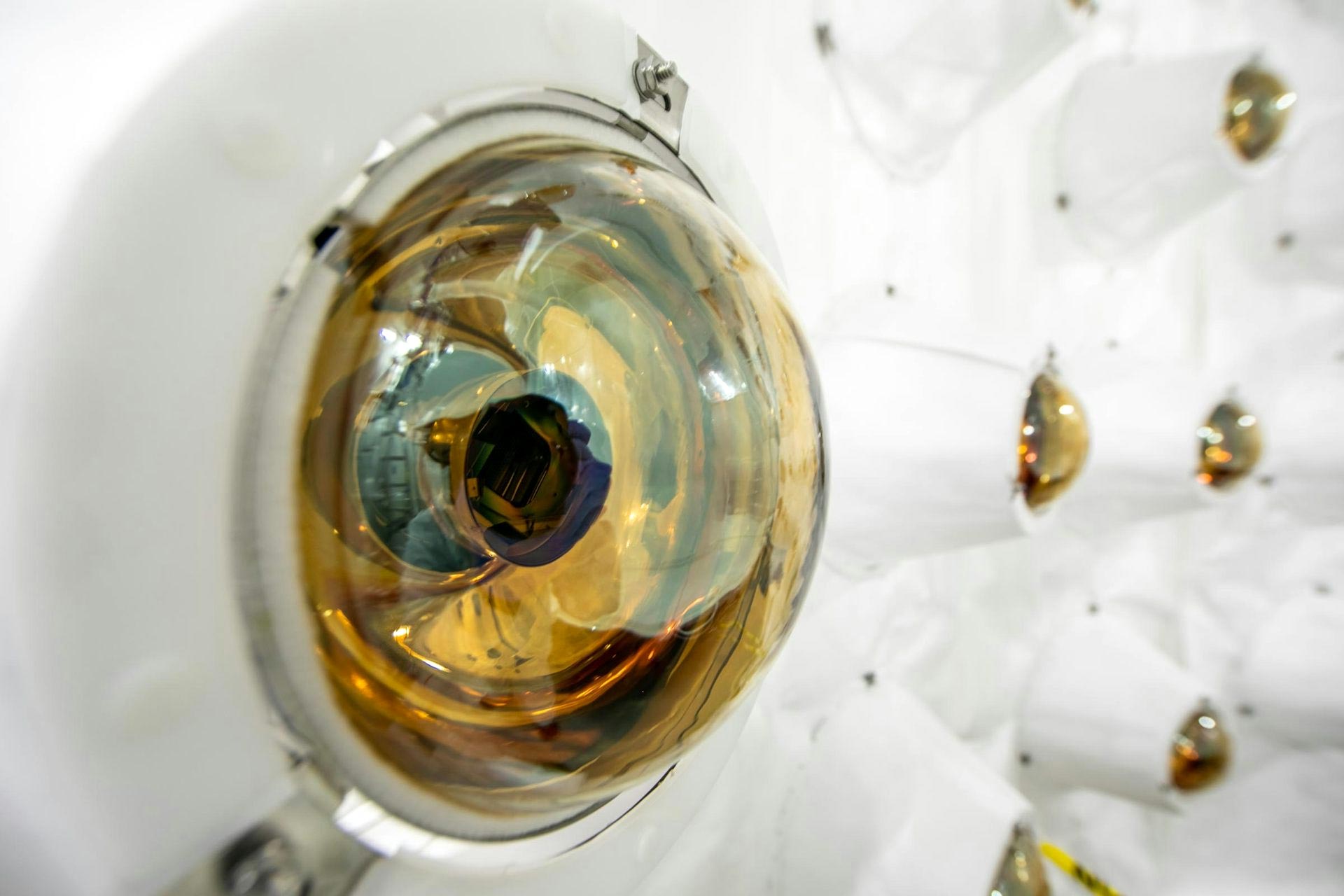
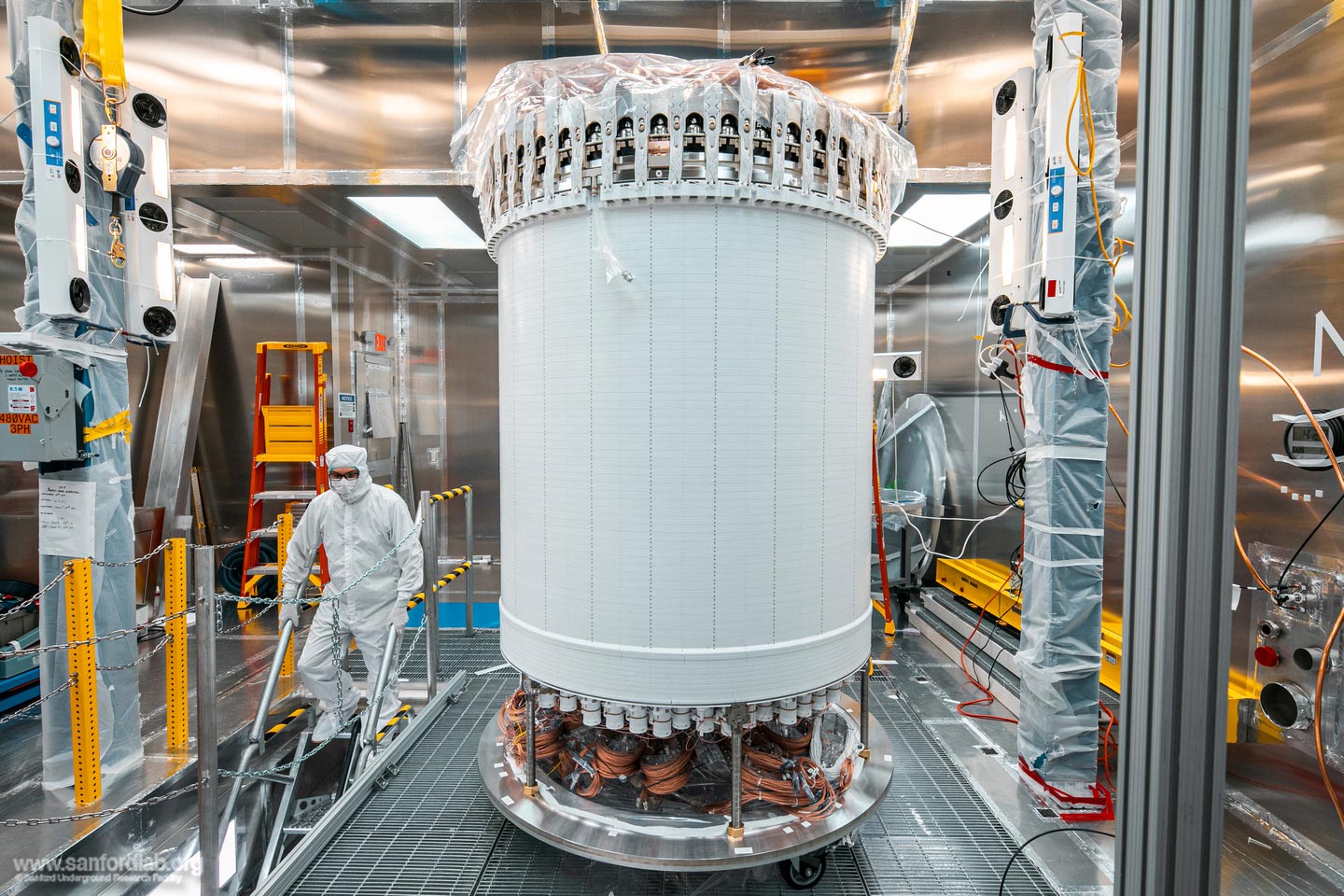
The LZ dark matter experiment continues its quest to detect dark matter, utilizing a large xenon tank to capture rare particle interactions deep underground.
Although no dark matter particles have been identified, the experiment has refined the search by excluding numerous potential particle properties.
Dark Matter Mysteries
Most of the matter in the universe is missing. Scientists believe around 85% of the matter in the cosmos is made of invisible dark matter, which has only been detected indirectly by its gravitational effects on its surroundings.
My colleagues and I – a team of some 250 scientists from around the world working on a dark matter experiment called LUX-ZEPLIN (or LZ) – reported our latest findings from the long quest to discover exactly what this dark matter is made of.
Latest Findings in Dark Matter Research
We have not yet found the elusive particles we believe dark matter consists of, but we have set the tightest limits yet on their properties. We have also shown our detector is working as expected – and should produce even better results in the future.
Our results were reported on August 26 at the TeV Particle Astrophysics 2024 conference in Chicago and the LIDINE 2024 conference in São Paulo, Brazil. A journal paper will be submitted for peer review in the coming weeks.
What Is Dark Matter?
When astronomers look at the universe, they see evidence that the visible matter of stars, gas and galaxies is not all there is. Many phenomena, such as how fast galaxies spin and the pattern of the residual glow of the Big Bang, can only be explained by the presence of large amounts of some invisible substance – dark matter.
So what is this dark matter made of? We currently don’t know of any kind of particle that could explain these astronomical observations.
There are dozens of theories that aim to explain dark matter observations, ranging from exotic unknown particles to tiny black holes or fundamental changes to our theory of gravity. However, none of them has yet been proven correct.
The Role of WIMPs in Dark Matter
One of the most popular theories suggests dark matter is made up of so-called “weakly interacting massive particles” (or WIMPs). These relatively heavy particles could cause the observed gravitational effects and also – very rarely – interact with ordinary matter.
How would we know if this theory is correct? Well, we think these particles must be streaming through Earth all the time. For the most part, they will pass through without interacting with anything, but every so often a WIMP might crash directly into the nucleus of an atom – and these collisions are what we are trying to spot.
Detecting Dark Matter at Great Depths
The LZ experiment is located in an old goldmine about 1,500 meters below ground in South Dakota in the US. Placing the experiment deep underground helps to cut out as much background radiation as possible.
The experiment consists of a large double-walled tank filled with seven tonnes of liquid xenon, a noble gas chilled down to a temperature of 175 kelvin (–98°C).
If a dark matter particle smacks into a xenon nucleus, it should give off a tiny flash of light. Our detector has 494 light sensors to detect these flashes.
Scientists complete building the sensor array for the LZ experiment.
Challenges in Dark Matter Detection
Of course, dark matter particles aren’t the only things that can create these flashes. There is still some background radiation from the surroundings and even the materials of the tank and detectors themselves.
A big part of figuring out whether we are seeing signs of dark matter is disentangling this background radiation from anything more exotic. To do this, we make detailed simulations of the results we would expect to see with and without dark matter.
These simulations have been the focus of much of my part in the experiment, which began when I started my PhD in 2015. I also developed detector monitoring sensors and was responsible for the integration and commissioning of the central detector underground, which began collecting data in 2021.
Drawing the Net Tighter
Our latest results show no signs of dark matter. However, they let us rule out a lot of possibilities.
We found no traces of particles with masses above 1.6 × 10⁻²⁶ kilograms, which is about ten times as heavy as a proton.
These results are based on 280 days’ worth of observations from the detector. Eventually, we aim to collect 1,000 days’ worth – which will let us search for even more elusive potential dark matter particles.
Looking Forward: The Future of Dark Matter Experiments
If we’re lucky, we might find dark matter turns up in the new data. If not, we have already begun to make plans for a next generation dark matter experiment. The XLZD (XENON-LUX-ZEPLIN-DARWIN) consortium is aiming to build a detector almost ten times bigger that would allow us to trawl through even more of the space where these ubiquitous yet elusive particles may be hiding.
Written by Theresa Fruth, Lecturer in Physics, University of Sydney.
Adapted from an article originally published in The Conversation.
Never miss a breakthrough: Join the SciTechDaily newsletter.
Follow us on Google and Google News.
5 Comments
Closing In on Dark Matter Deep Underground: The Quest To Find the Universe’s Missing 85%. Stupid behavior and ugly mentality are truly astonishing.
It can be certain that the universe’s missing 85% is all around us, the things researchers don’t see in nature far exceed what they can see. Researchers really don’t need to dig caves around like mice.
Scientific research guided by correct theories can help humanity avoid detours, failures, and pomposity. Please witness the exemplary collaboration between theoretical physicists and experimentalists (https://scitechdaily.com/microscope-spacecrafts-most-precise-test-of-key-component-of-the-theory-of-general-relativity/#comment-854286). Some people in contemporary physics has always lived in a self righteous children’s story world. Whose values have been overturned by such a comical and ridiculous reality?
Low dimensional spacetime matter is the substructure of high-dimensional spacetime matter. Topological vortices and their antivortices have identical spatiotemporal structures. The synchronous effect of countless topological vortex fractal structures makes spatiotemporal motion more complex. One-dimensional or two-dimensional is mainly manifested between topological vortices and their antivortices, rather than between the high-dimensional spacetime matter formed by their interactions. In theory, it is difficult for any atoms, any electrons, or even any observable high-dimensional spacetime objects to be absolutely one-dimensional or two-dimensional.
The physical phenomena observed in scientific experiments are always just appearances, not the natural essence of things. The natural essence of things needs to be extracted and sublimated based on natural phenomena via mathematical theories. Mathematics is the main environment for modeling problems in other areas. Observations and experiments, theory, and modeling reinforce each other and together lead to our understanding of physical phenomena. After understanding and mastering the natural essence of things, humans can predict more possible natural phenomena, and even manipulate and implement them.
To deny the scientificity of low dimensional spacetime mathematical model (such as geometric shapes, topological vortices, etc.) is to deny the value of mathematics to science.
It can be certain that the universe’s missing 85% is all around us, the things researchers don’t see in nature far exceed what they can see.
Scientific research guided by correct theories can help humanity avoid detours, failures, and pomposity. Please witness the exemplary collaboration between theoretical physicists and experimentalists (https://scitechdaily.com/microscope-spacecrafts-most-precise-test-of-key-component-of-the-theory-of-general-relativity/#comment-854286). Some people in contemporary physics has always lived in a self righteous children’s story world. Whose values have been overturned by such a comical and ridiculous reality?
The synchronous effect of countless topological vortices makes spacetime motion complex, and the energy gaps formed by and between topological vortices are the linchpin to the evolution of vortices motion from low dimensional spacetime to high-dimensional spacetime.
The spin of topological vortices creates all things. The spin of topological vortices creates the world.
Physics should believe in the natural essence of low dimensional spacetime mathematical model (such as geometric shapes, topological vortices, etc.), rather than a cat that is both dead and alive and even two high-dimensional spacetime objects (such as two sets of cobalt-60) rotating in opposite directions can be transformed into two objects that mirror each other.
Interesting.
Talking about Detectors, how about building extremely sensitive detectors to detect Bacteria, Viruses and Pathogens which limit our life spans and cause disease, curable and incurable?
The same research being used to attempt to detect Dark Matter, can be adapted and Miniaturized and set up as Global Network to enable quick detection and prevention of the spread of deadly Pandemics we experienced as a Species in 2019?
Who thins that such esoteric research is not useful and a waste of precious resources? NOT ME!
Views expressed are personal and not binding on anyone.