

Close Menu
    Facebook X (Twitter) Instagram
    SciTechDaily
    • Biology
    • Chemistry
    • Earth
    • Health
    • Physics
    • Science
    • Space
    • Technology
    Facebook X (Twitter) Pinterest YouTube RSS
    SciTechDaily
    Home»Health»A Shocking Tool in the Fight Against Bladder Cancer: Anthrax
    Health

    A Shocking Tool in the Fight Against Bladder Cancer: Anthrax

    By Purdue UniversityNovember 12, 2019No Comments4 Mins Read
    Facebook Twitter Pinterest Telegram LinkedIn WhatsApp Email Reddit
    Share
    Facebook Twitter LinkedIn Pinterest Telegram Email Reddit
    Anthrax Sign
    The bladder has its own protective layer, which saves the good cells from the anthrax mixture but offers no protection for the cancer cells and tumors.

    Anthrax may soon help more people win the fight against bladder cancer, which the Centers for Disease Control and Prevention says strikes about 72,000 Americans each year and kills about 16,000, and is one of the most expensive cancers to treat.

    The current treatments for bladder cancer are invasive for patients — who often must sit for hours at a time with a bladder full of an agent designed to kill cancer cells and tumors. Bladder cancer also is one of the most reoccurring for people diagnosed with the disease.

    “We have seen outstanding results with our treatment. It is fast and effective, both of which are critical for people dealing with this devastating disease.” — R. Claudio Aguilar

    Now, researchers at Purdue University have come up with a way to combine the anthrax toxin with a growth factor to kill bladder cancer cells and tumors. The research is published in the October 4 edition of the International Journal of Cancer.

    “We have effectively come up with a promising method to kill the cancer cells without harming the normal cells in the bladder,” said R. Claudio Aguilar, an associate professor and the assistant head of biological sciences in Purdue’s College of Science. “It is basically like creating a special solution that targets cancer cells while leaving healthy cells alone.”
    Purdue Bladder Cancer
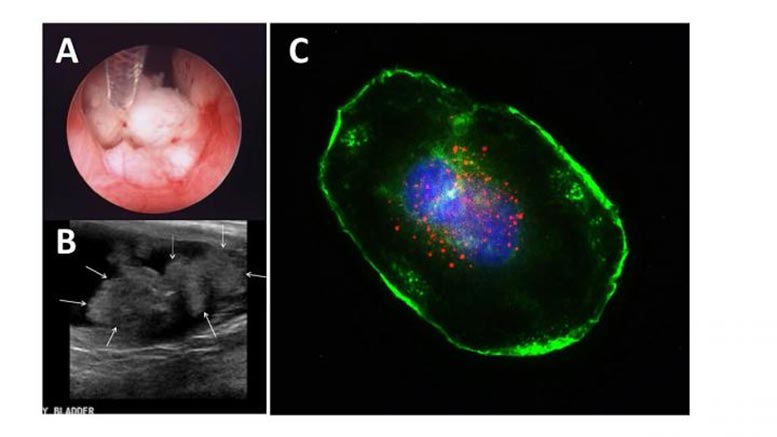
    Pet dogs suffering bladder cancer, for which all other approaches failed, were treated with a Purdue University experimental approach. A: Bladder cystoscopic biopsy being performed in patient dog to investigate tumor characteristics. B: Ultrasound image obtained to record tumor mass dimensions. Sagittal view of the bladder. Arrows point to a mass in the neck of the bladder. C: Presence of Epidermal Growth Factor (EGF) Receptor on bladder cancer cells was revealed by binding and uptake of fluorescently labeled EGF (red). Nucleus (blue) and actin cytoskeleton (green) are also shown. Credit: Purdue University/R. Claudio Aguilar

    Aguilar said the bladder has its own protective layer, which saves the good cells from the anthrax mixture but offers no protection for the cancer cells and tumors. He said the Purdue system works within minutes — instead of the usual hours for bladder cancer treatment — to target the cancer cells in the bladder.

    “We have seen outstanding results with our treatment,” said Aguilar, who works as part of a team focused on cell identity and signaling at the Purdue University Center for Cancer Research. “It is fast and effective, both of which are critical for people dealing with this devastating disease.”

    Aguilar and his group worked with the Purdue teams led by Timothy Ratliff and Deborah Knapp to test their solution in dogs with bladder cancer who had run out of other treatment options. They found this new agent decreased the tumor size without causing any other side effects in the animals.

    The Purdue team thinks a similar treatment may help people and animals with other cancers, including those affecting the lungs or skin.

    ###

    Reference: “A novel, safe, fast and efficient treatment for Her2‐positive and negative bladder cancer utilizing an EGF‐anthrax toxin chimera” by Sherwin Jack, Kayalvizhi Madhivanan, Swetha Ramadesikan, Sneha Subramanian, Daniel F. Edwards II, Bennett D. Elzey, Deepika Dhawan, Andrew McCluskey, Erin M. Kischuk, Alexander R. Loftis, Nicholas Truex, Michael Santos, Mike Lu, Amy Rabideau, Bradley Pentelute, John Collier, Hristos Kaimakliotis, Michael Koch, Timothy L. Ratliff, Deborah W. Knapp and Ruben C. Aguilar, 4 October 2019, International Journal of Cancer.
    DOI: 10.1002/ijc.32719

    The researchers also worked with partners in the Indiana University School of Medicine, the Massachusetts Institute of Technology, and Harvard University.

    Aguilar and the other researchers worked with the Purdue Research Foundation Office of Technology Commercialization to patent the new treatments.

    Never miss a breakthrough: Join the SciTechDaily newsletter.
    Follow us on Google and Google News.

    Anthrax Cancer Purdue University
    Share. Facebook Twitter Pinterest LinkedIn Email Reddit

    Related Articles

    Scientists Develop New Cancer Therapy That Stops Tumor Growth in Its Tracks

    Combined Drug Treatment Delays Resistance in Melanoma Patients

    RNA Delivering Nanoparticles Shrink Tumors in Mice

    Data on CYP17A1 Structure May Lead to Advances in Prostate Cancer Drug Design

    New Drug Candidate Kills Cancer Cells Better Than Cisplatin

    New Antibody Drug Boosts the Immune System’s Capacity to Fight Cancer

    Custom Tailored Brain Cancer Vaccine Proves Effective

    Protein NLRP12 Protects Against Colon Cancer

    First Volume of the Cancer Cell Line Encyclopedia

    Leave A Reply Cancel Reply

    • Facebook
    • Twitter
    • Pinterest
    • YouTube

    Don't Miss a Discovery

    Subscribe for the Latest in Science & Tech!

    Trending News

    Breakthrough Parkinson’s Drug Targets Disease at Its Genetic Roots

    Just 4 Weeks of Simple Diet Changes Reversed Signs of Aging in Older Adults

    Scientists May Have Finally Solved Why Humans Are Right-Handed

    NASA’s Hubble Accidentally Witnesses a Comet Shattering in Space

    Researchers Discover the Body’s Hidden “Off Switch” for Inflammation

    Scientists Discover Metformin Doesn’t Work the Way We Thought

    Tea or Coffee? Your Daily Choice Could Affect Osteoporosis Risk

    Vitamin C May Fight Cancer in a Surprising Way

    Follow SciTechDaily
    • Facebook
    • Twitter
    • YouTube
    • Pinterest
    • Newsletter
    • RSS
    SciTech News
    • Biology News
    • Chemistry News
    • Earth News
    • Health News
    • Physics News
    • Science News
    • Space News
    • Technology News
    Recent Posts
    • Scientists Unravel the Mystery of Angola’s Giant “Ghost Elephants”
    • Ancient DNA Shatters the Simple Story of Europe’s Origins
    • Scientists Say a 59,000-Year-Old Neanderthal Tooth Shows Evidence of Surgery
    • Scientists Stunned by Hybrid California Bees That Beat Deadly Mites
    • Scientists Discover Terrifying Giant Crocodile That Hunted Human Ancestors
    Copyright © 1998 - 2026 SciTechDaily. All Rights Reserved.
    • Science News
    • About
    • Contact
    • Editorial Board
    • Privacy Policy
    • Terms of Use

    Type above and press Enter to search. Press Esc to cancel.