
Close Menu
    Facebook X (Twitter) Instagram
    SciTechDaily
    • Biology
    • Chemistry
    • Earth
    • Health
    • Physics
    • Science
    • Space
    • Technology
    Facebook X (Twitter) Pinterest YouTube RSS
    SciTechDaily
    Home»Chemistry»New Bio-Inspired Hydrogel Acts Like Superglue in Seawater
    Chemistry

    New Bio-Inspired Hydrogel Acts Like Superglue in Seawater

    By Hokkaido UniversityNovember 12, 2019No Comments3 Mins Read
    Facebook Twitter Pinterest Telegram LinkedIn WhatsApp Email Reddit
    Share
    Facebook Twitter LinkedIn Pinterest Telegram Email Reddit
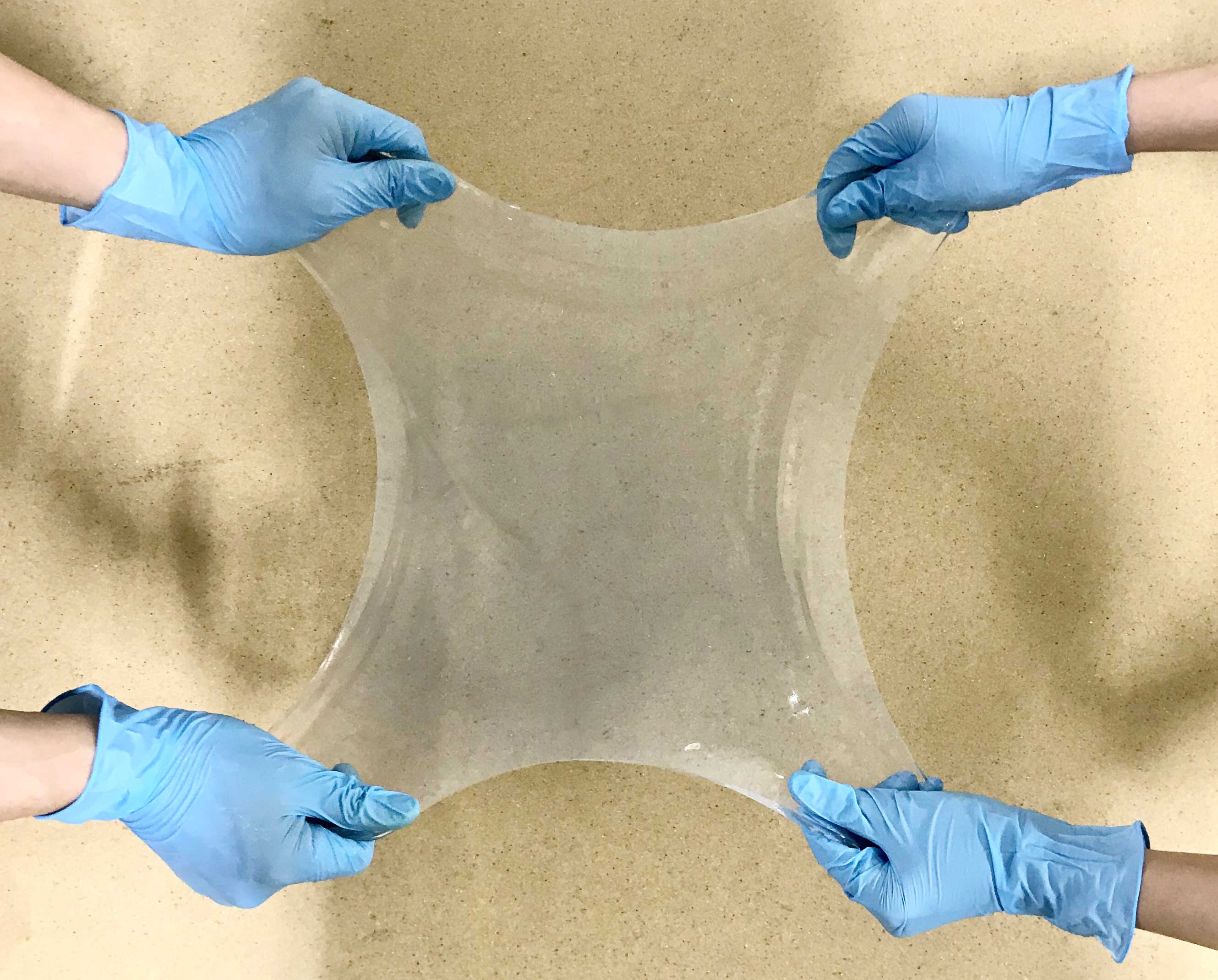
    Bio Inspired Hydrogel
    The newly developed gel adheres to negatively-charged solid surfaces in highly ionic conditions, such as in seawater. Credit: Hailong Fan et al., Nature Communications, November 12, 2019

    Getting glued in the sea: New bio-inspired hydrogels can act like superglue in highly ionic environments such as seawater, overcoming issues in currently available marine adhesives.

    Scientists have been working on developing adhesives for the marine environment that are inspired by organisms that fix themselves to underwater surfaces, like mussels. These catechol-based glues are easily oxidized and so eventually lose their adhesiveness, making them less than satisfactory for their intended purpose. 

    In the current study published in Nature Communications, Hokkaido University’s Hailong Fan and Jian Ping Gong with their colleagues explored the possibility of developing adhesives that utilize electrostatic interaction to stick to negatively charged surfaces such as rocks, glass, and metals under the sea.

    The team built polymer chains made from two types of monomers as building blocks. One contains a positively charged “cationic” residue and the other contains an “aromatic” ring. In biosystems, adjacent cationic–aromatic amino acid sequences in proteins are known to facilitate electrostatic interactions in saline water. It has been challenging, however, to introduce such sequences in synthetic polymers due to difficulties in controlling monomer sequences.

    Gong and her colleagues discovered that the synthetic polymers with adjacent cationic–aromatic sequences could easily be manufactured using a highly scalable, cost-effective method called “cation–p complex-aided free-radical polymerization.”
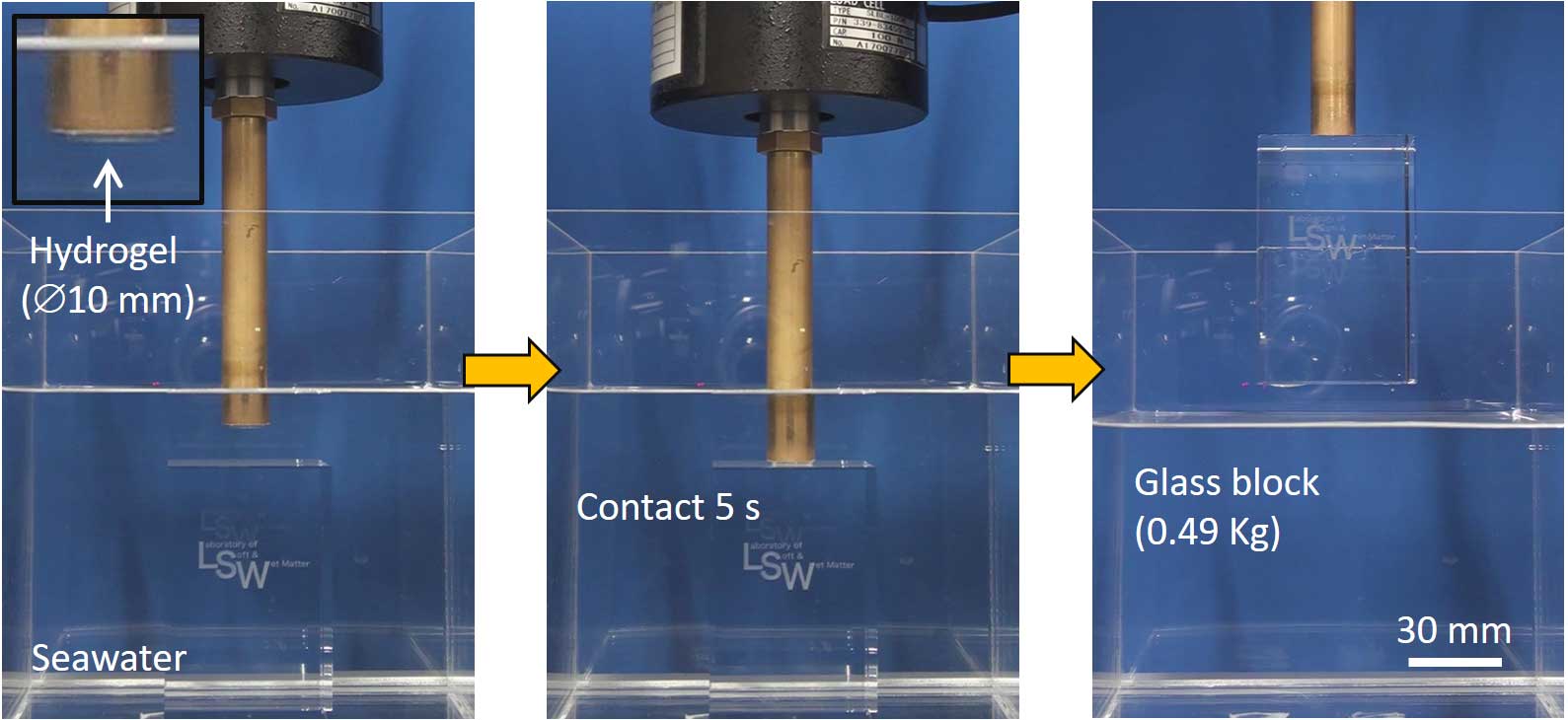
    Hydrogel Glue Glass Block
    The hydrogel took only five seconds to glue to the glass block before lifting it up out of the seawater to the air. Credit: Hailong Fan et al., Nature Communications, November 12, 2019

    The researchers found that the two residue types in polymers bonded together to form a hydrogel that stuck well to negatively-charged solid surfaces in saltwater — the adhesive strength approached approximately 60 kPa. Hydrogels composed of a variety of cationic-aromatic monomer combinations exhibited fast, strong, but reversible adhesion to the surfaces. Adhesion was largely thanks to the electrostatic interaction between the positively charged residues on the polymers and the negatively charged surfaces. But, interestingly, polymers made from these cationic-aromatic monomers without adjacent sequences weren’t nearly as adherent, indicating that adjacent aromatic residue enhances electrostatic interaction in high ionic strength environments.
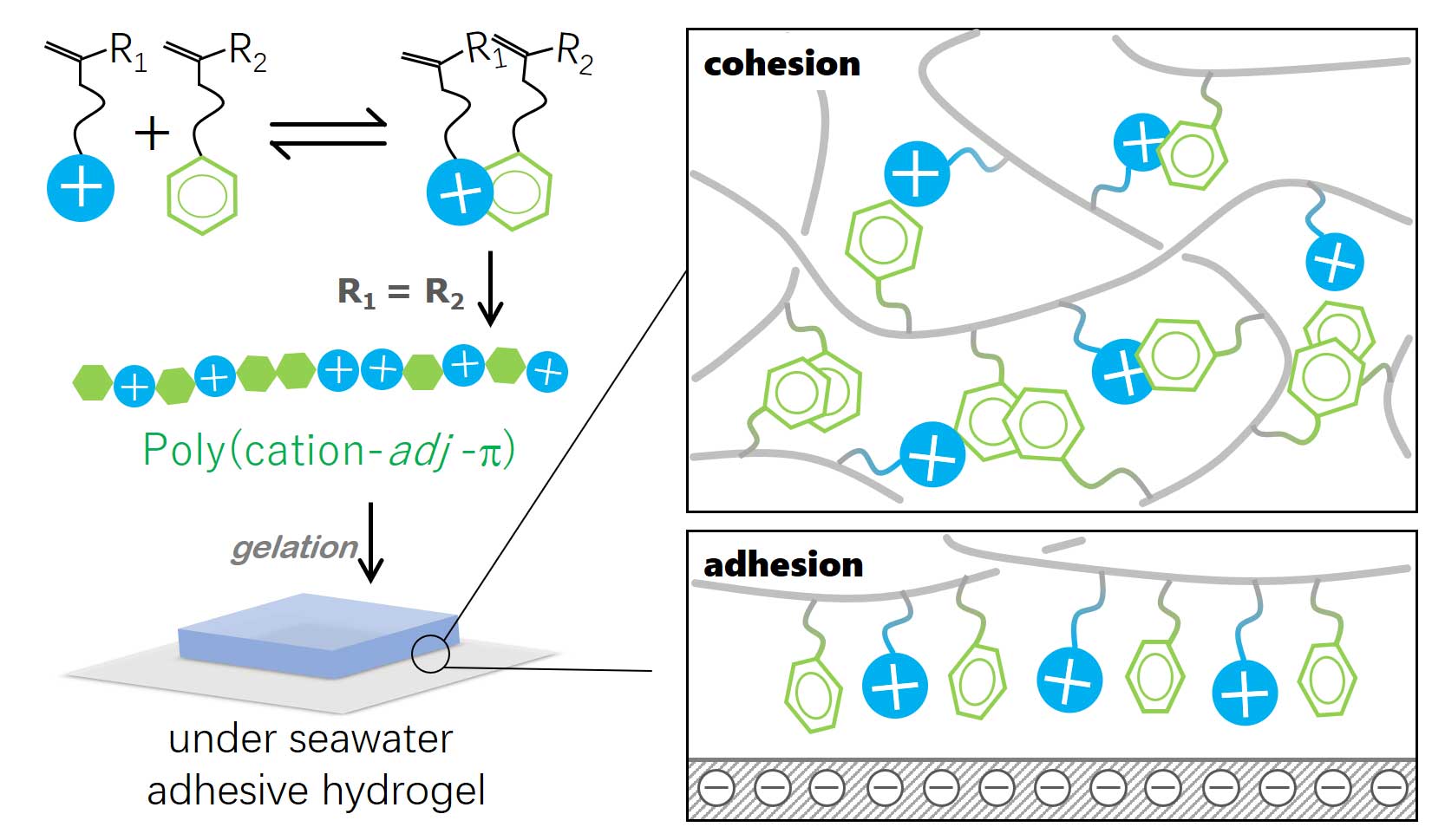
    Synthetic Method Yields Polymers
    The synthetic method yields polymers with adjacent cationic (blue)–aromatic (green) sequences. The two monomer types in polymers bonded together to form a hydrogel that stuck well to negatively-charged solid surfaces in saltwater. Credit: Hailong Fan et al., Nature Communications, November 12, 2019

    “Our sequence-controlled polymeric hydrogel should have promising applications as glues for undersea leakage, sea sand binders for preserving marine environments, and coagulants for concrete in the sea,” says Gong. Their study could also pave the way for further investigations into electrostatic interactions in highly ionic environments.

    This study was conducted in part at the Institute for Chemical Reaction Design and Discovery (WPI-ICReDD) which was established at Hokkaido University in 2018 to advance our understanding of and efficiently develop chemical reactions.

    Reference: Hailong Fan et al., Adjacent cationic–aromatic sequences yield strong electrostatic adhesion of hydrogels in seawater. Nature Communications. November 12, 2019.
    DOI: 10.1038/s41467-019-13171-9

    Funding: This study was supported by the Japan Society for the Promotion of Science (JSPS)’s KAKENHI grant (JP17H06144).

    Never miss a breakthrough: Join the SciTechDaily newsletter.
    Follow us on Google and Google News.

    Chemical Engineering Hokkaido University Hydrogel Polymers
    Share. Facebook Twitter Pinterest LinkedIn Email Reddit

    Related Articles

    Green Chemistry Creates Coatings From Nature: Turning Biomass Into High-Quality Coatings

    Engineers Build Chemically Driven Wheels That “Morph” Into Gears to Perform Mechanical Work

    Bacterial Strain Uncovered for Producing Bioplastics From Sewage Sludge and Wastewater

    Separating Gases Using Flexible Molecular Sieves Made From Metal-Organic Frameworks

    Advanced Gas Separation Membranes for Capturing Carbon Dioxide From the Air

    Faster, More Efficient Way of Recycling Bioplastics Developed

    New Dual-Action Coating Invented to Prevent Bacterial Cross-Contamination of Fresh Produce

    Scientists to Communicate Polymers More Easily With New Notation System

    MIT Researchers Develop New Strategy for Stronger Polymers

    Leave A Reply Cancel Reply

    • Facebook
    • Twitter
    • Pinterest
    • YouTube

    Don't Miss a Discovery

    Subscribe for the Latest in Science & Tech!

    Trending News

    Scientists May Have Found the Key to Jupiter and Saturn’s Moon Mystery

    Scientists Uncover Brain Changes That Link Pain to Depression

    Saunas May Do More Than Raise Body Temperature – They Activate Your Immune System

    Exercise in a Pill? Metformin Shows Surprising Effects in Cancer Patients

    Hidden Oceans of Magma Could Be Protecting Alien Life

    New Study Challenges Alzheimer’s Theories: It’s Not Just About Plaques

    Artificial Sweeteners May Harm Future Generations, Study Suggests

    Splashdown! NASA Artemis II Returns From Record-Breaking Moon Mission

    Follow SciTechDaily
    • Facebook
    • Twitter
    • YouTube
    • Pinterest
    • Newsletter
    • RSS
    SciTech News
    • Biology News
    • Chemistry News
    • Earth News
    • Health News
    • Physics News
    • Science News
    • Space News
    • Technology News
    Recent Posts
    • “A Plague Is Upon Us”: The Mass Death That Changed an Ancient City Forever
    • This Strange Material Can Turn Superconductivity on and off Like a Switch
    • Scientists Discover Game-Changing New Way To Treat High Cholesterol
    • Breakthrough Drug Delays Rheumatoid Arthritis for Years After Treatment Ends
    • This Small Change to Your Exercise Routine Could Be the Secret to Living Longer
    Copyright © 1998 - 2026 SciTechDaily. All Rights Reserved.
    • Science News
    • About
    • Contact
    • Editorial Board
    • Privacy Policy
    • Terms of Use

    Type above and press Enter to search. Press Esc to cancel.