
Close Menu
    Facebook X (Twitter) Instagram
    SciTechDaily
    • Biology
    • Chemistry
    • Earth
    • Health
    • Physics
    • Science
    • Space
    • Technology
    Facebook X (Twitter) Pinterest YouTube RSS
    SciTechDaily
    Home»Space»A Tilted Wonder 50,000 Light-Years Across
    Space

    A Tilted Wonder 50,000 Light-Years Across

    By ESA/HubbleAugust 30, 20201 Comment2 Mins Read
    Facebook Twitter Pinterest Telegram LinkedIn WhatsApp Email Reddit
    Share
    Facebook Twitter LinkedIn Pinterest Telegram Email Reddit
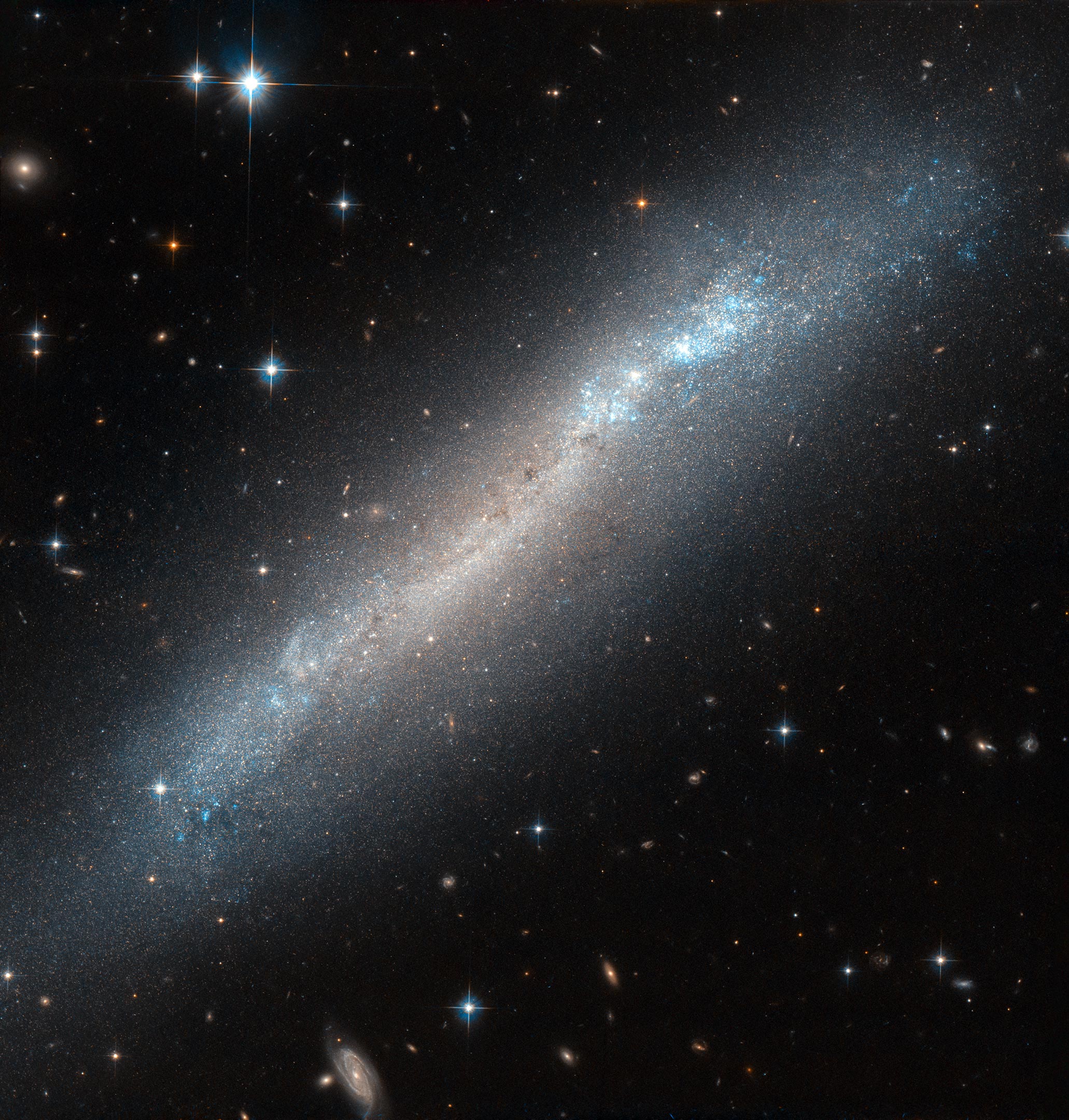
    Galaxy NGC 2188
    NASA/ESA Hubble Space Telescope image of a galaxy named NGC 2188. Credit: ESA/Hubble & NASA, R. Tully

    The blue and orange stars of the faint galaxy named NGC 2188 sparkle in this image taken with the NASA/ESA Hubble Space Telescope. Although NGC 2188 appears at first glance to consist solely of a narrow band of stars, it is classified by astronomers as a barred-spiral galaxy. It appears this way from our viewpoint on Earth as the center and spiral arms of the galaxy are tilted away from us, with only the very narrow outer edge of the galaxy’s disc visible to us. Astronomers liken this occurrence to turning a dinner plate in your hands so you see only its outer edge. The true shape of the galaxy was identified by studying the distribution of the stars in the inner central bulge and outer disc and by observing the stars’ colors.

    NGC 2188 is estimated to be just half the size of our Milky Way, at 50,000 light-years across, and it is situated in the northern hemisphere constellation of Columba (The Dove). Named in the late 1500s after Noah’s dove in biblical stories, the small constellation consists of many faint yet beautiful stars and astronomical objects.

    Never miss a breakthrough: Join the SciTechDaily newsletter.
    Follow us on Google and Google News.

    Astronomy European Space Agency Hubble Space Telescope NASA Popular
    Share. Facebook Twitter Pinterest LinkedIn Email Reddit

    Related Articles

    Hubble’s Newest Discovery Isn’t a Star, It’s a Window Into the Dark Universe

    Hubble Celebrates 34th Anniversary With a Spectacular View of the Little Dumbbell Nebula

    Hubble Views Spiral Galaxy NGC 5793

    Hubble Captures Face-On Image of Messier 61

    Hubble Views an Ongoing Cosmic Collision

    Hubble Views Newborn Stars in Galaxy IC 5052

    New XDF Image, The Deepest-Ever View of the Universe

    Hubble Zooms in on the Center of M4

    Hubble Image of Peculiar Galaxy Pair Arp 116

    1 Comment

    1. Ron on September 1, 2020 5:47 am

      The constellation that NGC2188 is is situated in,Columba is the “Southern” Hemisphere.
      Coordinates = RA 6h:10min:53sec Dec-34°06’19”
      Therefor it is not in a “Northern” Hemisphere Constellation.
      Regards
      Ron

      Reply
    Leave A Reply Cancel Reply

    • Facebook
    • Twitter
    • Pinterest
    • YouTube

    Don't Miss a Discovery

    Subscribe for the Latest in Science & Tech!

    Trending News

    Millions of People Have Osteopenia Without Realizing It – Here’s What You Need To Know

    Researchers Discover Boosting a Single Protein Helps the Brain Fight Alzheimer’s

    World-First Study Reveals Human Hearts Can Regenerate After a Heart Attack

    Why Your Dreams Feel So Real Sometimes and So Strange Other Times

    This Simple Home Device May Boost Brain Power in Adults Over 40

    Enormous Prehistoric Insects Puzzle Scientists

    Scientists Develop Bioengineered Chewing Gum That Could Help Fight Oral Cancer

    After 37 Years, the World’s Longest-Running Soil Warming Experiment Uncovers a Startling Climate Secret

    Follow SciTechDaily
    • Facebook
    • Twitter
    • YouTube
    • Pinterest
    • Newsletter
    • RSS
    SciTech News
    • Biology News
    • Chemistry News
    • Earth News
    • Health News
    • Physics News
    • Science News
    • Space News
    • Technology News
    Recent Posts
    • After 100 Years, Scientists Uncover Hidden Rule Governing Cosmic Rays
    • The Milky Way Has a Hidden Edge and Scientists Finally Mapped It
    • Scientists Stunned by New Organic Molecules Found on Mars
    • Scientists Discover Evolution’s 120-Million-Year-Old “Cheat Sheet”
    • This New “Sound Laser” Could Measure Gravity With Stunning Precision
    Copyright © 1998 - 2026 SciTechDaily. All Rights Reserved.
    • Science News
    • About
    • Contact
    • Editorial Board
    • Privacy Policy
    • Terms of Use

    Type above and press Enter to search. Press Esc to cancel.