
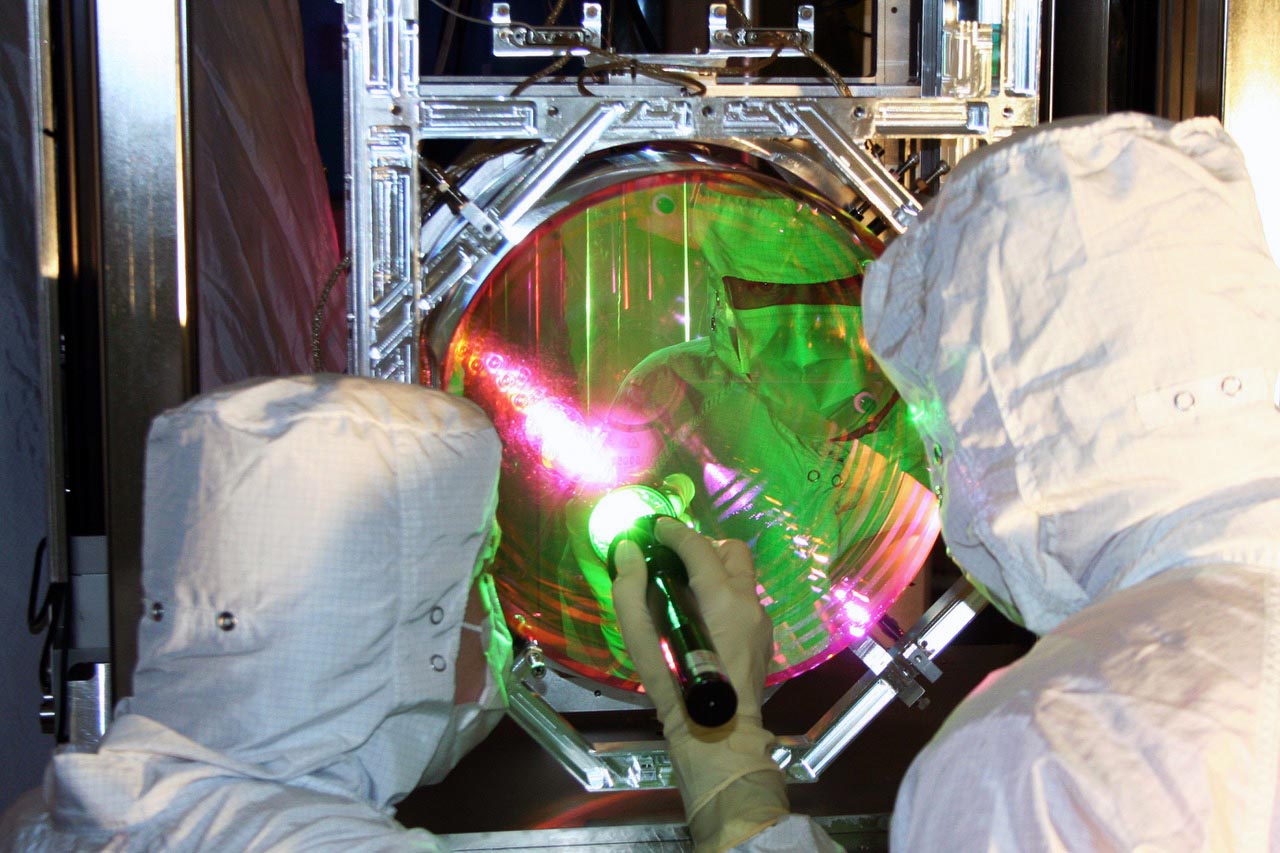
LIGO’s mirrors, cooled to near quantum limits, break new ground in quantum mechanics and gravitational-wave detection.
Using LIGO’s suspended mirrors, researchers have demonstrated the ability to cool a large-scale object — the 10-kilogram optomechanical oscillator the suspended mirrors form — to nearly the motional quantum ground state. Upgrading LIGO (Laser Interferometer Gravitational-Wave Observatory) with such a modification would not only increase the device’s sensitivity and range in detecting gravitational waves but could also provide new insights into large-scale quantum phenomena.
For most mechanical objects to be coaxed into a quantum state, they need to be cooled to exceedingly low temperatures to overcome the thermal vibrations, or phonons, that mask the signature of quantum motion. This brings the object closer to its motional ground state. However, achieving motional ground state has generally only been demonstrated in nanoscale objects and the methods used to prepare these tiny systems are not feasible at larger mass scales.
Here, Chris Whittle and colleagues report on the active laser-cooling of Advanced LIGO’s mirrors, which effectively form a 10-kg mechanical oscillator, from room temperature to 77 nanokelvin, causing the system to approach its motional ground state.
According to Whittle et al., this cooling put the oscillator in a state with an average phonon occupation of 10.8 — suppressing quantum back-action noise by 11 orders of magnitude. What’s more, the results represent a 13 orders-of-magnitude increase in the mass of an object prepared close to its motional ground state over other demonstrations.
For more on this research, read Physicists Bring Human-Scale Object to Near Standstill, Reaching a Quantum State.
Reference: “Approaching the motional ground state of a 10-kg object” by Chris Whittle, Evan D. Hall, Sheila Dwyer, Nergis Mavalvala, Vivishek Sudhir, R. Abbott, A. Ananyeva, C. Austin, L. Barsotti, J. Betzwieser, C. D. Blair, A. F. Brooks, D. D. Brown, A. Buikema, C. Cahillane, J. C. Driggers, A. Effler, A. Fernandez-Galiana, P. Fritschel, V. V. Frolov, T. Hardwick, M. Kasprzack, K. Kawabe, N. Kijbunchoo, J. S. Kissel, G. L. Mansell, F. Matichard, L. McCuller, T. McRae, A. Mullavey, A. Pele, R. M. S. Schofield, D. Sigg, M. Tse, G. Vajente, D. C. Vander-Hyde, Hang Yu, Haocun Yu, C. Adams, R. X. Adhikari, S. Appert, K. Arai, J. S. Areeda, Y. Asali, S. M. Aston, A. M. Baer, M. Ball, S. W. Ballmer, S. Banagiri, D. Barker, J. Bartlett, B. K. Berger, D. Bhattacharjee, G. Billingsley, S. Biscans, R. M. Blair, N. Bode, P. Booker, R. Bork, A. Bramley, K. C. Cannon, X. Chen, A. A. Ciobanu, F. Clara, C. M. Compton, S. J. Cooper, K. R. Corley, S. T. Countryman, P. B. Covas, D. C. Coyne, L. E. H. Datrier, D. Davis, C. Di Fronzo, K. L. Dooley, P. Dupej, T. Etzel, M. Evans, T. M. Evans, J. Feicht, P. Fulda, M. Fyffe, J. A. Giaime, K. D. Giardina, P. Godwin, E. Goetz, S. Gras, C. Gray, R. Gray, A. C. Green, E. K. Gustafson, R. Gustafson, J. Hanks, J. Hanson, R. K. Hasskew, M. C. Heintze, A. F. Helmling-Cornell, N. A. Holland, J. D. Jones, S. Kandhasamy, S. Karki, P. J. King, Rahul Kumar, M. Landry, B. B. Lane, B. Lantz, M. Laxen, Y. K. Lecoeuche, J. Leviton, J. Liu, M. Lormand, A. P. Lundgren, R. Macas, M. MacInnis, D. M. Macleod, S. Márka, Z. Márka, D. V. Martynov, K. Mason, T. J. Massinger, R. McCarthy, D. E. McClelland, S. McCormick, J. McIver, G. Mendell, K. Merfeld, E. L. Merilh, F. Meylahn, T. Mistry, R. Mittleman, G. Moreno, C. M. Mow-Lowry, S. Mozzon, T. J. N. Nelson, P. Nguyen, L. K. Nuttall, J. Oberling, Richard J. Oram, C. Osthelder, D. J. Ottaway, H. Overmier, J. R. Palamos, W. Parker, E. Payne, R. Penhorwood, C. J. Perez, M. Pirello, H. Radkins, K. E. Ramirez, J. W. Richardson, K. Riles, N. A. Robertson, J. G. Rollins, C. L. Romel, J. H. Romie, M. P. Ross, K. Ryan, T. Sadecki, E. J. Sanchez, L. E. Sanchez, T. R. Saravanan, R. L. Savage, D. Schaetz, R. Schnabel, E. Schwartz, D. Sellers, T. Shaffer, B. J. J. Slagmolen, J. R. Smith, S. Soni, B. Sorazu, A. P. Spencer, K. A. Strain, L. Sun, M. J. Szczepanczyk, M. Thomas, P. Thomas, K. A. Thorne, K. Toland, C. I. Torrie, G. Traylor, A. L. Urban, G. Valdes, P. J. Veitch, K. Venkateswara, G. Venugopalan, A. D. Viets, T. Vo, C. Vorvick, M. Wade, R. L. Ward, J. Warner, B. Weaver, R. Weiss, B. Willke, C. C. Wipf, L. Xiao, H. Yamamoto, L. Zhang, M. E. Zucker and J. Zweizig, 18 June 2021, Science.
DOI: 10.1126/science.abh2634
Never miss a breakthrough: Join the SciTechDaily newsletter.
Follow us on Google and Google News.