
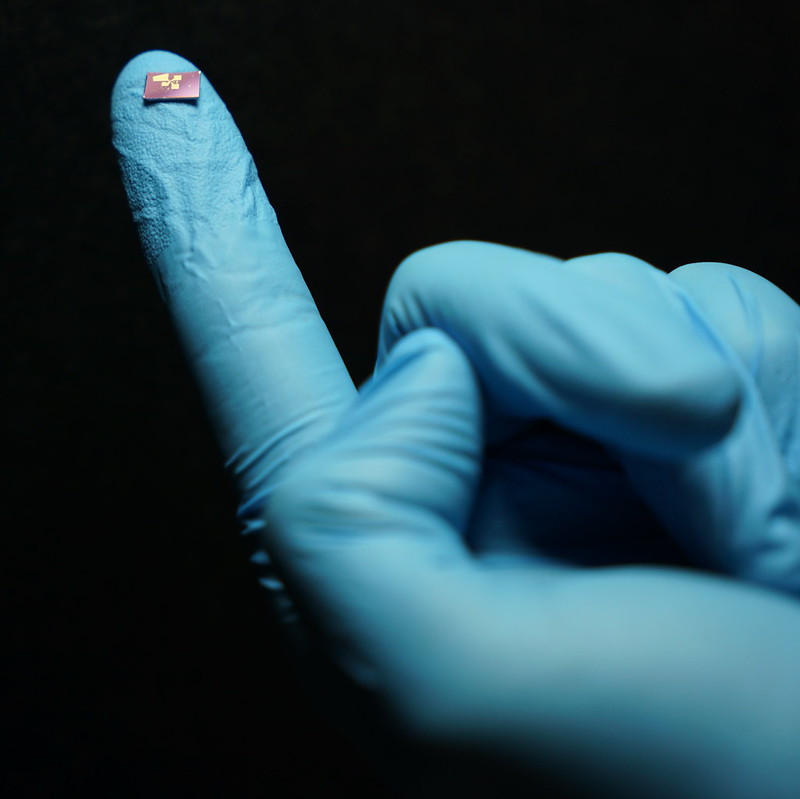
The tool opens the door to the widespread use of portable spectrometers.
Researchers in the field of optical spectrometry have created a better instrument for measuring light. This advancement could improve everything from smartphone cameras to environmental monitoring.
The research, led by Finland’s Aalto University, developed a powerful, incredibly small spectrometer that fits on a microchip and is run by artificial intelligence. Their research was recently published in the journal Science.
The study used a relatively new class of super-thin materials known as two-dimensional semiconductors, and the result is a proof of concept for a spectrometer that could be easily integrated into a number of technologies such as quality inspection platforms, security sensors, biomedical analyzers, and space telescopes.
“We’ve demonstrated a way of building spectrometers that are far more miniature than what is typically used today,” said Ethan Minot, a professor of physics at the Oregon State University College of Science who worked on the study. “Spectrometers measure the strength of light at different wavelengths and are super useful in lots of industries and all fields of science for identifying samples and characterizing materials.”
Minot claimed that the new spectrometer could fit on the end of a human hair, in contrast to conventional spectrometers that need large optical and mechanical components. According to the new study, such components could be replaced with novel semiconductor materials and artificial intelligence, enabling spectrometers to be drastically scaled down in size from the smallest ones currently available, which are around the size of a grape.
Enhanced Performance Without Conventional Components
“Our spectrometer does not require assembling separate optical and mechanical components or array designs to disperse and filter light,” said Hoon Hahn Yoon, who led the study with Aalto University colleague Zhipei Sun Yoon. “Moreover, it can achieve a high resolution comparable to benchtop systems but in a much smaller package.”
The device is 100% electrically controllable regarding the colors of light it absorbs, which gives it massive potential for scalability and widespread usability, the researchers say.
“Integrating it directly into portable devices such as smartphones and drones could advance our daily lives,” Yoon said. “Imagine that the next generation of our smartphone cameras could be hyperspectral cameras.”
Those hyperspectral cameras could capture and analyze information not just from visible wavelengths but also allow for infrared imaging and analysis.
“It’s exciting that our spectrometer opens up possibilities for all sorts of new everyday gadgets and instruments to do new science as well,” Minot said.
Transformative Impacts Across Multiple Fields
In medicine, for example, spectrometers are already being tested for their ability to identify subtle changes in human tissue such as the difference between tumors and healthy tissue.
For environmental monitoring, Minot added, spectrometers can detect exactly what kind of pollution is in the air, water or ground, and how much of it is there.
“It would be nice to have low-cost, portable spectrometers doing this work for us,” he said. “And in the educational setting, the hands-on teaching of science concepts would be more effective with inexpensive, compact spectrometers.”
Applications abound as well for science-oriented hobbyists, Minot said.
“If you’re into astronomy, you might be interested in measuring the spectrum of light that you collect with your telescope and having that information identify a star or planet,” he said. “If geology is your hobby, you could identify gemstones by measuring the spectrum of light they absorb.”
Minot thinks that as work with two-dimensional semiconductors progresses, “we’ll be rapidly discovering new ways to use their novel optical and electronic properties.” Research into 2D semiconductors has been going on in earnest for only a dozen years, starting with the study of graphene, carbon arranged in a honeycomb lattice with a thickness of one atom.
“It’s really exciting,” Minot said. “I believe we’ll continue to have interesting breakthroughs by studying two-dimensional semiconductors.”
Reference: “Miniaturized spectrometers with a tunable van der Waals junction” by Hoon Hahn Yoon, Henry A. Fernandez, Fedor Nigmatulin, Weiwei Cai, Zongyin Yang, Hanxiao Cui, Faisal Ahmed, Xiaoqi Cui, Md Gius Uddin, Ethan D. Minot, Harri Lipsanen, Kwanpyo Kim, Pertti Hakonen, Tawfique Hasan and Zhipei Sun, 20 October 2022, Science.
DOI: 10.1126/science.add8544
The study was funded by the Academy of Finland.
Never miss a breakthrough: Join the SciTechDaily newsletter.
Follow us on Google and Google News.
2 Comments
As something of a ‘worse’ but not ‘worst’ case scenario of a now senior former industrial electrician American male victim/investigator/discoverer still dealing with still medically unrecognized long-term chronic subclinical non-IgE-mediated food and food additive allergies (e.g., first diagnosed via shortly thereafter medically abandoned “cytotoxic blood testing for food allergies” in late 1981) and forty-one years and counting of potentially life threatening chronic illnesses, I already use a finger pulse-oximeter to monitor my brief and practically harmless individual allergy reactions (e.g., pulse ‘up’ and blood oxygen ‘down’) to avoid them becoming chronic and deadly dangerous. And, I estimate that about 4,000 unsuspecting Americans die prematurely every day in 2022 of undiagnosed allergies aggravated (or not) with FDA approved food poisoning (e.g., added MSG [1980] and soy [late 1960s], minimally; others) and/or related/resultant medical errors. If a particular allergy/additive reaction substance could be identified and the “Ultra-Tiny Spectrometer” could be mounted in a finger pulse-oximeter and/or a fitness band, I believe it could save upwards of one and a half million American (minimally) lives and untold billions of healthcare dollars a year. Anecdotally, this may be exactly what Elizabeth Holmes needed to make her Theranos medical diagnostic system work, while still being ignorant of the allergy and FDA approved food poisoning factors and only partially culpable, in my senior lay opinion.
For a geologist the spectrometer could be used to identify minerals, not so much gemstones. In many rocks individual mineral crystals are too small to see, but the colors they reflect, and absorb would be the same as for large crystals.
I’d love to have one of these to identify chemical compounds/minerals with.