

A novel spiral crystal spectrometer enhances NIF plasma diagnostics, boosting signal clarity for high-energy X-ray studies.
Scientists at Lawrence Livermore National Laboratory (LLNL) have collaborated with Princeton Plasma Physics Laboratory (PPPL) to design a novel X-ray crystal spectrometer to provide high-resolution measurements of a challenging feature of high energy density (HED) matter produced by National Ignition Facility (NIF) experiments.
The work is featured in a paper[1] in the Review of Scientific Instruments that describes the new crystal shape being fabricated for NIF, the world’s most energetic laser.
Laser-produced high energy density plasmas, similar to those found in stars, nuclear explosions, and the core of giant planets, may be the most extreme state of matter created on Earth.
PPPL previously built a spectrometer for NIF that was quite successful. The spectrometer, delivered in 2017, provides high-resolution measurements of the temperature and density of NIF extreme plasmas for inertial confinement fusion experiments, and the data obtained was presented in invited talks and peer-reviewed publications.
The instruments measure profiles of key parameters such as the ion and electron temperatures in large volumes of hot plasmas that are magnetically confined in doughnut-shaped tokamak fusion devices to facilitate fusion reactions. By contrast, NIF laser-produced HED plasmas are tiny, point-like substances that require differently designed spectrometers for high-resolution studies.
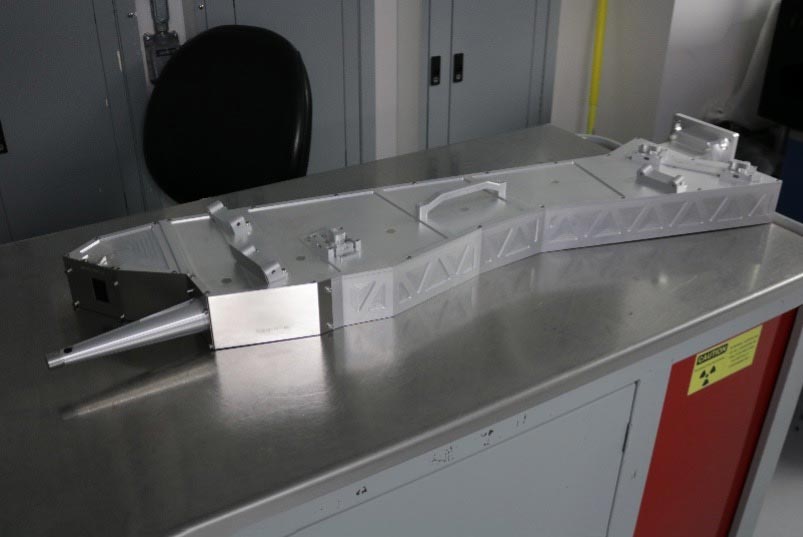
Third-Generation Crystal Targets Higher-Energy Elements
Marilyn Schneider, leader of the Radiative Properties Group in the Physical and Life Sciences Directorate at LLNL and a co-author of the paper, said this is the third designed crystal for extended X-ray absorption fine structure (EXAFS) experiments at NIF. These crystals are part of a high-resolution spectrometer named HiRAXS, which is described in another paper[2] in Review of Scientific Instruments. LLNL co-authors of this paper include Stanislav Stoupin, Daniel Thorn, Neil Ose, Yuan Ping, Federica Coppari, Bernard Kozioziemski, Andy Krygier, Hong Sio, Jay Ayers, Philip Efthimion, and Schneider. PPPL co-authors include Lan Gao, Ken Hill, Manfred Bitter and Brian Kraus.
The spectrometer examines copper, tantalum, and now lead EXAFS. The X-ray energy gets higher from copper to tantalum to lead, and the signal to noise gets lower, so there was a need to optimize the spectrometer design.
The collaboration will move to NIF in October when the new crystal is scheduled for testing there, with researchers at both laboratories eagerly awaiting the results.
“Experiments at NIF that measure the EXFAS spectrum at high X-ray energies have had low signals,” Schneider said. “The spectrometer design described in the paper concentrates the low signal and increases the signal-to-noise ratio while maintaining the high resolution required for observing EXAFS.”
“Unlike commonly used spherically, cylindrically or toroidally curved crystals, this new shape of crystal follows sinusoidal spirals,” said Yuan Ping, leader of the EXAFS project and the Dynamic Multiscale Material Properties Group. “Such a novel design makes it possible to meet the strict requirements for EXAFS measurements to probe the thermal state of highly compressed higher-Z materials.”
References:
“A new class of focusing crystal shapes for Bragg spectroscopy of small, point-like, x-ray sources in laser produced plasmas” by M. Bitter, N. Pablant, K. W. Hill, Lan Gao, B. Kraus, P. C. Efthimion, L. Delgado-Apericio, B. Stratton, M. Schneider, F. Coppari, R. Kauffman, M. J. MacDonald, A. MacPhee, Y. Ping, S. Stoupin and D. Thorn, 9 April 2021, Review of Scientific Instruments.
DOI: 10.1063/5.0043599
“The multi-optics high-resolution absorption x-ray spectrometer (HiRAXS) for studies of materials under extreme conditions” by S. Stoupin, D. B. Thorn, N. Ose, L. Gao, K. W. Hill, Y. Ping, F. Coppari, B. Kozioziemski, A. Krygier, H. Sio, J. Ayers, M. Bitter, B. Kraus, P. C. Efthimion and M. B. Schneider, 10 May 2021, Review of Scientific Instruments.
DOI: 10.1063/5.0043685
In addition to Schneider and Ping, LLNL co-authors include Federica Coppari, Robert Kauffman, Michael MacDonald, Andrew MacPhee, Stanislav Stoupin and Daniel Thorn. PPPL co-authors include Manfred Bitter, Ken Hill, Lan Gao, Luis Delgado-Aparicio, Brent Stratton, Brian Kraus and Philip Efthimion. The DOE Office of Science supported this research.
Never miss a breakthrough: Join the SciTechDaily newsletter.
Follow us on Google and Google News.