
Pfizer’s new antiviral drug, Paxlovid, has demonstrated promising results in clinical trials, achieving an 89% reduction in COVID-19-related severe outcomes. Developed with the help of DOE’s Argonne National Laboratory, this oral treatment is authorized for emergency use in the United States.
On December 22, 2021, the U.S. Food and Drug Administration issued emergency use authorization for Paxlovid for the treatment of mild-to-moderate coronavirus disease in adults and children 12 years of age and older who are at high risk for progression to severe COVID-19. Paxlovid is the first oral antiviral to be authorized by the FDA for use to treat COVID-19.
Pharmaceutical company Pfizer has announced the results of clinical trials of its new oral antiviral treatment against COVID-19. The new drug candidate, Paxlovid, proved to be effective against the SARS-CoV-2 virus, which causes COVID-19, according to results released by Pfizer on November 5.
Scientists at Pfizer created Paxlovid with the help of the ultrabright X-rays of the Advanced Photon Source (APS), a U.S. Department of Energy (DOE) Office of Science user facility at DOE’s Argonne National Laboratory.
“This is excellent news, and we’re very pleased to have played a part in the creation of this potentially life-saving antiviral treatment candidate.” Stephen Streiffer, deputy laboratory director for science and technology and director of the APS, Argonne National Laboratory
“Today’s news is a real game-changer in the global efforts to halt the devastation of this pandemic,” said Albert Bourla, chairman and chief executive officer of Pfizer, in a company press release. “These data suggest that our oral antiviral candidate, if approved or authorized by regulatory authorities, has the potential to save patients’ lives, reduce the severity of COVID-19 infections, and eliminate up to nine out of 10 hospitalizations.”
DOE invests in user facilities such as the APS for the benefit of the nation’s scientific community, and supports biological research as part of its energy mission. This research has been critical in the fight against COVID-19. The DOE national laboratories formed the National Virtual Biotechnology Laboratory (NVBL) consortium in 2020 to combat COVID-19 using capabilities developed for their DOE mission, and that consortium helps support research into antiviral treatments such as Paxlovid.
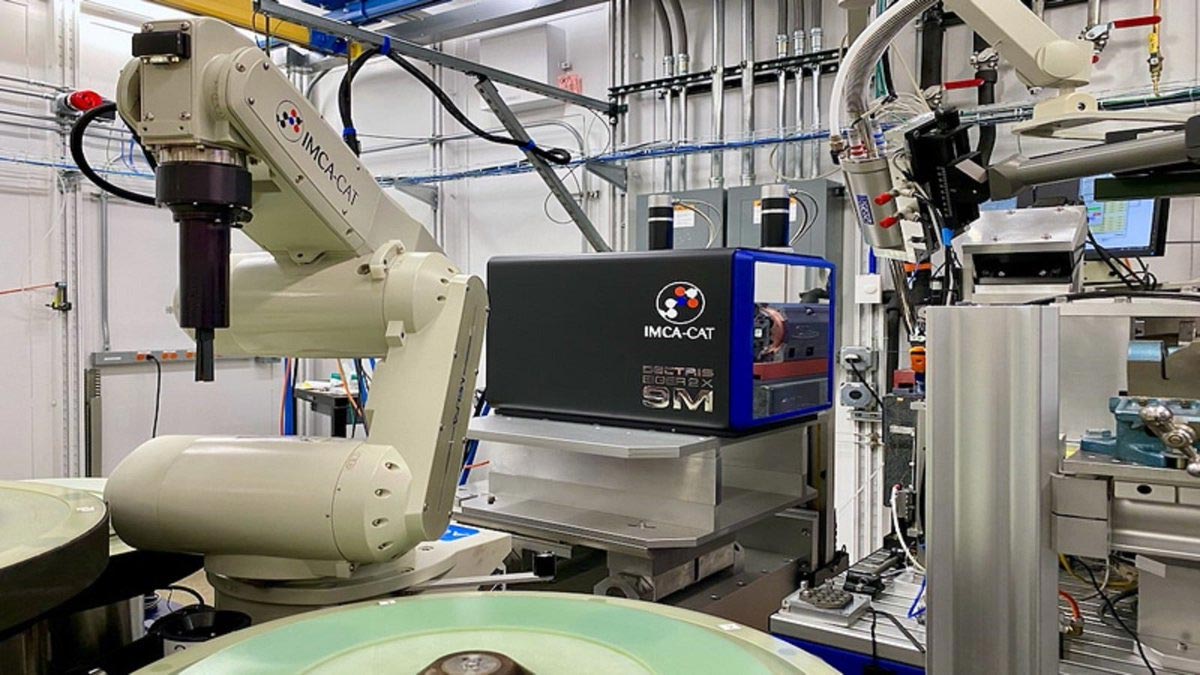
Work to determine the structure of the antiviral candidate was done at the Industrial Macromolecular Crystallography Association Collaborative Access Team (IMCA-CAT) beamline at the APS, operated by the Hauptman-Woodward Medical Research Institute (HWI) on behalf of a collaboration of pharmaceutical companies, of which Pfizer is a member.
As a member of IMCA-CAT, Pfizer routinely conducts drug development experiments at the APS, and the process of narrowing down and zeroing in on this drug candidate was performed over many months, according to Lisa Keefe, executive director of IMCA-CAT and vice president for advancing therapeutics and principal scientist at Hauptman-Woodward Medical Research Institute. IMCA-CAT, she said, delivers quality results in a timely manner, much faster than the home laboratories of the companies themselves can do.
Access like this to a DOE facility such as the APS, she said, is vitally important for a breakthrough like Paxlovid to happen.
“This is an important illustration of how valuable the national laboratories are to advancing the work of U.S. industries, and that has a hugely beneficial impact on society,” Keefe said. “When the results have a global impact, as in the case of treatments against COVID-19, they motivate us and inspire us.”
Using X-rays to Understand SARS-CoV-2 and Drug Interactions
IMCA-CAT uses the X-rays of the APS to probe the atomic structures of proteins, like those that make up the SARS-CoV-2 virus. Scientists use this information to see how potential drug compounds may interact with the virus. This lays the groundwork for the creation of new vaccines and potentially effective treatments, such as Paxlovid.
If approved, Paxlovid would be the first oral antiviral specifically designed to inhibit a key protease (3CL) of the SARS-CoV-2 virus. For the latest phase of clinical trials, Pfizer tested the treatment on more than 1200 adults, all of whom had been diagnosed with COVID-19 no more than five days prior, and had at least one medical condition or characteristic that enhanced the risk of severe illness.
Results reported by Pfizer showed an 89 percent reduction in risk of COVID-19-related hospitalization or death, compared with a similar number of patients who took a placebo.
Results of the first phase of trials were recently published in Science.
Pfizer’s next step is to pursue an emergency use authorization from the U.S. Food and Drug Administration.
“This is excellent news, and we’re very pleased to have played a part in the creation of this potentially life-saving antiviral treatment candidate,” said Stephen Streiffer, Argonne’s deputy laboratory director for science and technology and director of the APS. “DOE facilities such as the APS have performed an important role in the fight against this global pandemic, from providing the foundation for vaccines to enabling more reliable data about the spread of the virus.”
Reference: “An oral SARS-CoV-2 Mpro inhibitor clinical candidate for the treatment of COVID-19″ by Dafydd R. Owen, Charlotte M. N. Allerton, Annaliesa S. Anderson, Lisa Aschenbrenner, Melissa Avery, Simon Berritt, Britton Boras, Rhonda D. Cardin, Anthony Carlo, Karen J. Coffman, Alyssa Dantonio, Li Di, Heather Eng, RoseAnn Ferre, Ketan S. Gajiwala, Scott A. Gibson, Samantha E. Greasley, Brett L. Hurst, Eugene P. Kadar, Amit S. Kalgutkar, Jack C. Lee, Jisun Lee, Wei Liu, Stephen W. Mason, Stephen Noell, Jonathan J. Novak, R. Scott Obach, Kevin Ogilvie, Nandini C. Patel, Martin Pettersson, Devendra K. Rai, Matthew R. Reese, Matthew F. Sammons, Jean G. Sathish, Ravi Shankar P. Singh, Claire M. Steppan, Al E. Stewart, Jamison B. Tuttle, Lawrence Updyke, Patrick R. Verhoest, Liuqing Wei, Qingyi Yang and Yuao Zhu, 2 November 2021, Science.
DOI: 10.1126/science.abl4784
The Advanced Photon Source is a U.S. Department of Energy (DOE) Office of Science User Facility operated for the DOE Office of Science by Argonne National Laboratory. Additional funding for beamlines used for COVID-19 research at the APS is provided by the National Institutes of Health (NIH) and by DOE Office of Science Biological and Environmental Research. Supplemental support for COVID-19 research was provided by the DOE Office of Science through the National Virtual Biotechnology Laboratory, a consortium of DOE national laboratories focused on response to COVID-19 with funding provided by the Coronavirus CARES Act.
IMCA-CAT beamline staff who worked with industry on this research include Anne Mulichak, Jesse Yoder, Erica Duguid, and Eric Zoellner.
Never miss a breakthrough: Join the SciTechDaily newsletter.
Follow us on Google and Google News.