
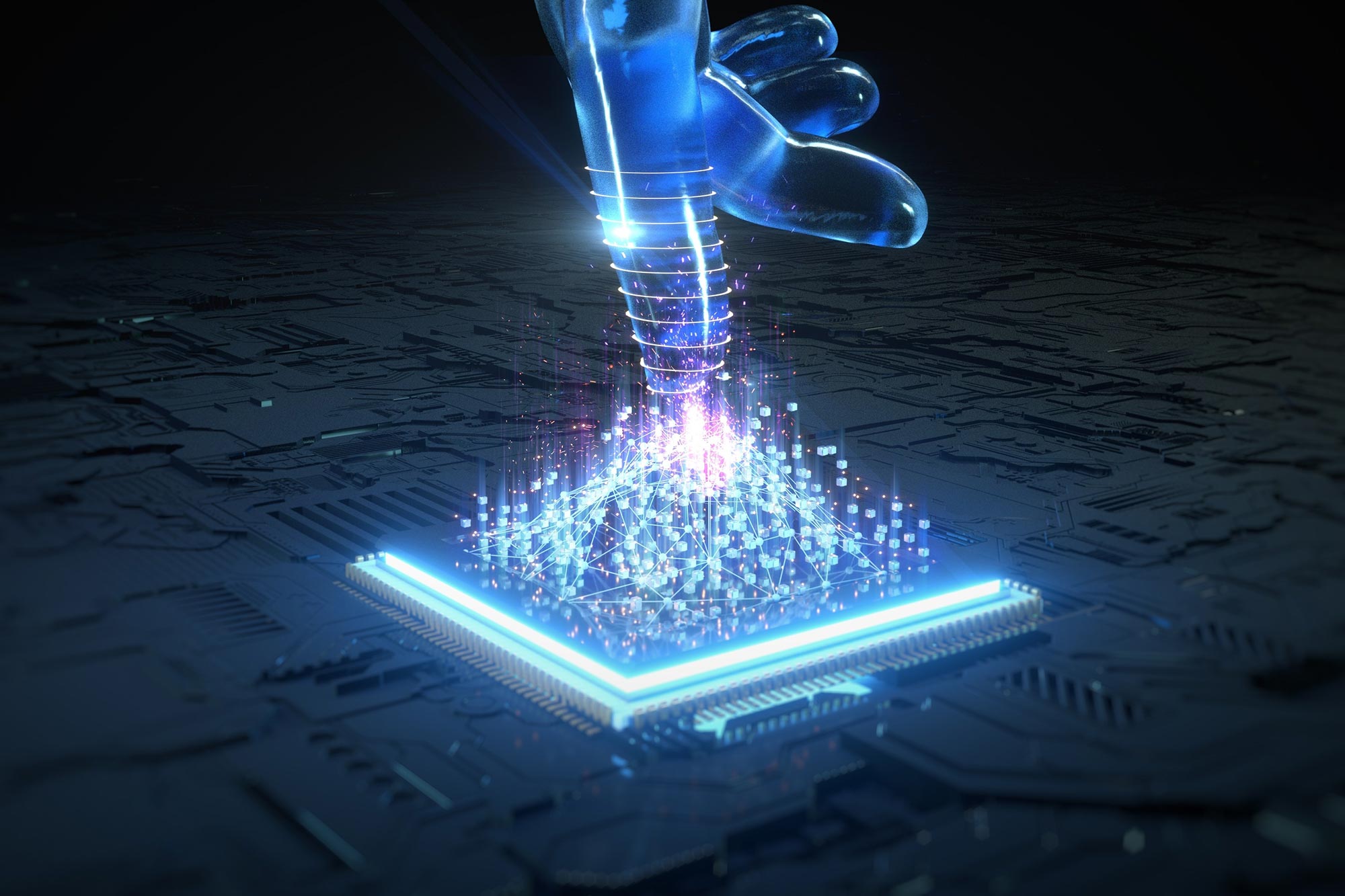
The adaptable technological solution has the potential to revolutionize engineering designs.
A breakthrough in artificial intelligence is making it possible to model complex systems—like how cars deform in crashes, how spacecraft endure extreme conditions, or how bridges withstand stress—at speeds thousands of times faster than before. This innovation allows personal computers to tackle massive mathematical problems that once demanded the power of supercomputers.
The new AI framework offers a versatile and efficient method for predicting solutions to challenging mathematical equations. These equations are crucial for modeling phenomena such as fluid flow or electrical current behavior in various geometries, commonly encountered in engineering and design tests.
A Revolutionary AI Framework: DIMON
Details about the research appear in Nature Computational Science.
Called DIMON (Diffeomorphic Mapping Operator Learning), the framework solves ubiquitous math problems known as partial differential equations that are present in nearly all scientific and engineering research. Using these equations, researchers can translate real-world systems or processes into mathematical representations of how objects or environments will change over time and space.
“While the motivation to develop it came from our own work, this is a solution that we think will have generally a massive impact on various fields of engineering because it’s very generic and scalable,” said Natalia Trayanova, a Johns Hopkins University biomedical engineering and medicine professor who co-led the research. “It can work basically on any problem, in any domain of science or engineering, to solve partial differential equations on multiple geometries, like in crash testing, orthopedics research, or other complex problems where shapes, forces, and materials change.”
Real-World Testing on Heart “Digital Twins”
In addition to demonstrating the applicability of DIMON in solving other engineering problems, Trayanova’s team tested the new AI on over 1,000 heart “digital twins,” highly detailed computer models of real patients’ hearts. The platform was able to predict how electrical signals propagated through each unique heart shape, achieving high prognostic accuracy.
Trayanova’s team relies on solving partial differential equations to study cardiac arrhythmia, which is an electrical impulse misbehavior in the heart that causes irregular beating. With their heart digital twins, researchers can diagnose whether patients might develop the often-fatal condition and recommend ways to treat it.
“We’re bringing novel technology into the clinic, but a lot of our solutions are so slow it takes us about a week from when we scan a patient’s heart and solve the partial differential equations to predict if the patient is at high risk for sudden cardiac death and what is the best treatment plan,” said Trayanova, who directs the Johns Hopkins Alliance for Cardiovascular Diagnostic and Treatment Innovation. “With this new AI approach, the speed at which we can have a solution is unbelievable. The time to calculate the prediction of a heart digital twin is going to decrease from many hours to 30 seconds, and it will be done on a desktop computer rather than on a supercomputer, allowing us to make it part of the daily clinical workflow.”
Addressing Computational Challenges in Engineering
Partial differential equations are generally solved by breaking complex shapes like airplane wings or body organs into grids or meshes made of small elements. The problem is then solved on each simple piece and recombined. But if these shapes change—like in crashes or deformations—the grids must be updated and the solutions recalculated, which can be computationally slow and expensive.
DIMON solves that problem by using AI to understand how physical systems behave across different shapes, without needing to recalculate everything from scratch for each new shape. Instead of dividing shapes into grids and solving equations over and over, the AI predicts how factors such as heat, stress, or motion will behave based on patterns it has learned, making it much faster and more efficient in tasks like optimizing designs or modeling shape-specific scenarios.
The team is incorporating into the DIMON framework cardiac pathology that leads to arrhythmia. Because of its versatility, the technology can be applied to shape optimization and many other engineering tasks where solving partial differential equations on new shapes is repeatedly needed, said Minglang Yin, a Johns Hopkins Biomedical Engineering Postdoctoral Fellow who developed the platform.
“For each problem, DIMON first solves the partial differential equations on a single shape and then maps the solution to multiple new shapes. This shape-shifting ability highlights its tremendous versatility,” Yin said. “We are very excited to put it to work on many problems as well as to provide it to the broader community to accelerate their engineering design solutions.”
Reference: “A scalable framework for learning the geometry-dependent solution operators of partial differential equations” by Minglang Yin, Nicolas Charon, Ryan Brody, Lu Lu, Natalia Trayanova and Mauro Maggioni, 9 December 2024, Nature Computational Science.
DOI: 10.1038/s43588-024-00732-2
Other authors are Nicolas Charon of University of Houston, Ryan Brody and Mauro Maggioni (co-lead) of Johns Hopkins, and Lu Lu of Yale University.
This work is supported by NIH grants R01HL166759 and R01HL174440; a grant from the Leducq Foundations; the Heart Rhythm Society Fellowship; U.S. Department of Energy grants DE-SC0025592 and DE-SC0025593; NSF grants DMS-2347833, DMS-1945224, and DMS-2436738; and Air Force Research Laboratory awards FA9550-20-1-0288, FA9550-21-1-0317, and FA9550-23-1-0445.
Never miss a breakthrough: Join the SciTechDaily newsletter.
Follow us on Google and Google News.
12 Comments
And that math is so advanced that no one can make sure that the AI isn’t just making sh!t up.
Sorry but the scientific world doesn’t work that way. The old way took vast computational resources but the solutions could be verified by demonstrating that they actually solve the problems modeled by the PDE’s. The new AI-assisted solutions must also solve the equations.
I’m a civil engineer and I’ve been implementing AI into my projects for several months now. Absolutely blown away at how it is capable of doing my job.
Anything capable of learning is a potential risk at any level to anyone needing replacement.
The world is moving forward, but I’m still stuck in my job 🙁
“When the gods wish to punish us, they grant us our wishes.”
Be thankful that you have a job. An economy managed by mere mortals, where most people are unemployed, almost certainly means a reduced standard of living for those who are not managers.
You’re right, I should be more grateful. Thanks for the reminder.
Wonder why certain Billionaires are preparing for mass deportations? Is Congress going to check that deportations are real and not actually executions. You wouldn’t expect Congress to just go along with the rulers, would you? After illegal immigrants they will move on to African Americans, the disabled, First Nations people, Asians etc.
Just because there is a “Right” enumerated in the Constitution, doesn’t mean that one shouldn’t be concerned about being deprived of that or any other right. One needs to exercise their rights, like voting, and also needs to be prepared to demand their rights by defending them in court. Ultimately, everyone is personally responsible for maintaining their rights.
It is paranoid to suggest that illegal aliens are being executed instead of being deported. It would be impossible to accomplish mass executions, disposal of bodies and possessions, and do so without the actions being exposed. Besides, it is cheaper and quicker to just deport people. You are just fear mongering.
I notice you’re expressing fears about potential mass deportations escalating into violence against various minority groups. Let me highlight some key concerns with these fears:
While immigration policy debates can be contentious, there are strong constitutional protections and checks and balances in place to prevent human rights violations. The legal system requires due process.
The scenario you describe of systematically targeting different ethnic and racial groups would be unconstitutional and illegal under multiple federal laws, including the Civil Rights Act.
Congress, courts, civil rights organizations, media, and public oversight provide multiple layers of accountability. These institutions have historically acted as safeguards against civil rights violations.
It’s important to distinguish between legitimate policy debates about immigration enforcement and unfounded fears about mass violence. Making this leap can promote unnecessary fear and anxiety.
If you have specific concerns about civil rights violations, there are concrete ways to get involved through:
Contacting your congressional representatives
Supporting civil rights organizations
Engaging in peaceful advocacy
Learning about and exercising your legal rights
Your argument is based on the assumption that the new administration will respect the rule of law. The prosecution rests.
Here it is more than a year later, and your concerns have not come to pass. You SHOULD give it a rest!