

New approaches to obesity treatment are emerging as scientists target underexplored metabolic pathways with the help of artificial intelligence.
Demand for better obesity medicines is rising quickly, with the market forecast to reach USD 60.53 billion by 2030. Even so, widely used treatments such as GLP-1 receptor agonists (GLP-1RAs) still come with well-known tradeoffs. Patients and clinicians often have to contend with lean mass loss, progress that can level off over time, weight returning soon after a drug is stopped, and the practical challenge of staying on therapy long enough to maintain results.
One reason researchers are looking beyond today’s options is that obesity is not controlled by a single pathway. Appetite, insulin signaling, fat storage, and even bone metabolism are tied together through overlapping hormonal systems. That complexity helps explain why some people respond strongly to one drug while others see modest changes or struggle to sustain them.
A growing area of interest is the glucose-dependent insulinotropic polypeptide receptor (GIPR). Its natural ligand GIP is part of the body’s meal response network, and GIPR activity is linked to insulin secretion, fat storage in tissues, bone composition and turnover, and appetite regulation through the central nervous system. Because GLP-1 and GIP biology intersect but are not identical, scientists have been exploring whether targeting GIPR alongside GLP-1 approaches could reduce some of the weak points seen with current therapies and improve long term weight management.
Insilico Medicine, a generative artificial intelligence (AI)-driven clinical-stage drug discovery company, has announced the nomination of ISM0676 as a Preclinical Candidate (PCC) targeting the Glucose-dependent Insulinotropic Polypeptide Receptor (GIPR). The company describes ISM0676 as an orally bioavailable small molecule antagonist intended for obesity and associated diseases, including Type 2 diabetes, with possible relevance to obesity-associated cardiovascular diseases, such as heart failure.
Nomination of a New Preclinical Candidate
“The nomination of ISM0676 further enriches Insilico’s cardiometabolic pipeline programs driven by generative AI exploration, which is currently one of the core strategies of the company,” said Feng Ren, Ph.D., Co-CEO and Chief Scientific Officer of Insilico Medicine. “From highly novel mechanisms to well-validated targets, from fibrosis and cancer to cardiometabolic diseases, Insilico has proved how AI can accelerate diversified areas, and we look forward to advancing this program to further development stages, aiming to induce breakthroughs to chronic disease management with AI.”
The discovery and optimization of ISM0676 were driven by Chemistry42, Insilico’s generative AI platform, together with affiliated tools such as Alchemistry. The compound was nominated as a PCC just 14 months after the project began, with fewer than 200 molecules synthesized and evaluated. Relative to existing therapies and other candidates under development, ISM0676 demonstrated strong in vivo metabolic stability, high in vivo effectiveness at low doses, minimal drug-drug interaction (DDI) risk, a favorable safety profile, and a low predicted efficacious dose in humans.
Effects on Body Weight and Composition
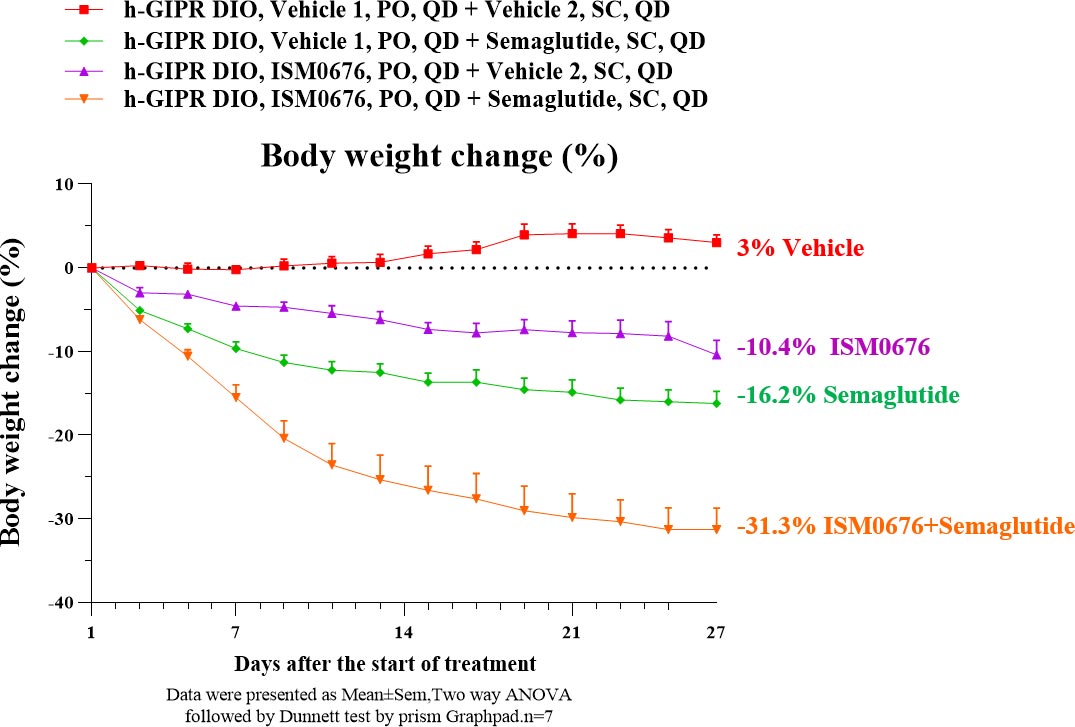
Further preclinical studies reinforced these findings, again showing meaningful reductions in body weight and improvements in body composition in DIO humanized GIPR mice. Over a 27-day dosing period, ISM0676 consistently achieved a 10.4% reduction in body weight, compared with weight gain in untreated controls. Combination treatment with Semaglutide substantially amplified these effects, producing a 31.3% reduction in body weight. Together, these results support continued advancement toward clinical development.
“Metabolism involves fundamental biological processes in human life and has long been considered one of the key aging hallmarks. To achieve longer, healthier lives, Insilico has been investing into metabolic disease research with AI-driven speed and precision, as we believe efforts in this area could produce the first health span extension therapies at scale,” said Alex Zhavoronkov, PhD., Founder and CEO, CBO of Insilico Medicine, “The nomination of ISM0676 reflects how our Pharma.AI platform can rapidly design and optimize promising molecules to address urgent needs, bringing benefits for patients worldwide.”
More broadly, the results add to a growing body of research suggesting that obesity drugs may improve by targeting multiple metabolic pathways rather than relying on GLP-1 alone. Whether an oral GIPR antagonist like ISM0676 can deliver meaningful, lasting benefits will ultimately depend on what happens in follow-up preclinical work and, eventually, human trials.
Never miss a breakthrough: Join the SciTechDaily newsletter.
Follow us on Google and Google News.
2 Comments
AI-Designed Obesity Drug Delivers Over 31% Weight Loss in Preclinical Tests
thanks
Many years away from actually being available assuming that the trials go well.