
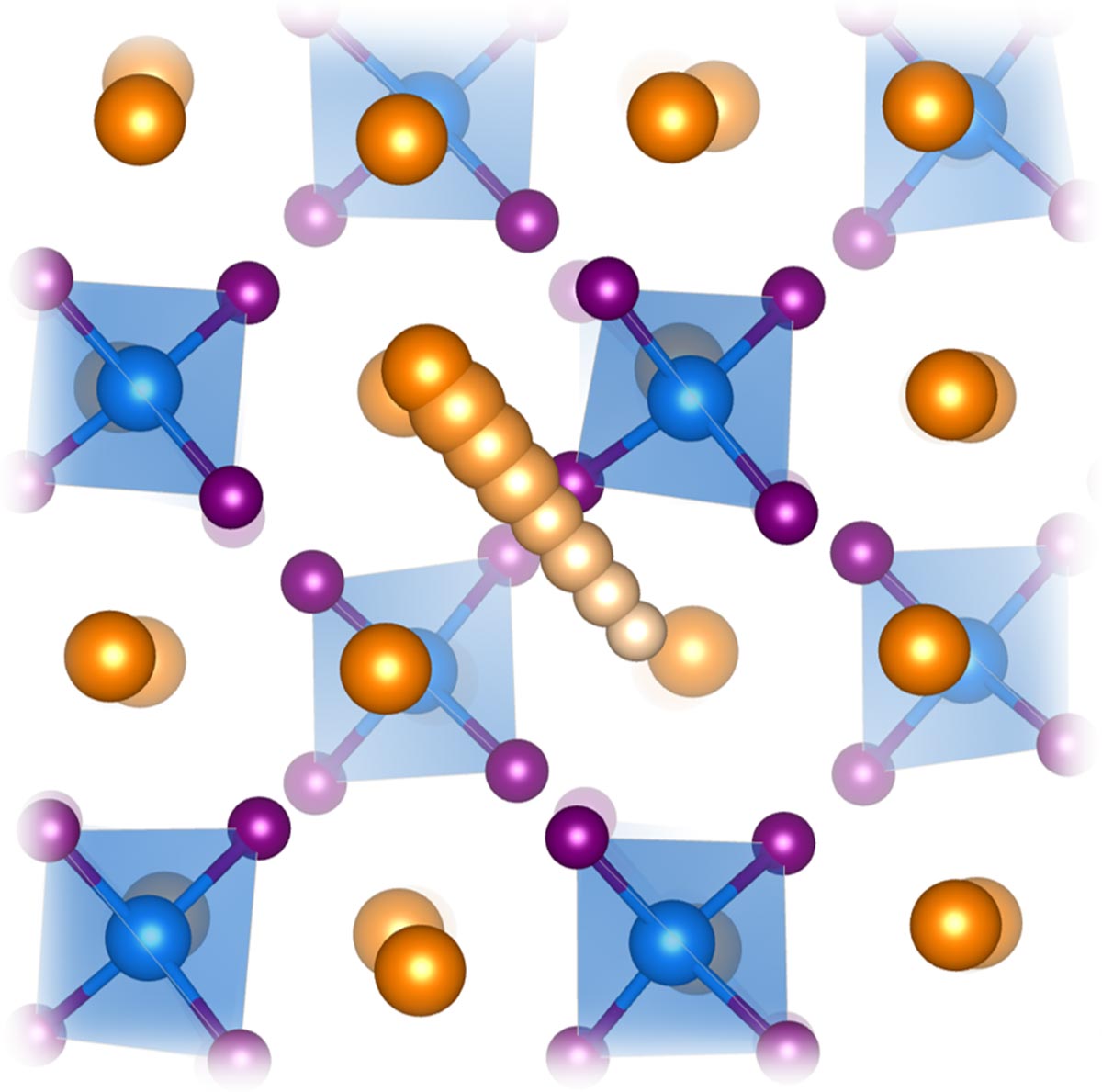
A new AI-driven technique spots the telltale Raman signal of liquid-like ion motion—helping scientists rapidly identify materials for next-generation solid-state batteries.
All-solid-state batteries (ASSB) are widely viewed as a safer and potentially more energy-dense alternative to conventional lithium-ion batteries. Their performance relies heavily on how quickly ions can move through solid electrolytes. Finding materials that enable this rapid ion transport has traditionally required extensive synthesis and experimental testing. Researchers also rely on computer simulations, but many existing computational approaches struggle to accurately represent the disordered and high-temperature conditions where ions move most freely.
Predicting when ions will move through a solid in a liquid-like way has been especially difficult. Standard computational methods that simulate these complex systems demand enormous computing resources, making them impractical for screening large numbers of candidate materials.
Machine Learning Predicts Raman Signatures of Fast Ion Conduction
To overcome these challenges, researchers developed a machine learning (ML) accelerated workflow that combines ML force fields with tensorial ML models to simulate Raman spectra. Their results show that strong low-frequency Raman intensity can serve as a clear spectroscopic marker of liquid-like ion conduction.
When ions travel through a crystal lattice in a fluid-like manner, their motion temporarily disturbs the symmetry of the structure. This disturbance relaxes the normal Raman selection rules and produces distinctive low-frequency Raman scattering. These spectral signals are closely associated with high ionic mobility. The new method achieves near-ab initio accuracy when simulating vibrational spectra of complex, disordered materials at realistic temperatures, while also lowering computational costs.
The team applied this workflow to sodium-ion conducting materials such as Na3SbS4. In these materials, strong low-frequency Raman features appeared when ions moved rapidly through the lattice. These signals arise from symmetry breaking caused by fast ion transport and provide a reliable indicator of efficient ionic conduction. The method also helps explain experimental observations reported in earlier studies and creates new opportunities for high-throughput screening of superionic materials.
Raman Signals Reveal Superionic Materials
The researchers confirmed the approach using several sodium-ion conductors. The model consistently identified Raman features linked to liquid-like ion motion. Materials that showed strong low-frequency Raman signals also exhibited high ionic diffusivity and dynamic relaxation of the host lattice.
In contrast, materials where ions move primarily by hopping between fixed positions did not produce the same spectral signatures. This difference highlights the connection between diffusive ion motion and the Raman features identified by the model.
Accelerating Discovery of Solid-State Battery Materials
By extending the concept of Raman selection rule breakdown beyond traditional superionic systems, the study introduces a broader framework for interpreting diffusive Raman scattering in many types of materials. The ML-accelerated Raman pipeline connects atomistic simulations with experimental measurements, allowing scientists to evaluate candidate materials more efficiently.
This strategy provides a powerful new pathway for data-driven materials discovery in energy storage. By identifying fast-ion conductors more quickly, the method could speed the development of high-performance solid-state battery technologies.
The findings were recently published in the online edition of AI for Science, an international journal dedicated to interdisciplinary artificial intelligence research.
Reference: “Revealing fast ionic conduction in solid electrolytes through machine learning accelerated Raman calculations” by Manuel Grumet, Takeru Miyagawa, Olivier Pittet, Paolo Pegolo, Karin S Thalmann, Waldemar Kaiser and David A Egger, 18 February 2026, AI for Science.
DOI: 10.1088/3050-287X/ae411a
Never miss a breakthrough: Join the SciTechDaily newsletter.
Follow us on Google and Google News.
1 Comment
thanks for this