

AI just helped scientists find five new materials that might outperform lithium in future batteries.
These discoveries could enable cheaper, safer, and more powerful energy storage by using elements like magnesium and zinc.
Tackling the Lithium-Ion Problem
Researchers at the New Jersey Institute of Technology (NJIT) are using artificial intelligence to address a major challenge in the future of energy storage: finding low-cost, environmentally friendly alternatives to lithium-ion batteries.
In a study published in Cell Reports Physical Science, a team led by Professor Dibakar Datta used generative AI to rapidly identify new porous materials that could transform the development of multivalent-ion batteries. These next-generation batteries rely on more widely available elements such as magnesium, calcium, aluminum, and zinc. Compared to lithium-ion batteries, which are increasingly strained by supply and sustainability concerns, multivalent-ion batteries represent a promising and more affordable path forward.
Why Multivalent-Ion Batteries Are the Future
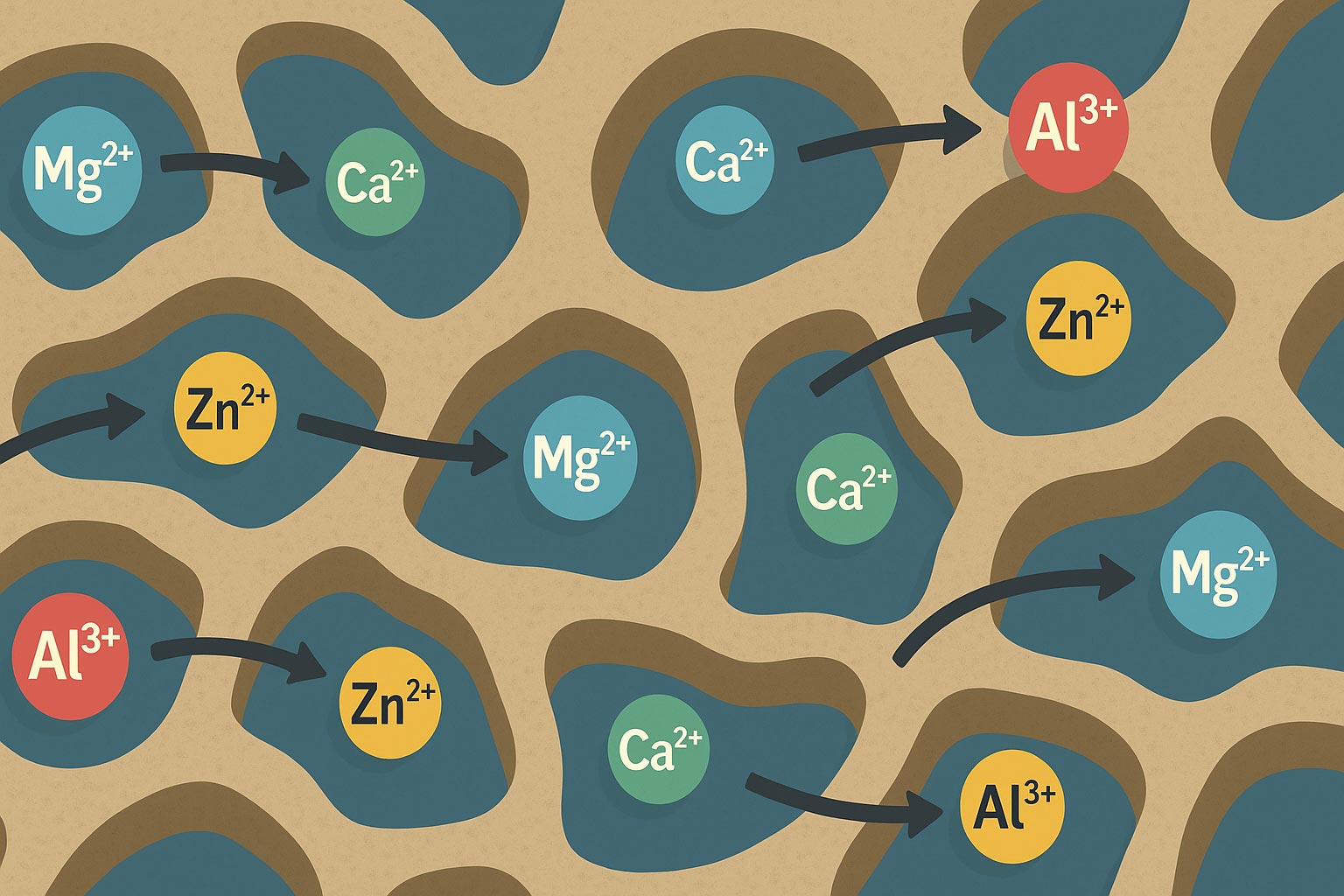
Multivalent-ion batteries differ from conventional lithium-ion versions by using ions that carry two or three positive charges instead of just one. This allows them to store much more energy, making them a compelling option for future energy storage technologies.
The challenge, however, lies in the larger size and stronger charge of these multivalent ions, which makes it difficult for them to move efficiently within standard battery materials. The NJIT team’s AI-powered approach was designed specifically to overcome this barrier by discovering materials better suited for handling these high-charge ions.
Turning to Generative AI for Solutions
“One of the biggest hurdles wasn’t a lack of promising battery chemistries — it was the sheer impossibility of testing millions of material combinations,” Datta said. “We turned to generative AI as a fast, systematic way to sift through that vast landscape and spot the few structures that could truly make multivalent batteries practical.
“This approach allows us to quickly explore thousands of potential candidates, dramatically speeding up the search for more efficient and sustainable alternatives to lithium-ion technology.”
The Power of Dual-AI: CDVAE and LLM
To overcome these hurdles, the NJIT team developed a novel dual-AI approach: a Crystal Diffusion Variational Autoencoder (CDVAE) and a finely tuned Large Language Model (LLM). Together, these AI tools rapidly explored thousands of new crystal structures, something previously impossible using traditional laboratory experiments.
The CDVAE model was trained on vast datasets of known crystal structures, enabling it to propose completely novel materials with diverse structural possibilities. Meanwhile, the LLM was tuned to zero in on materials closest to thermodynamic stability, crucial for practical synthesis.
Discovery of 5 Breakthrough Structures
“Our AI tools dramatically accelerated the discovery process, which uncovered five entirely new porous transition metal oxide structures that show remarkable promise,” said Datta. “These materials have large, open channels ideal for moving these bulky multivalent ions quickly and safely, a critical breakthrough for next-generation batteries.”
The team validated their AI-generated structures using quantum mechanical simulations and stability tests, confirming that the materials could indeed be synthesized experimentally and hold great potential for real-world applications.
Beyond Batteries: A Scalable Materials Revolution
Datta emphasized the broader implications of their AI-driven approach: “This is more than just discovering new battery materials — it’s about establishing a rapid, scalable method to explore any advanced materials, from electronics to clean energy solutions, without extensive trial and error.”
With these encouraging results, Datta and his colleagues plan to collaborate with experimental labs to synthesize and test their AI-designed materials, pushing the boundaries further towards commercially viable multivalent-ion batteries.
Reference: “Generative AI for discovering porous oxide materials for next-generation energy storage” by Joy Datta, Amruth Nadimpally, Nikhil Koratkar and Dibakar Datta, 26 June 2025, Cell Reports Physical Science.
DOI: 10.1016/j.xcrp.2025.102665
Never miss a breakthrough: Join the SciTechDaily newsletter.
Follow us on Google and Google News.
11 Comments
What happened to tin? That was being touted a few years back (in the clickbait headlines) as a multivalent-ion battery material to replace lithium.
Dilithium crystals worked for the federation.
Have you heard about hydrogen?
They’re going to make us miss protons for solving things in 2050, and in meantimes dig heat exchange loops that are also battery storage for the split (blower.)
I don’t understand why aren’t we using the old adage KISS ( keep it simple stupid!) the solution to size, power, availability, greener solutions. Is this two simple words Gravity Batteries first if we use existing things like old mines even quarry’s you could easily supply an avg size city with a couple old mines. So your infrastructure is already in place and paid for . You don’t have to harvest any significant resources its already in place. To me it’s a no brainer. It’s almost as if we are trying to look like big shots by developing technology we don’t really need at this point. Our power grid is already strained with AI now it isn’t going to hold up another year. …..SMH
Frequencies, Pyramids healing rooms,ceramic vase, and copper we still don’t know the mechanism that tied all together, We know they worked , but details of this by now.
If you do the math, gravity batteries are incredibly inefficient. Even with some “free” gradient, which doesn’t exist everywhere. it’s quite expensive. The exception is pumped hydro, but again, the topography isn’t always suitable, and it is not without its drawbacks.
And the materials it came up with are Nonexistium and Areyounutsium.
Interesting, but how easy or difficult will it be to actually manufacture them?
To Batteries
Or Not
To Batteries
Why are we still using batteries? Why do we need anything more along the lines of storage? Ok, starting capacitors, I get that, but that’s only for overcoming inertia. Zero point energy stores more than we can ever use. They want AI to tackle batteries? What a waste of resources. Instead of putting two AIs on two ends of one task, put all of AI onto one task…procuring the energy it and the rest of the world will need into the future Turn the best of AI to the zero point energy mechanics, solving the tech necessary to tap into that energy source.
“Zero Point” energy is the ultimate fraud. There is zero evidence that it exists at all, or, if it did, that there would be any practical way to exploit it. ZP energy makes fusion look practical and ready to go.