
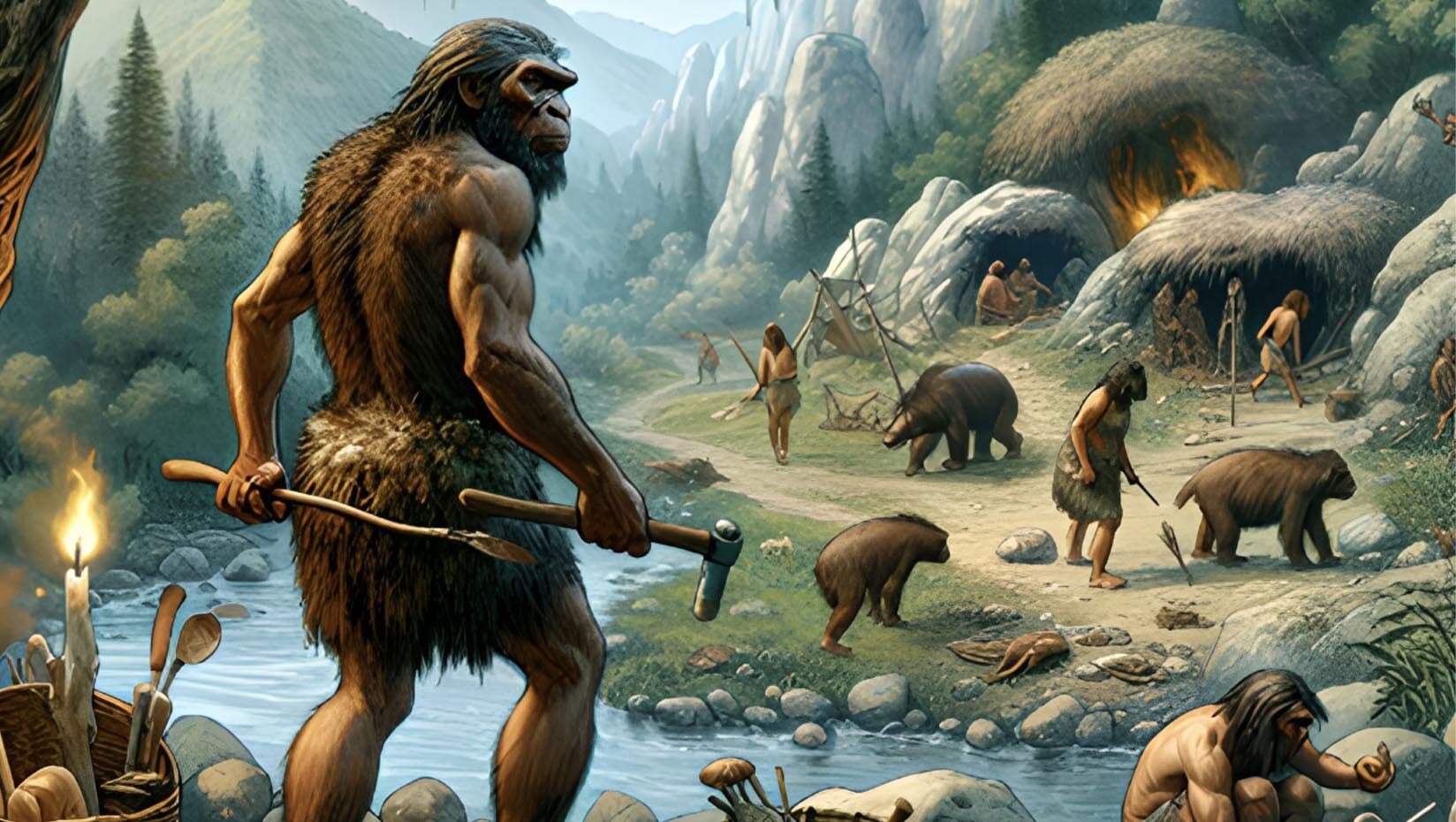
Generative AI can reproduce outdated scientific views, raising concerns about how it represents the past.
Technological progress over the past forty years has transformed computers and mobile devices into a vast, always accessible source of information, placing an immense digital library within easy reach.
Devices such as phones, laptops, tablets, and smartwatches have become deeply embedded in daily routines, making it easier to stay connected, informed, and entertained. Recent advances in generative artificial intelligence are further enhancing these capabilities, enabling people to retrieve information almost instantly. Whether someone is asking about prehistoric environments or checking their heart rate, AI can deliver responses faster than ever before. However, the reliability of those answers remains uncertain.
Generative AI is also shaping how people imagine and interpret the past. This growing influence has drawn attention from researchers across the United States, including Matthew Magnani at the University of Maine.
Magnani, an assistant professor of anthropology, collaborated with Jon Clindaniel, a professor at the University of Chicago who focuses on computational anthropology, to develop a framework grounded in long-established scientific research. They tasked two chatbots with generating images and written descriptions of Neanderthal daily life and reported their results in the journal Advances in Archaeological Practice.
Study design tests bias in outputs
Their analysis showed that the accuracy of AI-generated content depends heavily on the information sources it can access. In this case, both the visual and written outputs relied on outdated scientific material.
Magnani and Clindaniel conducted repeated trials using four different prompts, each run one hundred times. They used DALL-E 3 to create images and the ChatGPT API (GPT-3.5) to produce narratives. Some prompts explicitly asked for scientific accuracy, while others did not. Certain prompts also included additional details, such as clothing or activities, to provide context.
The objective was to examine how misinformation and bias about the past can emerge through everyday interactions with AI systems.
“It’s broadly important to examine the types of biases baked into our everyday use of these technologies,” Magnani said. “It’s consequential to understand how the quick answers we receive relate to state-of-the-art and contemporary scientific knowledge. Are we prone to receive dated answers when we seek information from chatbots, and in which fields?”
The project began in 2023, and within a short period, generative AI has shifted from an emerging technology to a widely used tool. Magnani noted that repeating the study today might yield different results if newer research were better integrated into these systems.
“Our study provides a template for other researchers to examine the distance between scholarship and content generated using artificial intelligence,” Magnani said.
Clindaniel emphasized that AI can be highly effective at processing large volumes of data and identifying patterns, but its usefulness depends on careful application and a strong connection to verified scientific knowledge.
AI reproduces outdated human history
Neanderthal remains were first described in 1864, and scientific interpretations of their behavior and appearance have changed repeatedly since then. Because of these evolving perspectives and remaining uncertainties, Neanderthals provided a useful case for evaluating how well AI systems handle complex and incomplete knowledge.
The generated images reflected outdated ideas from more than a century ago, portraying Neanderthals as primitive, ape-like figures with exaggerated body hair and hunched posture. These depictions also excluded women and children, reinforcing incomplete and biased representations.
The accompanying narratives similarly failed to capture the diversity and complexity of Neanderthal culture described in modern research. Roughly half of the text generated by ChatGPT did not align with current scientific understanding, and for one prompt, that figure exceeded eighty percent.
Both the images and written descriptions also included anachronistic elements such as basketry, thatched roofs, ladders, and materials like glass and metal, which do not match the historical period.
Training data shapes AI knowledge
By comparing the generated outputs with scientific literature from different time periods, Magnani and Clindaniel traced the likely sources of the information used by the AI systems. They found that ChatGPT’s responses aligned most closely with research from the 1960s, while DALL-E 3 reflected material from the late 1980s and early 1990s.
“One important way we can render more accurate AI output is to work on ensuring anthropological datasets and scholarly articles are AI-accessible,” Clindaniel said.
Restrictions introduced by copyright laws in the 1920s limited access to academic research for decades, until open access initiatives began expanding availability in the early 2000s. Future policies governing access to scholarly work are likely to shape how AI systems generate knowledge and influence public understanding of history.
“Teaching our students to approach generative AI cautiously will yield a more technically literate and critical society,” Magnani said.
Reference: “Artificial Intelligence and the Interpretation of the Past” by Matthew Magnani and Jon Clindaniel, 18 December 2025, Advances in Archaeological Practice.
DOI: 10.1017/aap.2025.10110
This research is part of a broader series in which Magnani and Clindaniel are investigating how artificial intelligence is being applied in archaeology and related fields.
Never miss a breakthrough: Join the SciTechDaily newsletter.
Follow us on Google and Google News.
1 Comment
Biased representations…
I’d say the CANDLE in the left foreground is a bigger problem 😆