
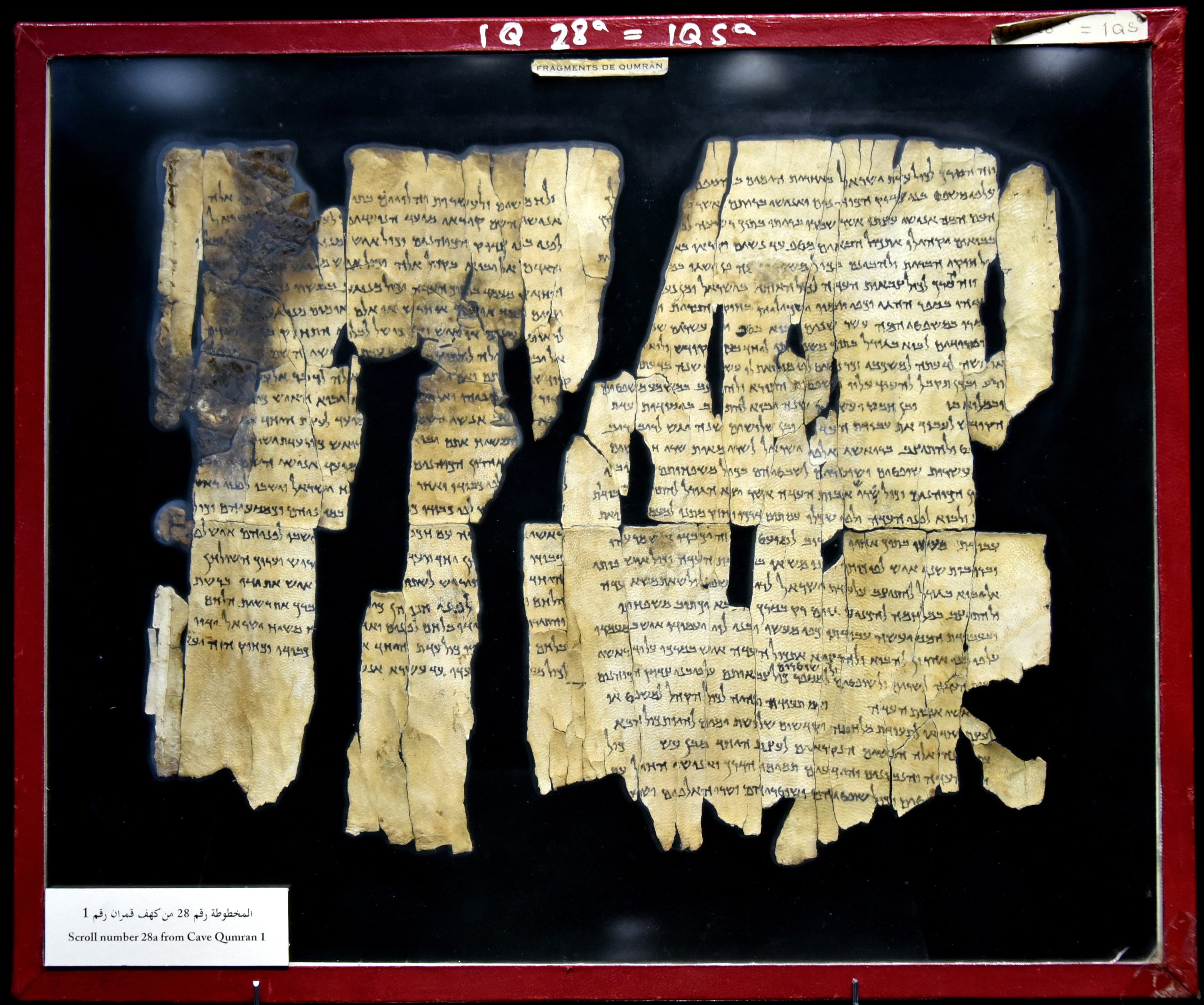

Using artificial intelligence and radiocarbon dating to determine the age of ancient manuscripts.
Since their discovery, the Dead Sea Scrolls have significantly deepened our understanding of Jewish and Christian origins. While scholars generally agree that the scrolls date from the third century BCE to the second century CE, pinpointing the age of individual manuscripts has remained uncertain. Now, an international team of researchers led by the University of Groningen has introduced a new model called Enoch, which uses radiocarbon dating, paleography, and artificial intelligence to produce more accurate, empirically grounded date estimates for each manuscript.
Their findings suggest that many scrolls are older than previously believed, and for the first time, they have confirmed that two biblical scroll fragments date back to the era of their traditionally attributed authors. The results were published on 4 June in the journal PLOS One.
Until now, most individual scrolls were dated primarily through paleography—the study of ancient handwriting. However, this method lacks a firm empirical basis. In most cases, calendar dates are unavailable, and there are no directly comparable date-bearing manuscripts from the relevant time period. A significant chronological gap exists between the few Aramaic and Hebrew manuscripts with known dates from the fifth to fourth centuries BCE and those from the late first to early second century CE, making it difficult to precisely date over a thousand Dead Sea Scrolls and fragments.
Digitized manuscripts
Researchers from the ERC project The Hands That Wrote the Bible have now filled this chronological gap by combining radiocarbon dating from 24 scroll samples with paleographic analysis using a machine-learning model based on Bayesian ridge regression.
The new radiocarbon dates serve as reliable, empirical time markers that link writing styles between the fourth century BCE and the second century CE. These markers provide objective dating for the scripts found in the analyzed manuscripts.
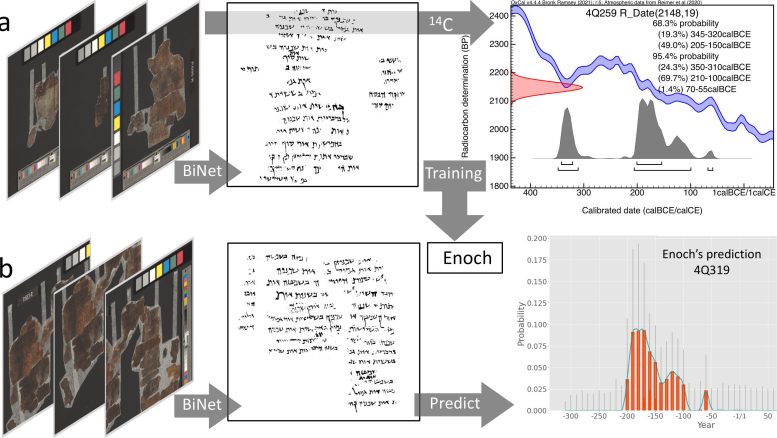
Using this data, the researchers trained a date-prediction model named Enoch. They employed BiNet, a deep neural network previously developed in-house, to detect ink-trace patterns in digitized manuscripts. BiNet performs a detailed geometric shape analysis of handwriting, examining both the microlevel curvature of ink traces (textural features) and the shape of characters (allographic features).
This approach offers a quantitative and empirical foundation for analyzing writing styles, something traditional paleography cannot achieve. Cross-validation tests showed that Enoch can estimate radiocarbon-based manuscript dates with a margin of error of approximately 30 years, which is even more accurate than direct radiocarbon dating for the period between 300 and 50 BCE.
The first machine-learning-based model
Now that Enoch is ready to use, researchers can begin dating the approximately one thousand Dead Sea manuscripts from this time period. As an initial step, they fed Enoch binarized images of 135 scrolls and had paleographers evaluate the resulting date predictions. With Enoch, scholars now have a powerful tool that can support, refine, or adjust their own subjective estimates for specific manuscripts, often narrowing the date to within just 50 years—even for texts written more than 2,000 years ago.
Enoch is the first complete machine-learning-based model that employs raw image inputs to deliver probabilistic date predictions for handwritten manuscripts, while ensuring transparency and interpretability through its explainable design. The combination of empirical evidence (radiocarbon from physics and character-shape-based analyses from geometry) brings a degree of quantified objectivity to paleography never before achieved in the field. And the methods underpinning Enoch can be used for date prediction in other partially-dated manuscript collections.
New chronology
First results from Enoch’s date predictions, presented in the PLOS One paper, demonstrate that many Dead Sea Scrolls are older than previously thought. This also changes how researchers should interpret the development of two ancient Jewish script styles which are called ‘Hasmonaean’ and ‘Herodian’. Specifically, manuscripts in Hasmonaean-type script can be older than the current estimate of ca. 150–50 BCE. And the Herodian-type script emerged earlier than previously thought, suggesting that these scripts existed next to each other since the late second century BCE instead of the mid-first century BCE which is the prevailing view.
This new chronology of the scrolls significantly impacts our understanding of political and intellectual developments in the eastern Mediterranean during the Hellenistic and early Roman periods (late fourth century BCE until second century CE). It allows for new insights to be developed about literacy in ancient Judaea in relation to historical, political, and cultural developments such as urbanization, the rise of the Hasmonaean dynasty, and the rise and development of religious groups such as those behind the Dead Sea Scrolls and the early Christians.
Anonymous authors
Furthermore, this study establishes 4QDanielc (4Q114) and 4QQoheleta (4Q109) to be the first known fragments of a biblical book from the time of their presumed authors. We do not know who exactly finished the Book of Daniel but the common assumption is that this author did so during the early 160s BCE.
Likewise, for Ecclesiastes (Qohelet), scholars assume that an anonymous author from the Hellenistic period (third century BCE) was behind this biblical book, instead of the view of tradition that it was King Solomon from the tenth century BCE. Our novel radiocarbon dating for 4Q114 and the Enoch date prediction for 4Q109 place these manuscripts in the same time as these anonymous authors from respectively the second and third centuries BCE. Thus, these results have now created the opportunity to study tangible evidence of the hands that wrote the Bible.
Reference: “Dating ancient manuscripts using radiocarbon and AI-based writing style analysis” by Mladen Popović, Maruf A. Dhali, Lambert Schomaker, Johannes van der Plicht, Kaare Lund Rasmussen, Jacopo La Nasa, Ilaria Degano, Maria Perla Colombini and Eibert Tigchelaar, 4 June 2025, PLOS ONE.
DOI: 10.1371/journal.pone.0323185
Funding: European Research Council
Never miss a breakthrough: Join the SciTechDaily newsletter.
Follow us on Google and Google News.