
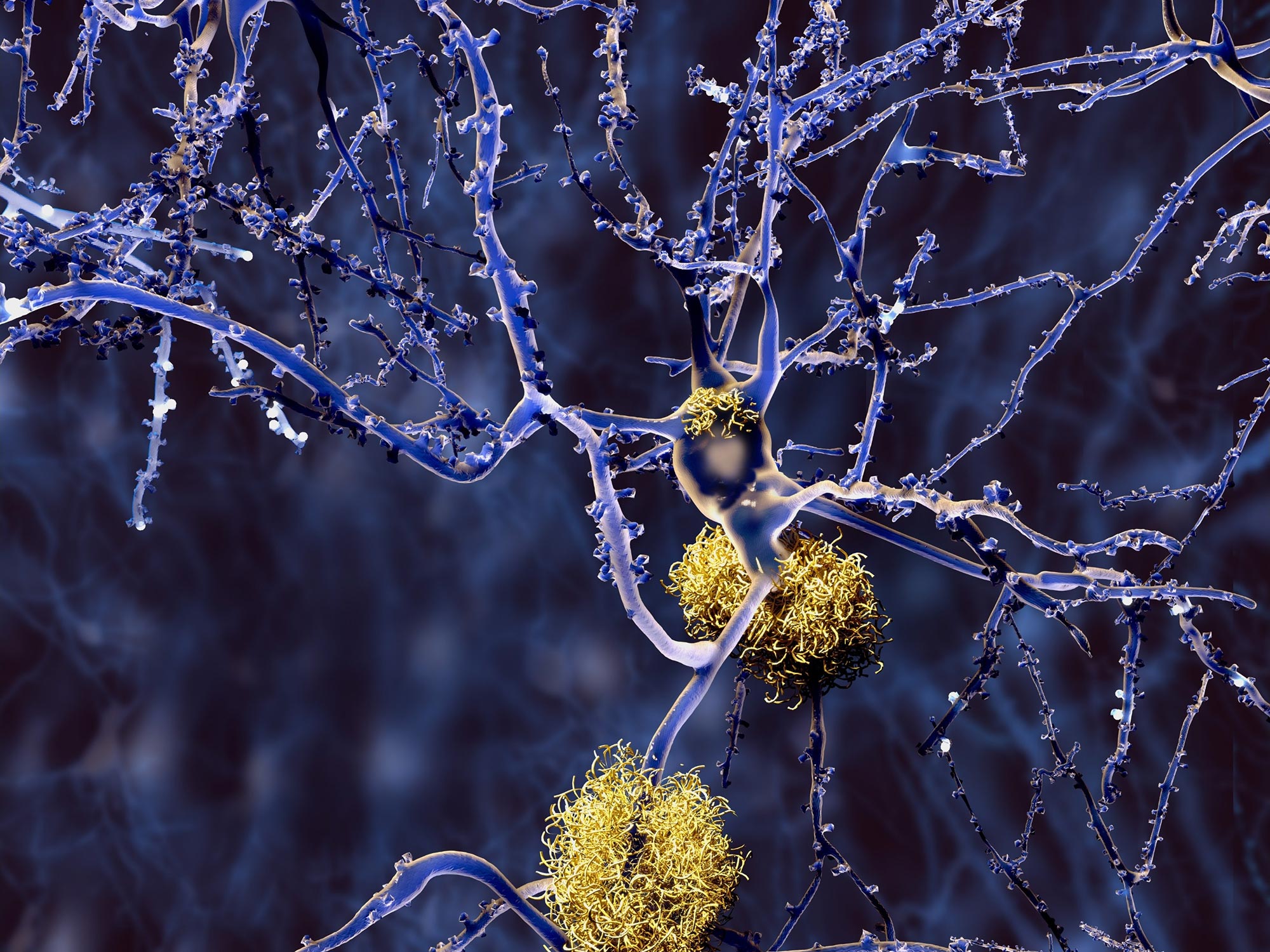
AI model reveals the structural secrets of misfolded proteins.
A new artificial intelligence (AI) tool has provided critical insights into how disease-related proteins misfold into harmful structures, an important step forward in understanding neurodegenerative diseases such as Alzheimer’s and Parkinson’s.
The research, led by Mingchen Chen of Changping Laboratory and Peter Wolynes of Rice University, introduces RibbonFold, a novel computational method designed to predict the structures of amyloids—long, twisted protein fibers that build up in the brains of individuals with neurodegenerative conditions. The findings were published on April 15 in the Proceedings of the National Academy of Sciences.
Unlike existing tools that focus on normally functioning proteins, RibbonFold is specifically developed to model the diverse and irregular shapes formed by misfolded proteins.
“We’ve shown how AI folding codes can be constrained by incorporating a physical understanding of the energy landscape of amyloid fibrils to predict their structures,” said Wolynes, the D.R. Bullard-Welch Foundation Professor of Science and co-director of the Center for Theoretical Biological Physics. “RibbonFold outperforms other AI-based prediction tools like AlphaFold, which were trained only to predict correctly folded globular protein structures.”
Eclipsing the gold standard
RibbonFold builds on recent advances in AI-driven protein structure prediction. Unlike tools such as AlphaFold2 or AlphaFold3, which are trained on well-behaved, globular proteins, RibbonFold includes constraints suited to capture the ribbon-like characteristics of amyloid fibrils. The researchers trained the model using existing structural data on amyloid fibrils, then validated it against other known fibril structures deliberately excluded from the training.
Their results demonstrated that RibbonFold outperforms existing AI tools in this specialized domain and reveals previously overlooked nuances in how amyloids form and evolve in the body. Importantly, it suggests that fibrils may begin in one structural form but may shift into more insoluble configurations over time, contributing to disease progression.

“Misfolded proteins can take on many different structures,” Wolynes said. “Our method shows that stable polymorphs will likely win out over time by being more insoluble than other forms, explaining the late onset of symptoms. This idea could reshape how researchers approach neurodegenerative disease treatment.”
New frontier in drug development and beyond
RibbonFold’s success in predicting amyloid polymorphs may mark a turning point in how scientists can approach neurodegenerative diseases.
Offering a scalable, accurate method for analyzing the structure of harmful protein aggregates, RibbonFold opens new possibilities for drug development. Pharmaceutical researchers can now target drug design by binding to the most disease-relevant fibril structures with greater precision.
“This work not only explains a long-standing problem but also equips us with the tools to systematically study and intervene in one of life’s most destructive processes,” said Chen, co-corresponding author of the study.
Beyond medicine, these findings offer insights into protein self-assembly, which could impact synthetic biomaterials. In addition, the study resolves a critical mystery in structural biology: why identical proteins can fold into multiple disease-causing forms.
“The ability to predict amyloid polymorphs efficiently may guide future breakthroughs in preventing harmful protein aggregation, a crucial step toward tackling some of the world’s most pressing neurodegenerative challenges,” Wolynes said.
Reference: “Generating the polymorph landscapes of amyloid fibrils using AI: RibbonFold” by Liangyue Guo, Qilin Yu, Di Wang, Xiaoyu Wu, Peter G. Wolynes and Mingchen Chen, 15 April 2025, Proceedings of the National Academy of Sciences.
DOI: 10.1073/pnas.2501321122
Other authors of this study include co-first authors Liangyue Guo and Qilin Yu along with Di Wang and Xiaoyu Wu of the Changping Laboratory. The study had support from the National Science Foundation, the Welch Foundation and the Changping Laboratory.
Never miss a breakthrough: Join the SciTechDaily newsletter.
Follow us on Google and Google News.
1 Comment
Put Chuck Schumer on it. He may be impotent and flaccid and unable to accomplish anything, but I hear he does write a very strong letter. With men like that in leadership he can push through anything to cure disease. It only takes a very strong letter.