
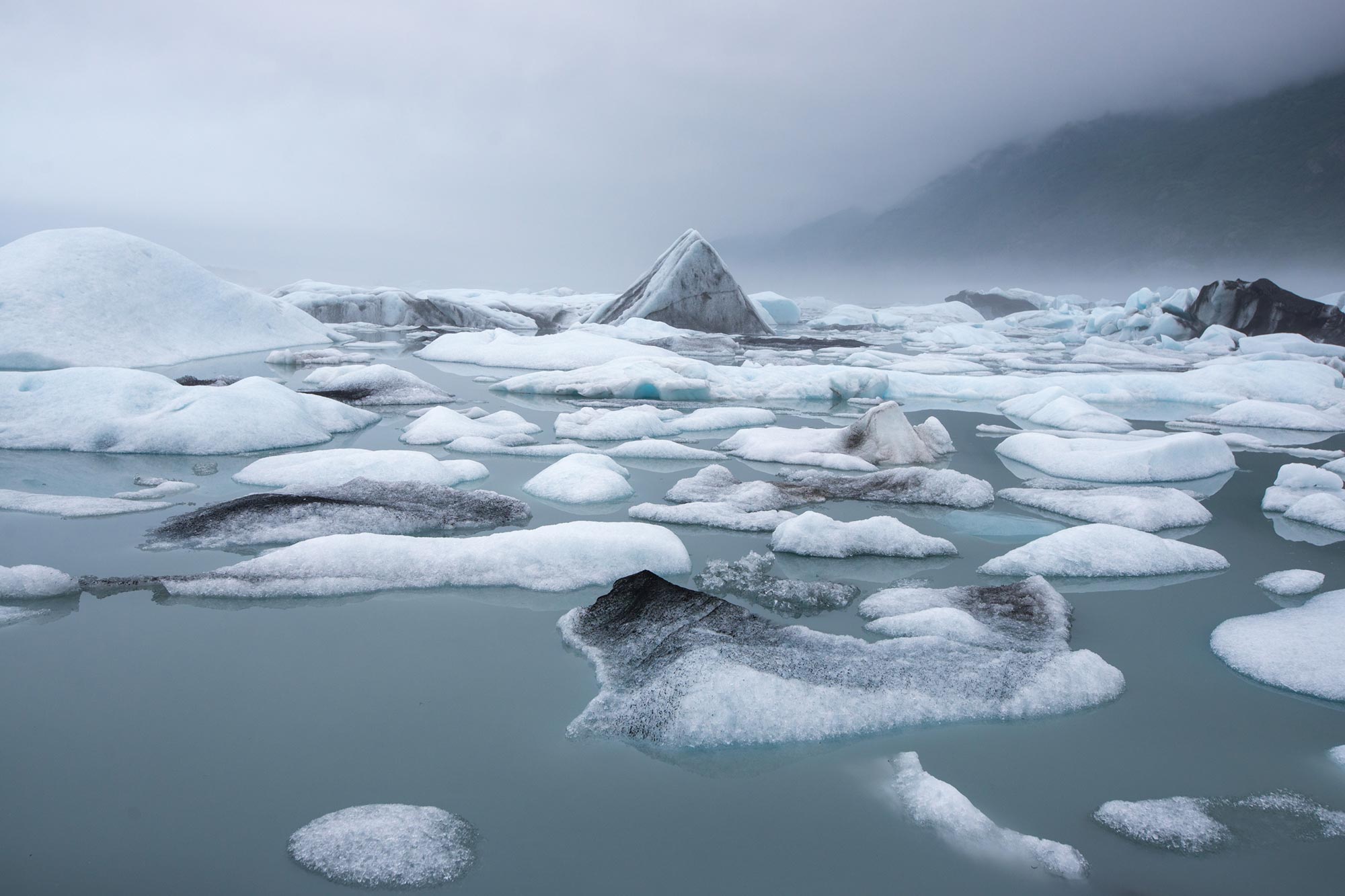
Along Alaska’s northern coast, a subtle but significant shift is unfolding as landfast sea ice forms later, disappears sooner, and covers less area than in previous decades.
Sea ice along Alaska’s northern coastline is lasting for shorter periods each year, based on a 27-year analysis by scientists at the University of Alaska Fairbanks.
This type of ice, known as landfast ice, remains attached to the shore rather than drifting with winds and currents. In recent winters, it has also covered a smaller overall area.
The study, led by research professor Andrew Mahoney of the University of Alaska Fairbanks Geophysical Institute, was published in January in the Journal of Geophysical Research: Oceans. Former UAF graduate student Andrew Einhorn is a co-author.
The research expands on a 2014 study by Mahoney that examined data from 1996 to 2008. The updated analysis focuses on the Chukchi and Beaufort seas.
Importance for Communities and Industry
Landfast sea ice has been declining in the Chukchi Sea for decades. The new findings show that ice in the Beaufort Sea, which remained relatively stable from the 1970s through the early 2000s, has also begun to decrease in recent years.
“Landfast ice is the ice that is used by people,” Mahoney said. “It has a much more immediate connection with humans.”
People in coastal communities depend on this stable ice to travel to hunting and fishing areas. The oil and gas industry also relies on it to build seasonal ice roads that connect to nearshore facilities. In addition, landfast ice helps protect coastlines from strong waves and allows river water to extend farther offshore.
“The shortening of the landfast ice season may matter even more for coastal communities than any loss of ice area during that season,” Mahoney said, “because it leaves shorelines more exposed to waves and makes hunting conditions much more uncertain.”
A Shorter Ice Season
The landfast ice season is getting shorter mainly because ice is forming later in the year. Even when air temperatures fall below freezing in autumn, the ocean retains heat longer, delaying the formation of solid coastal ice.
From 1996–2023, the landfast ice season shortened by 57 days in the Chukchi Sea and 39 days in the Beaufort Sea. In the Chukchi, both later formation and earlier breakup contributed to the change. In the Beaufort, the shift is driven by later formation alone.
Sea ice can attach to land in several ways. It may freeze directly to the shoreline, anchor to shallow areas of the seafloor, or connect with grounded ice ridges. These ridges form when chunks of sea ice are pushed together near the coast, piling up until they are thick enough to rest on the seafloor.
Changing Ice Dynamics in the Arctic
“Landfast ice is diminishing with the rest of the ice in the Arctic,” Mahoney said. “In some ways, it is following the same trends as we see in the rest of the Arctic, but we are also seeing some new changes.”
The decline in Beaufort Sea landfast ice is also reflected in its share of total landfast ice on the U.S. Outer Continental Shelf. This proportion fell from 3.8% during the first nine years of the 27-year record to 2% during the final nine years, 2014–2023.
The researchers also found that Beaufort Sea landfast ice is no longer extending as far offshore as it once did. In earlier years, it regularly reached waters about 20 meters (66 feet) deep, a feature that once set the Beaufort apart from other Arctic regions where retreat had already been observed.
The Role of Thinning Ice
The researchers suggest that this decline is linked to the overall thinning of Arctic sea ice. Thinner ice produces fewer ridges with deep bases that can anchor to the seafloor and stabilize the ice.
“We are seeing evidence that grounded ridges are not forming where they used to,” Mahoney said.
Mahoney noted that more research is needed to determine the cause.
“This is where the chicken and egg part of it comes in,” he said, “because once a ridge becomes grounded, it acts like a traffic jam; additional ice piles up into it and it becomes larger and larger.”
“But we don’t yet know whether the action that starts the ridge just isn’t happening or whether the traffic jam afterward isn’t happening,” he said. “For one reason or another, we don’t see evidence of grounded ridges where they had been forming, and that’s the outcome you would expect if the ice is getting thinner.”
Reference: “The Evolving Decline of Landfast Sea Ice in Northern Alaska and Adjacent Waters: Results from an Updated Climatology” by Andrew R. Mahoney and Andrew H. Einhorn, 1 January 2026, Journal of Geophysical Research: Oceans.
DOI: 10.1029/2025JC022464
The new extended work uses data from the National Ice Center and the National Weather Service Alaska Sea Ice Program.
Never miss a breakthrough: Join the SciTechDaily newsletter.
Follow us on Google and Google News.
1 Comment
When the authors say “is,” it would appear that they are including the years since 2012, which have been unlike the previous years with respect to total ice coverage. Personally, I would like to see the actual historical ice coverage, instead of just their verbal summary, as can be seen here:
https://wattsupwiththat.com/reference-pages/sea-ice-page/
The claimed “subtle” changes may be related to the fact that a low was achieved over 13 years ago, out of the 27-years they looked at. The ice coverage still appears to be declining, but it looks like it probably will be several years before it again reaches the annual low achieved in 2012 — if 2025 isn’t a harbinger of a change in the trend.