

Close Menu
    Facebook X (Twitter) Instagram
    SciTechDaily
    • Biology
    • Chemistry
    • Earth
    • Health
    • Physics
    • Science
    • Space
    • Technology
    Facebook X (Twitter) Pinterest YouTube RSS
    SciTechDaily
    Home»Space»Alien Eavesdropping: How SETI’s Latest Technology Scoured TRAPPIST-1 for Otherworldly Communications
    Space

    Alien Eavesdropping: How SETI’s Latest Technology Scoured TRAPPIST-1 for Otherworldly Communications

    By SETI InstituteOctober 16, 20242 Comments4 Mins Read
    Facebook Twitter Pinterest Telegram LinkedIn WhatsApp Email Reddit
    Share
    Facebook Twitter LinkedIn Pinterest Telegram Email Reddit
    TRAPPIST-1f Surface
    This artist’s concept allows us to imagine what it would be like to stand on the surface of the exoplanet TRAPPIST-1f, located in the TRAPPIST-1 system in the constellation Aquarius. Credit: NASA/JPL-Caltech

    Scientists at SETI and Penn State deployed the Allen Telescope to probe TRAPPIST-1 for alien signals over 28 hours.

    Utilizing planet-planet occultations and enhanced scanning technology, they identified potential signals, none of which were extraterrestrial, but the methods developed promise future success. This project marks the longest single-target search for radio signals from TRAPPIST-1.

    SETI’s Intensive Search at TRAPPIST-1

    Researchers from the SETI Institute and Penn State University utilized the Allen Telescope Array to conduct a 28-hour scan of the TRAPPIST-1 star system, searching for radio signals indicative of alien technology. This effort represents the most extended search focused solely on TRAPPIST-1 to date. While no signs of extraterrestrial technology were found, the project yielded important data and pioneered a novel approach for future signal searches.

    “This research shows we are getting closer to detecting radio signals similar to the ones we send into space,” said Nick Tusay, a graduate student research fellow at Penn State University. “Most searches assume some intent, like beacons, because our receivers have a sensitivity limit to a minimum transmitter power beyond anything we unintentionally send out. But, with better equipment, like the upcoming Square Kilometer Array (SKA), we might soon be able to detect signals from an alien civilization communicating with its spacecraft.”

    Planet Planet Occultation
    Planet Planet Occultation. Credit: Zayna Sheikh

    The Role of Planet-Planet Occultations in SETI

    The project focused on a phenomenon called planet-planet occultations (PPOs). PPOs happen when one planet moves in front of another. If intelligent life exists in that star system, radio signals sent between planets could leak and be detected from Earth.

    Using the upgraded ATA, the team scanned a wide range of frequencies, looking for narrowband signals, which are considered possible signs of alien technology. The team filtered millions of potential signals, narrowing down to about 11,000 candidates for detailed analysis. The team detected 2,264 of these signals during predicted PPO windows. However, none of the signals were of non-human origin.

    The ATA’s new capabilities, which include advanced software to filter signals, helped the team separate possible alien signals from Earth-based ones. They believe that refining these methods and focusing on events like PPOs could help increase the chances of detecting alien signals in the future.
    TRAPPIST-1 System
    TRAPPIST-1 is a remarkable star system located about 41 light years away from Earth, notable for its seven Earth-sized planets, several of which lie in the star’s habitable zone. This ultra-cool dwarf star has captured the attention of astronomers due to its potential for hosting life-sustaining conditions, making it a prime target for studies focused on exoplanet atmosphere and the possibility of alien life. Credit: NASA and JPL/Caltech

    Engaging the Next Generation in SETI Research

    “This project included work by undergraduate students in the 2023 SETI Institute Research Experience for Undergraduates (REU) program,” said Dr. Sofia Sheikh, a SETI researcher at the SETI Institute. “The students looked for signals from human-made orbiters around Mars to check if the system could detect signals correctly. It was an exciting way to involve students in cutting-edge SETI research.”

    The TRAPPIST-1 system is a small, cool star about 41 light years from Earth. It has seven rocky planets, some of which are in the habitable zone, where conditions might allow liquid water to exist—an essential ingredient for life as we know it. This makes TRAPPIST-1 a prime target searching for life beyond Earth.

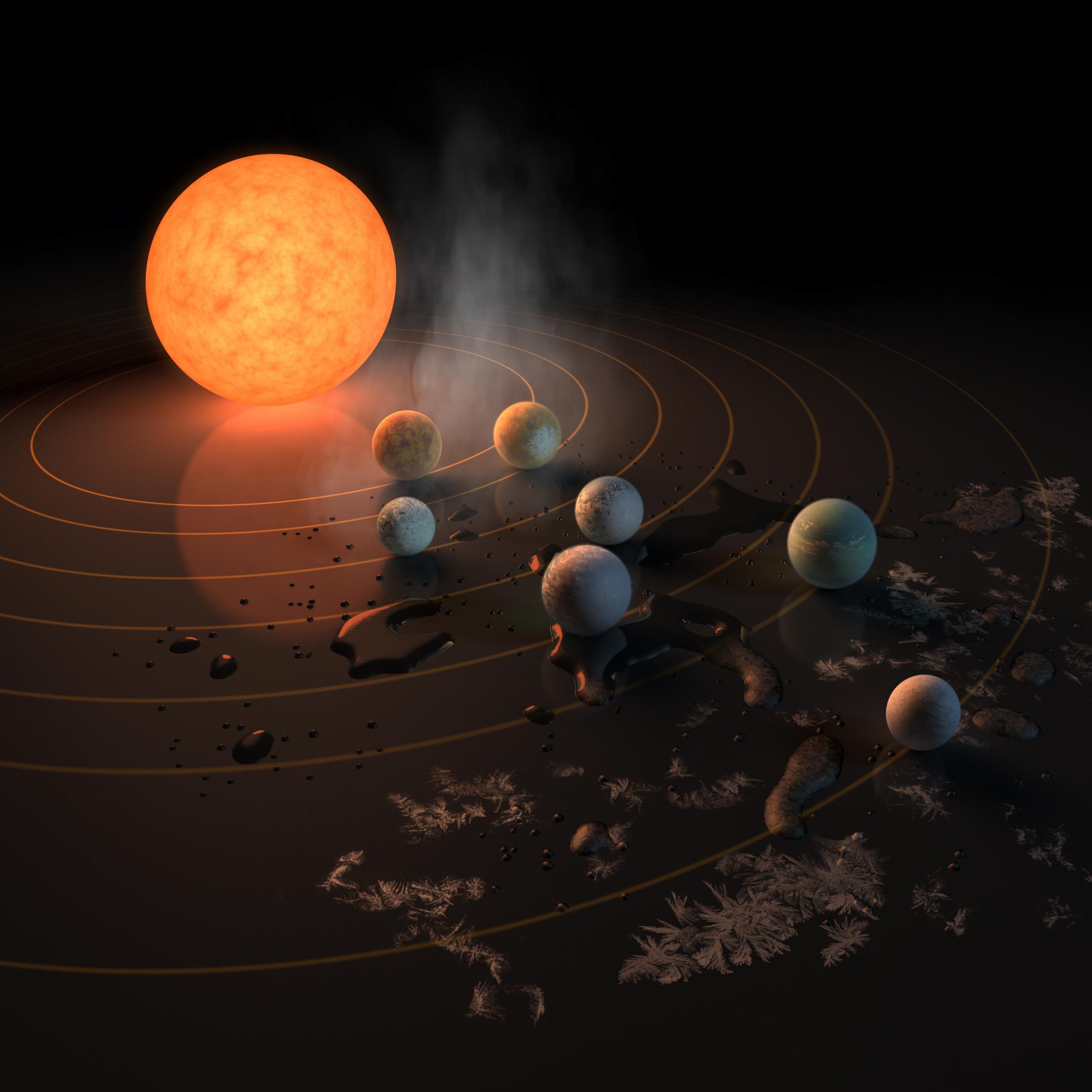
    TRAPPIST-1 Planetary System
    This illustration shows what the TRAPPIST-1 planetary system may look like, based on available data about the planets’ diameters, masses, and distances from the host star. Astronomers have named them the planets TRAPPIST-1a, TRAPPIST-1b, and so forth. Credit: NASA/JPL-Caltech

    Future Prospects in Extraterrestrial Signal Detection

    The team did not find any alien signals this time, but they will continue improving their search techniques and exploring other star systems. Future searches with bigger and more powerful telescopes could help scientists detect even fainter signals and expand our understanding of the universe.

    A paper describing the research is accepted for publication in the Astronomical Journal and is available online as a preprint.

    Reference: “A Radio Technosignature Search of TRAPPIST-1 with the Allen Telescope Array” 16 October 2024, The Astronomical Journal.
    DOI: 10.48550/arXiv.2409.08313

    Never miss a breakthrough: Join the SciTechDaily newsletter.
    Follow us on Google and Google News.

    Astronomy Exoplanet SETI Institute TRAPPIST-1
    Share. Facebook Twitter Pinterest LinkedIn Email Reddit

    Related Articles

    Alien Atmosphere? Webb Telescope Uncovers Surprising Secrets of Trappist-1 b

    TRAPPIST-1b: Bare Rock or Hazy Alien World? Webb’s Surprising Discovery

    Breakthrough Technique Could Reveal Alien Communications Between Planets

    Exploring Alien Worlds With NASA’s Webb Space Telescope: TRAPPIST-1 System

    Orbital Harmony of TRAPPIST-1 Planets Could Survive Only Limited Early Bombardment

    TRAPPIST-1 Exoplanets Potentially Hold More Water Than Earth

    Astronomers Conduct First Atmospheric Survey of Earth-Sized Planets Orbiting TRAPPIST-1

    TRAPPIST-1 Exoplanets May Have Liquid Water on Their Surfaces

    Astronomers Reveal TRAPPIST-1 Planetary System is Older Than Our Solar System

    2 Comments

    1. LGM on October 16, 2024 11:38 am

      “The team detected 2,264 of these signals during predicted PPO windows. However, none of the signals were of non-human origin.”

      I humbly suggest that all of the signals were of non-human origin. They were not created by humans.

      Reply
    2. Samuel Bess on October 17, 2024 9:48 am

      Billions spent listening fir a voice that was not created. Billions spent on technology looking for a will-o-the wisp fantasy theory that life
      Resides elsewhere. Massive waste
      Of resources that redirected could solve prob l em’s here, where all life was created.

      Reply
    Leave A Reply Cancel Reply

    • Facebook
    • Twitter
    • Pinterest
    • YouTube

    Don't Miss a Discovery

    Subscribe for the Latest in Science & Tech!

    Trending News

    One of the Universe’s Largest Stars May Be Getting Ready To Explode

    Scientists Discover Enzyme That Could Supercharge Ozempic-Like Weight Loss Drugs

    Popular Sweetener Linked to DNA Damage – “It’s Something You Should Not Be Eating”

    Ancient “Rock” Microbes May Reveal How Complex Life Began

    Researchers Capture Quantum Interference in One of Nature’s Rarest Atoms

    “A Plague Is Upon Us”: The Mass Death That Changed an Ancient City Forever

    Scientists Discover Game-Changing New Way To Treat High Cholesterol

    This Small Change to Your Exercise Routine Could Be the Secret to Living Longer

    Follow SciTechDaily
    • Facebook
    • Twitter
    • YouTube
    • Pinterest
    • Newsletter
    • RSS
    SciTech News
    • Biology News
    • Chemistry News
    • Earth News
    • Health News
    • Physics News
    • Science News
    • Space News
    • Technology News
    Recent Posts
    • Natural Compounds Boost Bone Implant Success While Killing Bacteria and Cancer Cells
    • After 60 Years, Scientists Uncover Unexpected Brain Effects of Popular Diabetes Drug Metformin
    • New Research Uncovers Hidden Side Effects of Popular Weight-Loss Drugs
    • Scientists Rethink Extreme Warming After Surprising Ocean Discovery
    • The Surprising Role of Asteroids in the Origin of Life
    Copyright © 1998 - 2026 SciTechDaily. All Rights Reserved.
    • Science News
    • About
    • Contact
    • Editorial Board
    • Privacy Policy
    • Terms of Use

    Type above and press Enter to search. Press Esc to cancel.