
Close Menu
    Facebook X (Twitter) Instagram
    SciTechDaily
    • Biology
    • Chemistry
    • Earth
    • Health
    • Physics
    • Science
    • Space
    • Technology
    Facebook X (Twitter) Pinterest YouTube RSS
    SciTechDaily
    Home»Space»ALMA Reveals Rings and Gaps in Developing Planetary System Elias 24
    Space

    ALMA Reveals Rings and Gaps in Developing Planetary System Elias 24

    By Megan Watzke, Harvard-Smithsonian Center For AstrophysicsMarch 30, 2018No Comments3 Mins Read
    Facebook Twitter Pinterest Telegram LinkedIn WhatsApp Email Reddit
    Share
    Facebook Twitter LinkedIn Pinterest Telegram Email Reddit
    ALMA Discovers Rings and Gaps in a Developing Planetary System
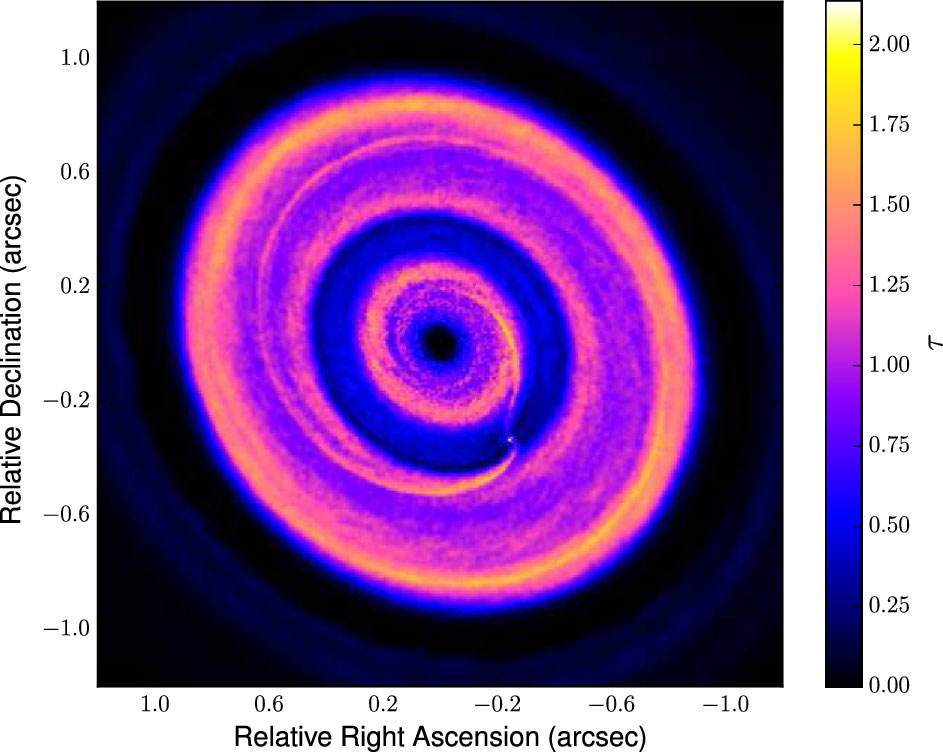
    A model of the dust ring around the young star Elias 24 produced from simulations based on new ALMA millimeter images of the system. The model finds that the dust was shaped by a planet with 70% of Jupiter’s mass located about 60 au from the star. Optical depth map at 1.3 mm of our model. Most of the disc is marginally optically thick, apart from the outer ring region. Credit: Dipierro et al. 2018

    The discovery of an exoplanet has most often resulted from the monitoring of a star’s flicker (the transiting method) or its wobble (the radial velocity method). Discovery by direct imaging is rare because it is so difficult to spot a faint exoplanet hidden in the glare of its host star. The advent of the new generation of radio interferometers (as well as improvements in near-infrared imaging), however, has enabled the imaging of protoplanetary discs and, in the disc substructures, the inference of orbiting exoplanets. Gaps and ring-like structures are particularly fascinating clues to the presence or ongoing formation of planets.

    Rings of dust have already been identified in many protoplanetary systems from their infrared and submillimeter emission. The origin of these rings is debated. They might have formed from dust “pile-up,” dust settling, gravitational instabilities, or even from variations in the optical properties of the dust. Alternatively, the rings could result dynamically from the orbital motions of planets that have already developed or that are well on their way. Planets will induce waves in the dusty discs which, as they dissipate, can produce gaps or rings. The key to solving the problem is recognizing that different-sized dust grains behave differently, with small grains being strongly coupled to the gas and so track the gas mass, whereas larger grains (millimeter-sized or larger) tend to follow pressure gradients and concentrate near gap edges.

    CfA astronomers Sean Andrews and David Wilner were members of a team of scientists who used the ALMA facility to image the dust around the young star Elias 24 with a resolution of about 28 au (one astronomical unit is about the average distance of the Earth from the Sun). The astronomers find evidence for gaps and rings and, assuming these are produced by an orbiting planet, they model the system allowing both the planet’s mass and location and the dust’s density distribution to evolve. Their best model explains the observations quite well: after about forty-four thousand years the inferred planet has a mass 70% of Jupiter’s mass and is located 61.7 au from the star. The result reinforces the conclusion that both gaps and rings are prevalent in a wide variety of young circumstellar disks, and signal the presence of orbiting planets.

    Reference: “Rings and Gaps in the Disc Around Elias 24 Revealed by ALMA” by G Dipierro, L Ricci, L Pérez, G Lodato, R D Alexander, G Laibe, S Andrews, J M Carpenter, C J Chandler, J A Greaves, C Hall, T Henning, W Kwon, H Linz, L Mundy, A Sargent, M Tazzari, L Testi and D Wilner, 23 January 2018, MNRAS.
    DOI: 10.1093/mnras/sty181

    Never miss a breakthrough: Join the SciTechDaily newsletter.
    Follow us on Google and Google News.

    ALMA Astronomy Harvard-Smithsonian Center for Astrophysics Planetary Science
    Share. Facebook Twitter Pinterest LinkedIn Email Reddit

    Related Articles

    ALMA Observes Gas Emission in a Protoplanetary Disk

    ALMA Views Fomalhaut Star System in Never-Before-Seen Detail

    Astronomers Reveal a Planet Forming in an Earth-Like Orbit Around Young Star TW Hydrae

    ALMA Telescope Reveals Planetary Influences on Young Stellar Disks

    ALMA Reveals First Ever Snow Line Seen Around a Distant Star

    Earth-like Planets May Have Older and More Evolved Life

    Kepler Data Suggests 17 Billion Earth-Sized Worlds in the Milky Way

    A New Subclass of Extra-Solar Planets Discovered

    Near Miss Asteroid – An Opportunity To Test a Rapid Response Program

    Leave A Reply Cancel Reply

    • Facebook
    • Twitter
    • Pinterest
    • YouTube

    Don't Miss a Discovery

    Subscribe for the Latest in Science & Tech!

    Trending News

    Just a Few Breathless Minutes a Day Could Slash Your Risk of 8 Major Diseases

    This Simple Habit Could Cut Your Risk of Dementia by 30%

    Scientists Debunk Rattlesnake Myth That Fooled Hikers and Doctors for Decades

    Scientists Discover Plants Can “Count” – and May Be Smarter Than We Thought

    New Research Reveals Ancient Mars May Have Been Warm, Wet – and Possibly Alive

    This Surprising Daily Habit Could Cut Dementia Risk by 35%

    Just 10 Minutes a Day: Scientists Say This Ancient Chinese Practice Shows Powerful Blood Pressure Benefits

    Scientists Say This Popular Food Could Help Your Body Get Rid of Microplastics

    Follow SciTechDaily
    • Facebook
    • Twitter
    • YouTube
    • Pinterest
    • Newsletter
    • RSS
    SciTech News
    • Biology News
    • Chemistry News
    • Earth News
    • Health News
    • Physics News
    • Science News
    • Space News
    • Technology News
    Recent Posts
    • 160,000 Years Ago, Hominins in China Were Far More Advanced Than We Thought
    • Teenager’s Fossil Find Leads to Discovery of Shark Teeth in 5 Million-Year-Old Whale Skull
    • Weight-Loss Drugs Like Ozempic Are Creating a Hidden Environmental Disaster
    • Even Occasional Binge Drinking May Triple Liver Damage Risk
    • Quantum Circuits Have a Hidden Weakness and It Changes Everything
    Copyright © 1998 - 2026 SciTechDaily. All Rights Reserved.
    • Science News
    • About
    • Contact
    • Editorial Board
    • Privacy Policy
    • Terms of Use

    Type above and press Enter to search. Press Esc to cancel.