
Close Menu
    Facebook X (Twitter) Instagram
    SciTechDaily
    • Biology
    • Chemistry
    • Earth
    • Health
    • Physics
    • Science
    • Space
    • Technology
    Facebook X (Twitter) Pinterest YouTube RSS
    SciTechDaily
    Home»Space»Amazing New Wheels and Air Brakes Installed on NASA’s Perseverance Mars Rover
    Space

    Amazing New Wheels and Air Brakes Installed on NASA’s Perseverance Mars Rover

    By Jet Propulsion LaboratoryApril 4, 2020No Comments4 Mins Read
    Facebook Twitter Pinterest Telegram LinkedIn WhatsApp Email Reddit
    Share
    Facebook Twitter LinkedIn Pinterest Telegram Email Reddit
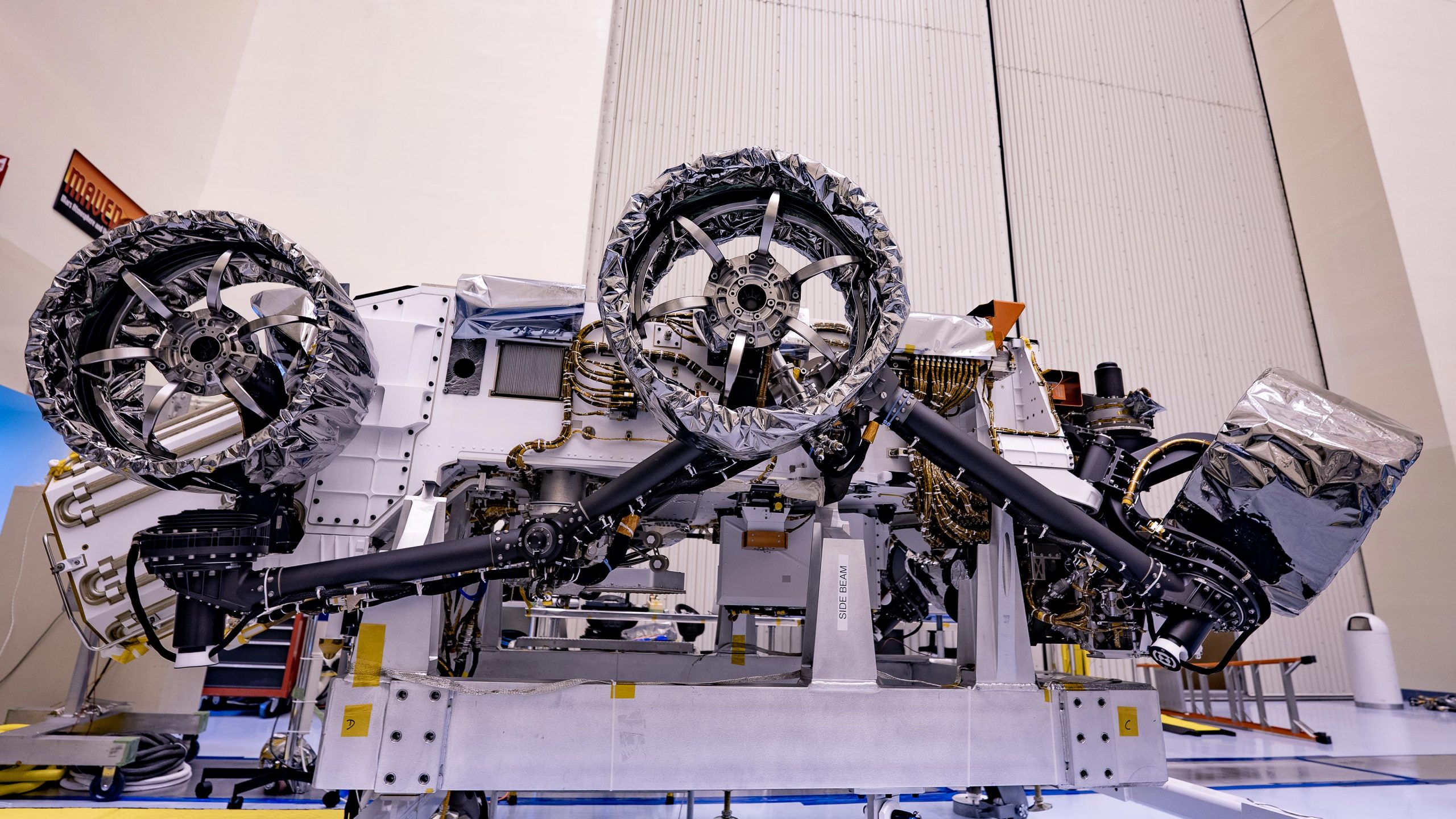
    NASA Mars Perseverance Rover Wheels
    Three of the six flight wheels that will travel to Mars can be seen attached to NASA’s Perseverance rover (which is inverted on a handling fixture) on March 30, 2020 at the Kennedy Space Center in Florida. The protective antistatic foil covering the wheels will be removed before launch this summer. Credit: NASA/JPL-Caltech

    After the rover was shipped from JPL to Kennedy Space Center, the team is getting closer to finalizing the spacecraft for launch later this summer.

    Final assembly and testing of NASA’s Perseverance rover continues at Kennedy Space Center in Florida as the July launch window approaches. In some of the last steps required prior to stacking the spacecraft components in the configuration they’ll be in atop the Atlas V rocket, the rover’s wheels and parachute have been installed.

    Perseverance received its six flight wheels on March 30, 2020. While the rover took a test drive last December, it was on “flight spares” that wouldn’t be making the trip to Mars. Designed for the kind of off-roading Perseverance will perform on the Red Planet, the wheels are re-engineered versions of the ones NASA’s Curiosity has been using on its traverses of Mount Sharp.
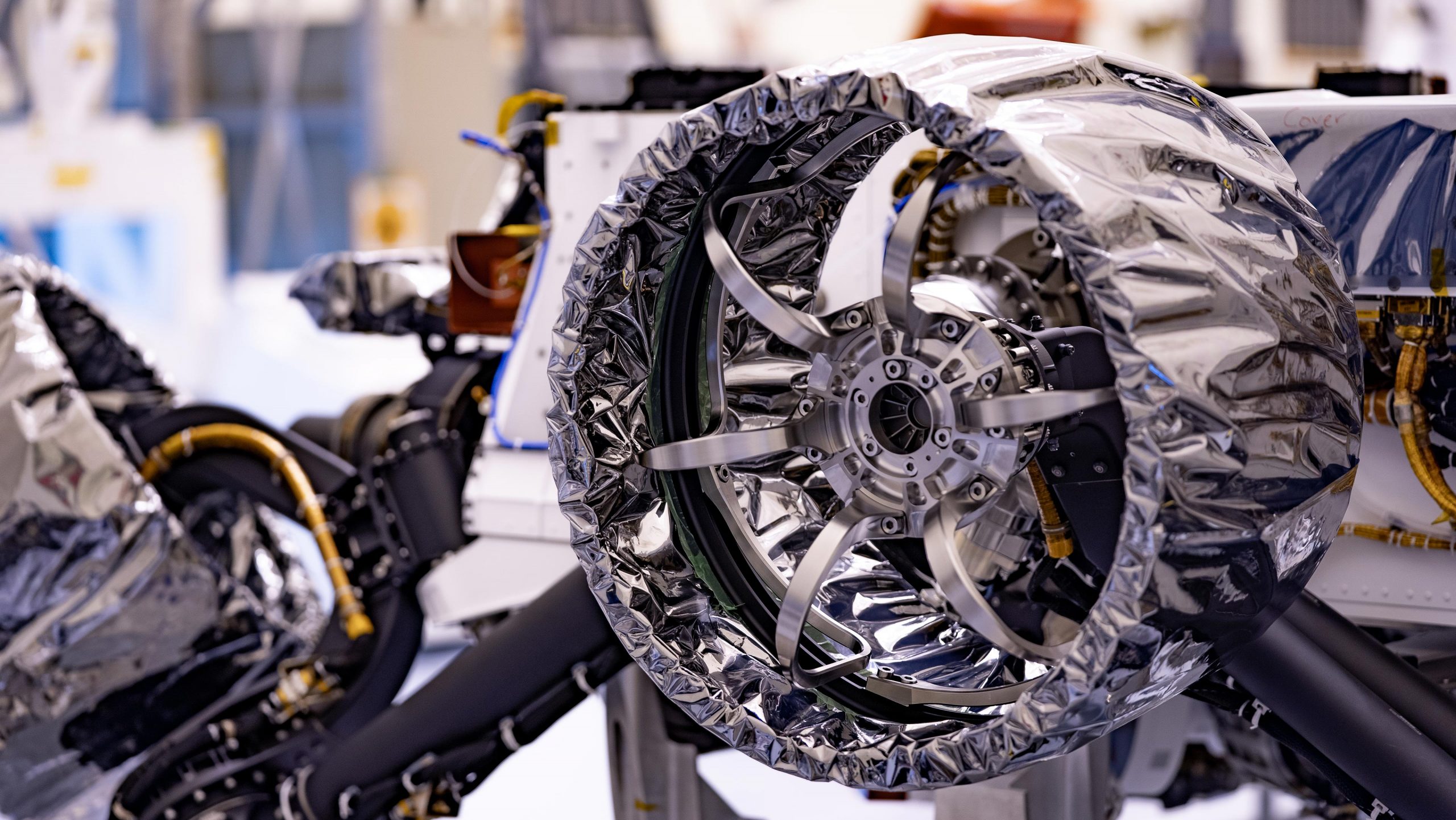
    NASA Mars Perseverance Rover Wheel
    This wheel, and five others just like it, heads to Mars on NASA’s Perseverance rover this summer. Wrapped in a protective antistatic foil that will be removed before launch, the wheel is 20.7 inches (52.6 centimeters) in diameter. The image was taken on March 30, 2020, at NASA’s Kennedy Space Center. Credit: NASA/JPL-Caltech

    Machined out of a block of flight-grade aluminum and equipped with titanium spokes, each wheel is slightly larger in diameter and narrower than Curiosity’s, with skins that are almost a millimeter thicker. They also feature new treads, or grousers: In place of Curiosity’s 24 chevron-pattern treads are 48 gently curved ones. Extensive testing in the Mars Yard at NASA’s Jet Propulsion Laboratory, which built the rover and manages operations, has shown these treads better withstand the pressure from sharp rocks and grip just as well or better than Curiosity’s when driving on sand.
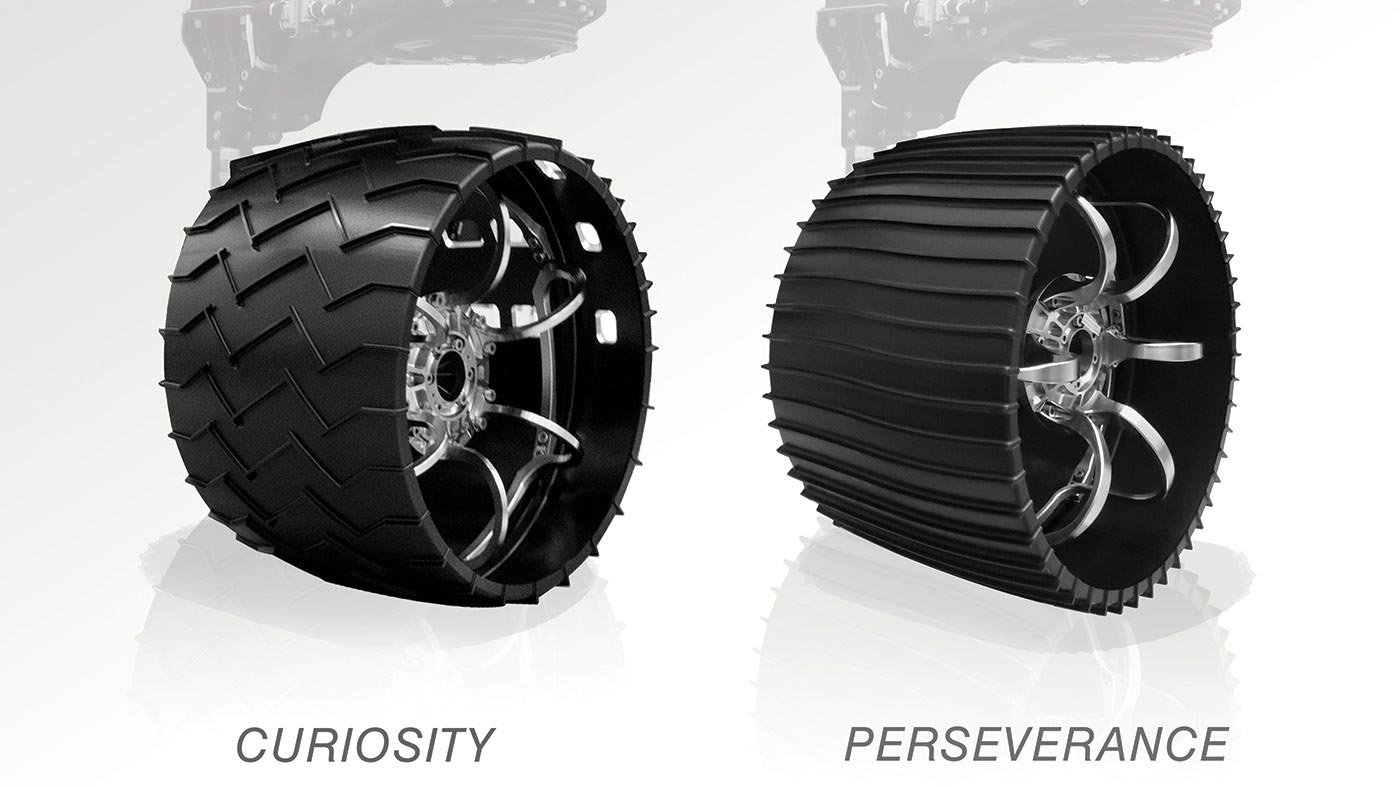
    Mars Rover Wheel Comparison
    Illustrated here, the aluminum wheels of NASA’s Curiosity (left) and Perseverance rovers. Slightly larger in diameter and narrower, 20.7 inches (52.6 centimeters) versus 20 inches (50.8 centimeters), Perseverance’s wheels have twice as many treads, and are gently curved instead of chevron-patterned. Credit: NASA/JPL-Caltech

    The Parachute

    The job of adding Perseverance’s parachute to the back shell, where the rover will be stowed on the journey to the Red Planet, took several days and was finished on March 26. Tasked with slowing the heaviest payload in the history of Mars exploration from Mach 1.7 to about 200 mph (320 kph) during the rover’s landing on February 18, 2021, the 194 pounds (88 kilograms) of nylon, Technora and Kevlar fibers are packed so tightly into a 20-inch-wide (50-centimeter-wide) aluminum cylinder that it is as dense as oak wood. When deployed at about 7 miles (11 kilometers) above the Martian surface, the chute will take about a half-second to fully inflate its 70.5-foot-wide (21.5-meter-wide) canopy.

    The Perseverance rover is a robotic scientist weighing 2,260 pounds (1,025 kilograms). It will search for signs of past microbial life, characterize the planet’s climate and geology, collect samples for future return to Earth, and pave the way for human exploration of the Red Planet. No matter what day Perseverance launches during its July 17-August 5 launch period, it will land on Mars’ Jezero Crater on February 18, 2021.

    Perseverance is part of a larger program that includes missions to the Moon as a way to prepare for human exploration of the Red Planet. Charged with returning astronauts to the Moon by 2024, NASA will establish a sustained human presence on and around the Moon by 2028 through NASA’s Artemis lunar exploration plans.

    Never miss a breakthrough: Join the SciTechDaily newsletter.
    Follow us on Google and Google News.

    JPL Mars 2020 Perseverance Rover NASA Popular
    Share. Facebook Twitter Pinterest LinkedIn Email Reddit

    Related Articles

    Martian Dust Devils: NASA’s Perseverance Studies the Wild Winds of Jezero Crater

    NASA’s Mars Perseverance Rover Has a Pet Rock!

    NASA’s Mars Perseverance Rover Now Selects Its Own Targets To Zap With Its Laser

    NASA’s Ingenuity Mars Helicopter in Contact With Perseverance Rover After Communications Dropout

    NASA’s Ingenuity Mars Helicopter Scouts Ridgeline for Perseverance Science Team

    NASA Ingenuity Helicopter Spots Spacecraft Wreckage on Mars – Perseverance’s Cone-Shaped Backshell

    We’ve Arrived! NASA’s Mars Perseverance Rover Starts the Delta Front Campaign

    Incredible Video of Solar Eclipse on Mars – Captured by NASA’s Perseverance Rover

    NASA’s Mars Perseverance Rover Arrives at Ancient Delta for New Science Campaign

    Leave A Reply Cancel Reply

    • Facebook
    • Twitter
    • Pinterest
    • YouTube

    Don't Miss a Discovery

    Subscribe for the Latest in Science & Tech!

    Trending News

    Scientists Discover 132-Million-Year-Old Dinosaur Tracks on South Africa’s Coast

    Scientists Uncover the Secret Ingredient Behind the Spark That May Have Started Life on Earth

    Physicists Observe Matter in Two Places at Once in Mind-Bending Quantum Experiment

    Stanford Scientists Discover Hidden Brain Circuit That Fuels Chronic Pain

    New Study Reveals Why Ozempic Works Better for Some People Than Others

    Climate Change Is Altering a Key Greenhouse Gas in a Way Scientists Didn’t Expect

    New Study Suggests Gravitational Waves May Have Created Dark Matter

    Scientists Discover Why the Brain Gets Stuck in Schizophrenia

    Follow SciTechDaily
    • Facebook
    • Twitter
    • YouTube
    • Pinterest
    • Newsletter
    • RSS
    SciTech News
    • Biology News
    • Chemistry News
    • Earth News
    • Health News
    • Physics News
    • Science News
    • Space News
    • Technology News
    Recent Posts
    • Groundbreaking Enzyme Atlas Rewrites Decades of Biology Research
    • New “Nanozyme Hypothesis” Could Rewrite the Story of Life’s Origins
    • Anatomy Isn’t Finished: The Human Body Still Holds Secrets
    • Researchers Discover Long-Lost Words of Ancient Greek Philosopher After 2,000 Years
    • New Study Warns: Asia’s Lifeline Water Source Is Rapidly Draining
    Copyright © 1998 - 2026 SciTechDaily. All Rights Reserved.
    • Science News
    • About
    • Contact
    • Editorial Board
    • Privacy Policy
    • Terms of Use

    Type above and press Enter to search. Press Esc to cancel.