
The year 1958 held much promise for the United States space program. Both the US and the Soviet Union were preparing to orbit a satellite as part of the International Geophysical Year (IGY), a series of activities planned between July 1957 and December 1958, intended to allow scientists around the world to study the Earth and space through coordinated observations. Given the Cold War competition between the two superpowers, the first to launch a satellite could claim technological pre-eminence. The Soviet Union leaped ahead of the US and stunned the world when they orbited Sputnik, the world’s first artificial satellite, on October 4, 1957.
The US response to Sputnik was two-fold. The first was to accelerate the Vanguard program, a joint National Academy of Sciences/US Naval Research Laboratory project, which unfortunately resulted in the spectacular and embarrassing launch failure of Vanguard TV3 on December 6. By that time, the Soviets had already achieved their second success with Sputnik 2, carrying a dog named Layka, the first live animal in space.
The second response was to resurrect the Army Ballistic Missile Agency’s (ABMA) Jupiter-C rocket program, which had involved Wernher Von Braun’s team and the California Institute of Technology’s Jet Propulsion Laboratory (JPL) testing reentry vehicles in sub-orbital launches. JPL designed and built the Explorer satellite. The ABMA and JPL completed the job of modifying the Jupiter-C to the Juno rocket and building Explorer 1 in 84 days, and it was hoped that 1958 would start off much better than 1957 had ended.
The Juno rocket could trace its ancestry back to the German V-2 rocket, which Von Braun had also designed. Once working in the US after World War II, he used the V-2 to develop the Redstone intermediate range ballistic missile, from which he developed the Jupiter-C as a high-performance three-stage rocket. The addition of a fourth stage created the Juno rocket, capable of launching a satellite into orbit.
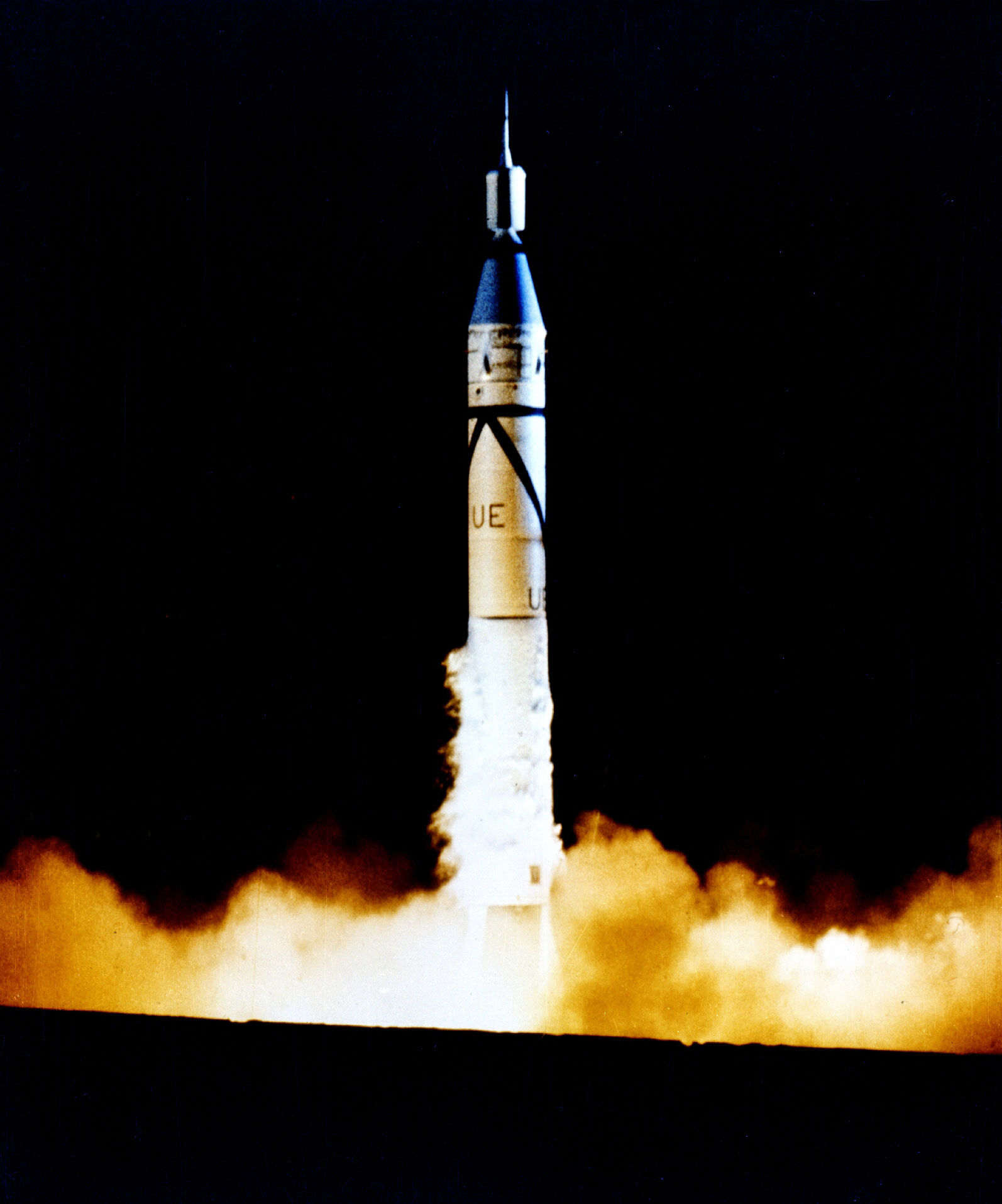
Explorer 1 successfully launched from Cape Canaveral’s Pad 26 on January 31, 1958. A team of women mathematicians at JPL computed Explorer’s trajectory and were able to confirm that it was indeed in orbit around the Earth, although its orbit of 224 miles (360 kilometers) by 1,575 miles (2,535 kilometers) was somewhat higher than planned.
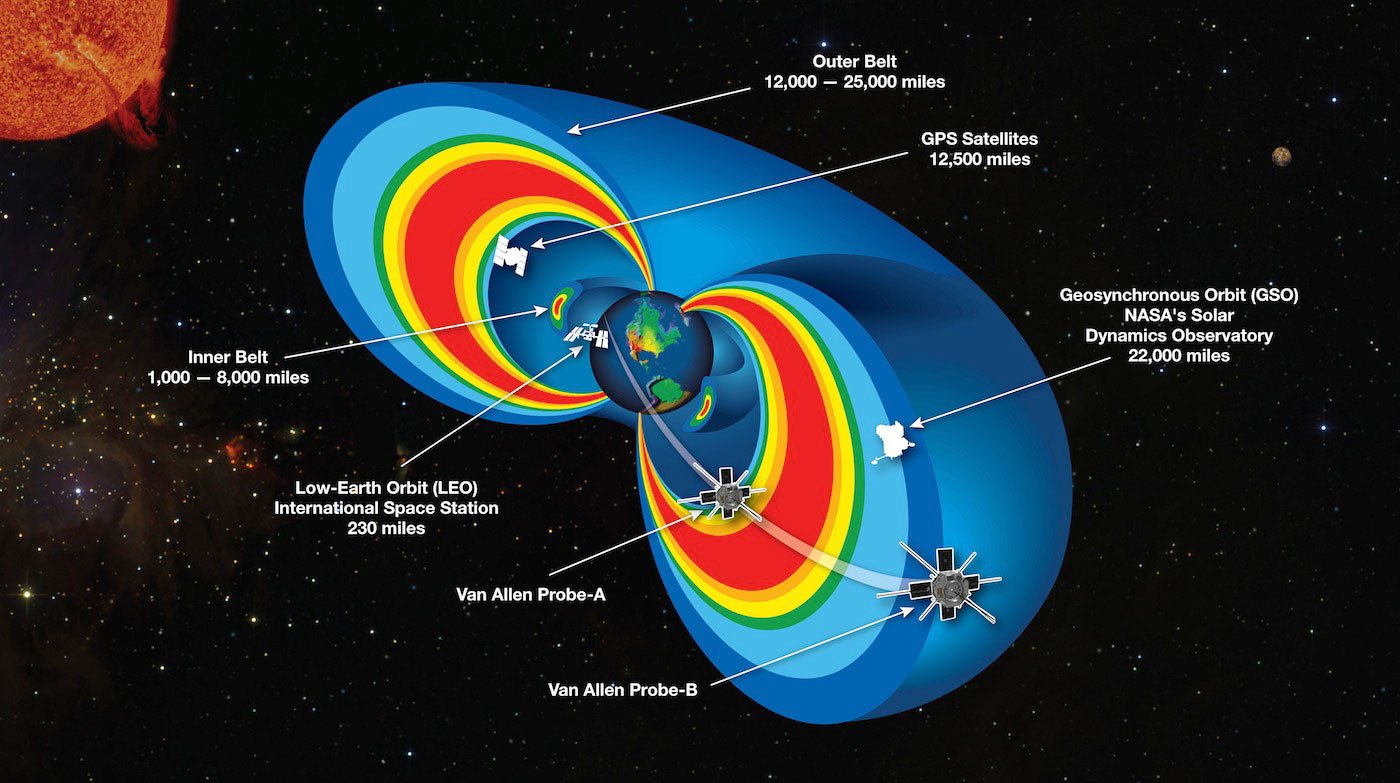
Explorer 1 weighed 30 pounds (14 kilograms) of which more than 18 pounds (8 kilograms) were scientific instruments developed under the direction of James Van Allen of the University of Iowa. The instrumentation consisted of a cosmic-ray detector, five temperature sensors, and two micrometeoroid detectors. The cosmic ray detector indicated a much lower cosmic ray count than expected. Van Allen postulated that the instrument was giving these readings because it was actually saturated by energetic charged particles originating mainly in the Sun and trapped by Earth’s magnetic field. Explorer 1’s discovery of these trapped radiation belts, subsequently named after Van Allen, is considered one of the outstanding scientific discoveries of the IGY.
Explorer 1 continued to record and transmit data until its batteries died on May 23, 1958. By then it had been joined in orbit by Explorer 3, also launched on a Juno rocket on March 26 (Explorer 2 failed at launch). Although no longer active, Explorer 1 remained in orbit until March 31, 1970, when it burned up on reentry over the Pacific Ocean. It was not only America’s first satellite in orbit, but also the first of a long-running series of scientific satellites that returned a wealth of useful information about the Earth, its environment, and interactions with the Sun.
Against the backdrop of the 1950s Cold War, after the Soviet Union successfully launched Sputnik, Americans were determined to launch their own Earth-orbiting satellite. Flash back to events leading up to the successful launch of America’s Explorer 1, and the beginnings of America’s Space Age, as told through newsreel and documentary clips of the time.
The competition between two separate groups to independently develop and orbit the first American satellite contributed to the recognition of the need for a single civilian space organization to plan future efforts. Following lengthy committee hearings, Congress passed the National Aeronautics and Space Act of 1958 on July 16, and President Dwight D. Eisenhower signed it on July 29, establishing the National Aeronautics and Space Administration. NASA officially began operating on October 1, 1958.
A fully-instrumented flight backup of Explorer 1 is on display at the Smithsonian Institute’s National Air and Space Museum’s Milestones of Flight Gallery, as is a model of a Juno rocket. A mockup of a Juno rocket is on display at Kennedy Space Center Visitors Center.
For more on Explorer 1, see https://www.jpl.nasa.gov/news/news.php?feature=7043
Never miss a breakthrough: Join the SciTechDaily newsletter.
Follow us on Google and Google News.