

Close Menu
    Facebook X (Twitter) Instagram
    SciTechDaily
    • Biology
    • Chemistry
    • Earth
    • Health
    • Physics
    • Science
    • Space
    • Technology
    Facebook X (Twitter) Pinterest YouTube RSS
    SciTechDaily
    Home»Technology»An Aqueous Battery That’s Fast Charging, Safer and Less Expensive
    Technology

    An Aqueous Battery That’s Fast Charging, Safer and Less Expensive

    By University of HoustonJanuary 24, 2021No Comments3 Mins Read
    Facebook Twitter Pinterest Telegram LinkedIn WhatsApp Email Reddit
    Share
    Facebook Twitter LinkedIn Pinterest Telegram Email Reddit
    Flow Battery Concept
    Researchers have developed a stable, high-performance, dendrite-free aqueous battery using a new 3D zinc-manganese nano-alloy anode, which overcomes previous limitations. Seawater serves as the electrolyte.

    New anode for aqueous batteries allows use of cheap, plentiful seawater as an electrolyte.

    Lithium-ion batteries are critical for modern life, from powering our laptops and cell phones to those new holiday toys. But there is a safety risk – the batteries can catch fire.

    Zinc-based aqueous batteries avoid the fire hazard by using a water-based electrolyte instead of the conventional chemical solvent. However, uncontrolled dendrite growth limits their ability to provide the high performance and long life needed for practical applications.

    A New Breakthrough: Zinc-Manganese Nano-Alloy Anode

    Now researchers have reported in Nature Communications that a new 3D zinc-manganese nano-alloy anode has overcome the limitations, resulting in a stable, high-performance, dendrite-free aqueous battery using seawater as the electrolyte.

    Xiaonan Shan, co-corresponding author for the work and an assistant professor of electrical and computer engineering at the University of Houston, said the discovery offers promise for energy storage and other applications, including electric vehicles.

    “It provides a low-cost, high energy density, stable battery,” he said. “It should be of use for reliable, rechargeable batteries.”
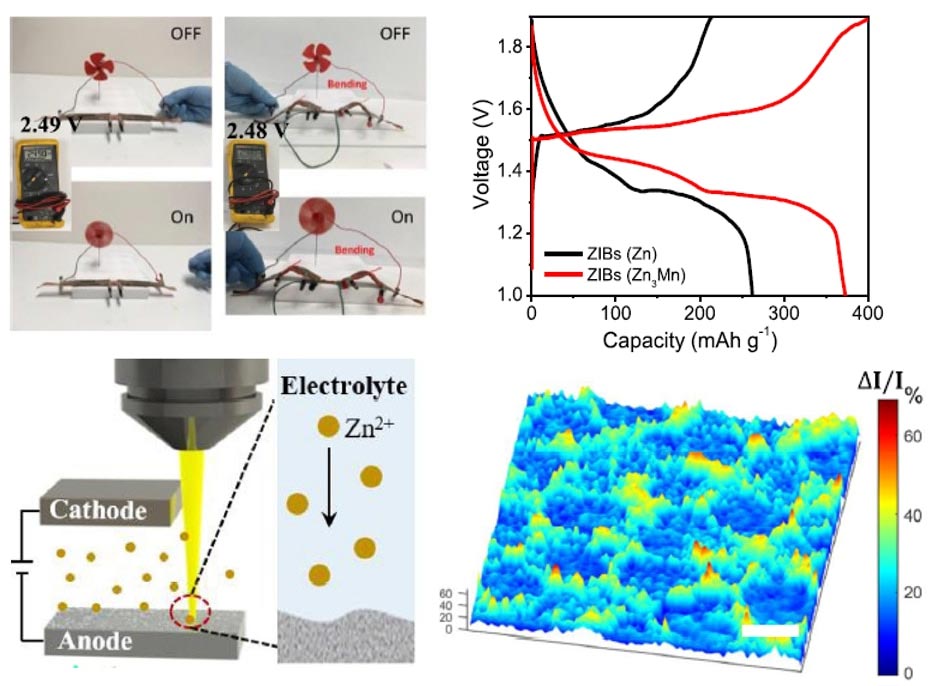
    Aqueous Battery
    An electric fan (top left) is powered by the proposed zinc battery; typical charge/discharge profiles of ZIBs at 0.5C (top right); in-situ microscope setup to image the zinc deposition dynamics (bottom left); and the morphology change caused by the zinc deposition (bottom right). Credit: University of Houston

    Shan and UH PhD student Guangxia Feng also developed an in situ optical visualization technique, allowing them to directly observe the reaction dynamics on the anode in real time. “This platform provides us with the capability to directly image the electrode reaction dynamics in situ,” Shan said. “This important information provides direct evidence and visualization of the reaction kinetics and helps us to understand phenomena that could not be easily accessed previously.”

    Testing determined that the novel 3D zinc-manganese nano alloy anode remained stable without degrading throughout 1,000 hours of charge/discharge cycling under high current density (80 mA/cm2).

    Using Seawater for Cost-Effective Energy Storage

    The anode is the electrode that releases current from a battery, while electrolytes are the medium through which the ionic charge flows between the cathode and anode. Using seawater as the electrolyte rather than highly purified water offers another avenue for lowering battery cost.

    Traditional anode materials used in aqueous batteries have been prone to dendrites, tiny growths that can cause the battery to lose power. Shan and his colleagues proposed and demonstrated a strategy to efficiently minimize and suppress dendrite formation in aqueous systems by controlling surface reaction thermodynamics with a zinc alloy and reaction kinetics by a three-dimensional structure.

    Shan said researchers at UH and University of Central Florida are currently investigating other metal alloys, in addition to the zinc-manganese alloy.

    Reference: “Stable, high-performance, dendrite-free, seawater-based aqueous batteries” by Huajun Tian, Zhao Li, Guangxia Feng, Zhenzhong Yang, David Fox, Maoyu Wang, Hua Zhou, Lei Zhai, Akihiro Kushima, Yingge Du, Zhenxing Feng, Xiaonan Shan and Yang Yang, 11 January 2021, Nature Communications.
    DOI: 10.1038/s41467-020-20334-6

    In addition to Shan and Feng, researchers on the project include Huajun Tian, Zhao Li, David Fox, Lei Zhai, Akihiro Kushima and co-corresponding author Yang Yang, all with the University of Central Florida; Zhenzhong Yang and Yingge Du, both with Pacific Northwest National Laboratory; Maoyu Wang and co-corresponding author Zhenxing Feng, both with Oregon State University; and Hua Zhou with Argonne National Laboratory.

    Never miss a breakthrough: Join the SciTechDaily newsletter.
    Follow us on Google and Google News.

    Battery Technology Energy University of Houston
    Share. Facebook Twitter Pinterest LinkedIn Email Reddit

    Related Articles

    Revolutionizing Large-Scale Energy Storage: Better Multivalent Metal Batteries

    Next-Generation Energy Storage Breakthrough: Fast-Charging, Long-Running, Flexible

    New Aqueous Lithium-Ion Battery – Low Cost & Improved Safety

    New Hybrid Device Efficiently Captures and Stores Solar Energy

    Iron-Air Batteries Promise Higher Energy Density Than Lithium-Ion Batteries

    New Aluminum Batteries Increase the Range of UUVs Tenfold

    MIT Engineers Look Toward All-Solid Lithium Batteries

    Engineers Design Calcium-Based Multi-Element for Liquid Batteries

    Power Conserving Chip May Increase Smartphone Battery Life

    Leave A Reply Cancel Reply

    • Facebook
    • Twitter
    • Pinterest
    • YouTube

    Don't Miss a Discovery

    Subscribe for the Latest in Science & Tech!

    Trending News

    Massive Study Warns Marijuana Use in Teens Is Linked to Serious Mental Illness

    Scientists Discover a Completely Unexpected Way T Cells Kill Cancer

    Scientists Just Found the Solar System’s Original “Planet Factory”

    Study Warns Widely Used Food Preservatives Linked to High Blood Pressure and Heart Disease

    New Treatment Could Reverse Osteoarthritis Within Weeks

    Physicists Have Measured “Negative Time” in Bizarre Quantum Experiment

    The Deadly Tapeworm Spreading Across America Has Reached the Pacific Northwest

    Could Low Vitamin D Be Making Your Pain Worse?

    Follow SciTechDaily
    • Facebook
    • Twitter
    • YouTube
    • Pinterest
    • Newsletter
    • RSS
    SciTech News
    • Biology News
    • Chemistry News
    • Earth News
    • Health News
    • Physics News
    • Science News
    • Space News
    • Technology News
    Recent Posts
    • Stanford’s Revolutionary New Microscope Reveals Living Cells in Stunning Detail
    • Scientists Discover a Sea Slug Smaller Than a Sesame Seed in Taiwan
    • Wasp Colonies Explode Into Violence After Losing Their Queen
    • Antarctica Suddenly Became Far More Sensitive to Climate Change 1 Million Years Ago
    • A Hidden Arctic Ocean Crisis Is Unfolding Beneath the Melting Ice
    Copyright © 1998 - 2026 SciTechDaily. All Rights Reserved.
    • Science News
    • About
    • Contact
    • Editorial Board
    • Privacy Policy
    • Terms of Use

    Type above and press Enter to search. Press Esc to cancel.