
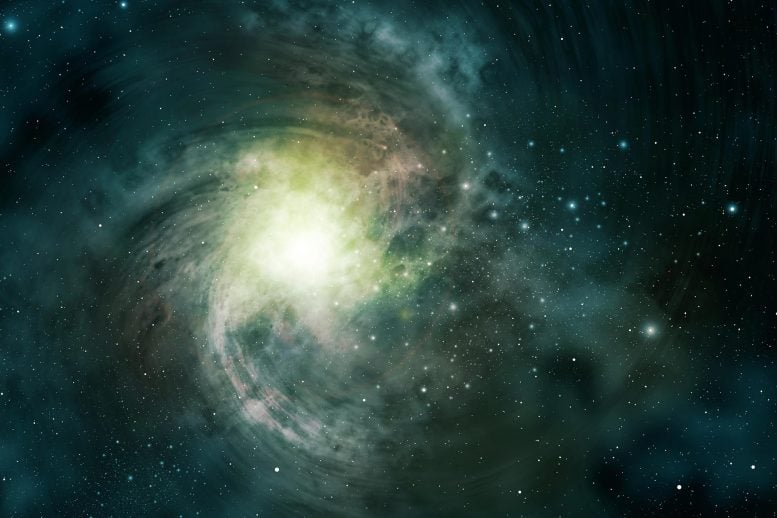
New COMAP radio survey will peer beneath the “tip of the iceberg” of galaxies to unveil a hidden era of star formation.
Sometime around 400 million years after the birth of our universe, the first stars began to form. This marked the end of the universe’s so-called dark ages, and a new light-filled era began. Over time, more and more galaxies began to take shape and served as factories for churning out new stars. This process reached a peak approximately 4 billion years after the Big Bang.
Luckily for astronomers, this bygone era can still be observed. Distant light takes time to reach us, and powerful telescopes can pick up light emitted by galaxies and stars billions of years ago (our universe is 13.8 billion years old). However, the details of this chapter in our universe’s history are fuzzy because most of the stars being formed at the time were faint and hidden by dust.
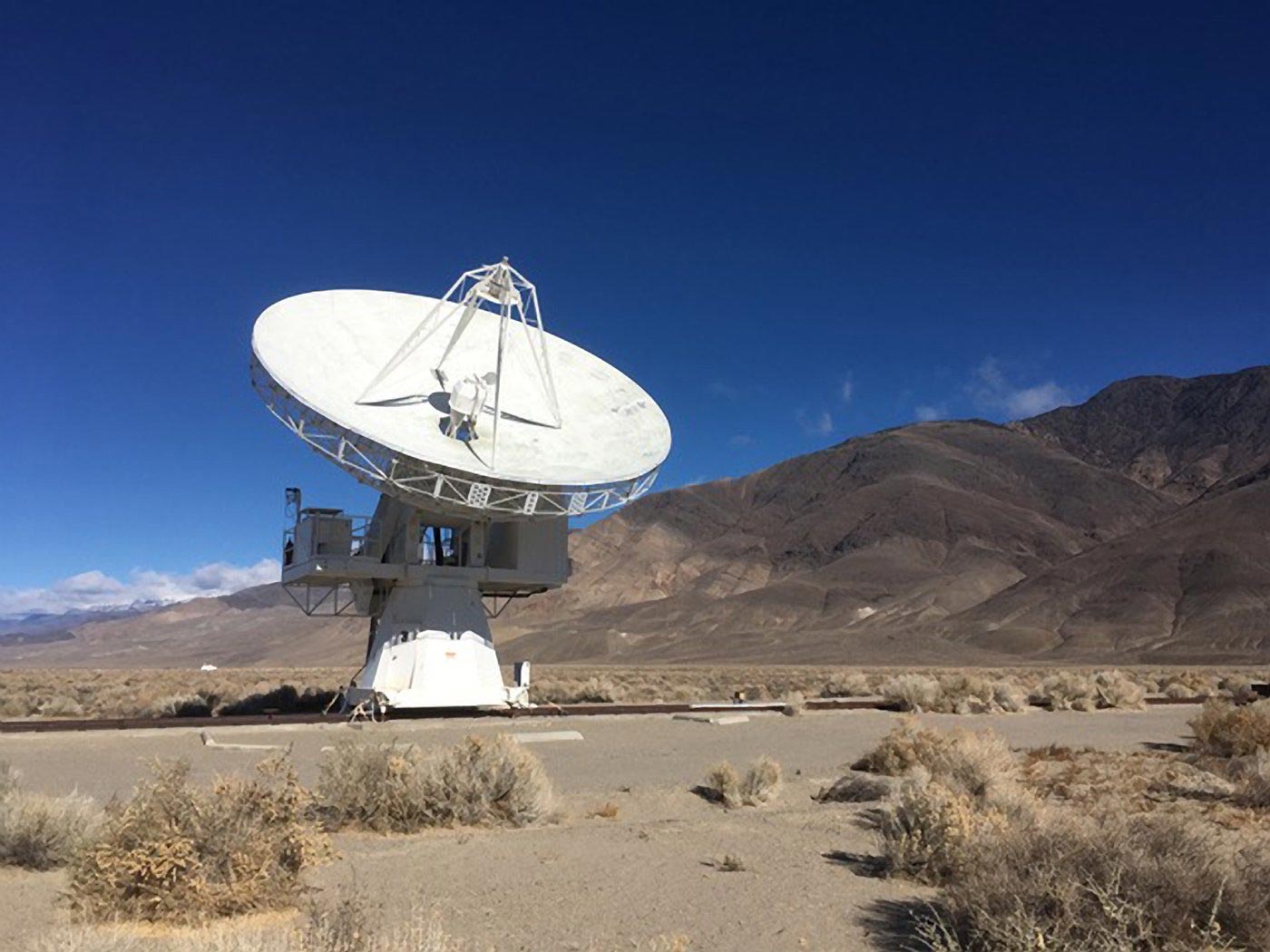
COMAP Project
A new Caltech project, called COMAP (CO Mapping Array Project), will present us with a new glimpse into this epoch of galaxy assembly. It will help answer questions about what really caused the universe’s rapid increase in the production of stars.
“Most instruments might see the tip of an iceberg when looking at galaxies from this period,” says Kieran Cleary, the project’s principal investigator and the associate director of Caltech’s Owens Valley Radio Observatory (OVRO). “But COMAP will see what lies underneath, hidden from view.”

In the current phase of the project, the 10.4-meter “Leighton” radio dish at OVRO is being used to study the most common kinds of star-forming galaxies spread across space and time. This includes those that are too difficult to view in other ways because they are too faint or hidden by dust. The radio observations trace cold hydrogen gas, the raw material from which stars are made. This gas is not easy to pinpoint directly, so instead COMAP measures bright radio signals from carbon monoxide (CO) gas, which is always present along with the hydrogen. COMAP’s radio camera is the most powerful ever built to detect these radio signals.
Early Results from the COMAP Survey
The first science results from the project have just been published in seven papers in The Astrophysical Journal. Based on observations taken one year into a planned five-year survey, COMAP set upper limits on how much cold gas must be present in galaxies at the epoch being studied, including the ones that are normally too faint and dusty to see. While the project has not yet made a direct detection of the CO signal, these early results demonstrate that it is on track to do so by the end of the initial five-year survey and ultimately will paint the most comprehensive picture yet of the universe’s history of star formation.
“Looking to the future of the project, we aim to use this technique to successively look further and further back in time,” Cleary says. “Starting 4 billion years after the Big Bang, we will keep pushing back in time until we reach the epoch of the first stars and galaxies, a couple of billion years earlier.”
Observing the Rise and Fall of Star Formation

Anthony Readhead, the co-principal investigator and the Robinson Professor of Astronomy, Emeritus, says that COMAP will see not only the first epoch of stars and galaxies, but also their epic decline. “We will observe star formation rising and falling like an ocean tide,” he says.
COMAP works by capturing blurry radio images of clusters of galaxies over cosmic time rather than sharp images of individual galaxies. This blurriness enables the astronomers to efficiently catch all the radio light coming from a larger pool of galaxies, even the faintest and dustiest ones that have never been seen.
“In this way, we can find the average properties of typical, faint galaxies without needing to know very precisely where any individual galaxy is located,” explains Cleary. “This is like finding the temperature of a large volume of water using a thermometer rather than analyzing the motions of the individual water molecules.”
These findings are the subject of a Focus Issue in the Astrophysical Journal, which contains links to the published papers.
The project has received funding from the Keck Institute for Space Studies (for critical early technology development) and from the National Science Foundation (NSF), for building the “Pathfinder” early phase of the project and performing the survey. The project is a collaboration between Caltech; the Jet Propulsion Laboratory (JPL), which is managed by Caltech for NASA; New York University; Princeton University; Stanford University; Université de Genève; University of Oslo; The University of Manchester; University of Maryland; University of Miami; and the University of Toronto (including the Canadian Institute for Theoretical Astrophysics and the Dunlap Institute for Astronomy and Astrophysics).
Never miss a breakthrough: Join the SciTechDaily newsletter.
Follow us on Google and Google News.
1 Comment
“…Sometime around 400 million years after the birth of our universe, the first stars began to form…”
Try 180 million years – complete with spiral galaxies and 2nd generation stars, according to James Webb Telescope data. Smack dab in what was supposed to be the Big Bang “Dark Ages”.