
Close Menu
    Facebook X (Twitter) Instagram
    SciTechDaily
    • Biology
    • Chemistry
    • Earth
    • Health
    • Physics
    • Science
    • Space
    • Technology
    Facebook X (Twitter) Pinterest YouTube RSS
    SciTechDaily
    Home»Physics»An Ultrafast Glimpse of the Photochemistry of the Atmosphere With Help From Reaction Nanoscopy
    Physics

    An Ultrafast Glimpse of the Photochemistry of the Atmosphere With Help From Reaction Nanoscopy

    By LMU MunichOctober 11, 2019No Comments3 Mins Read
    Facebook Twitter Pinterest Telegram LinkedIn WhatsApp Email Reddit
    Share
    Facebook Twitter LinkedIn Pinterest Telegram Email Reddit
    Ultrafast Glimpse of the Photochemistry of the Atmosphere
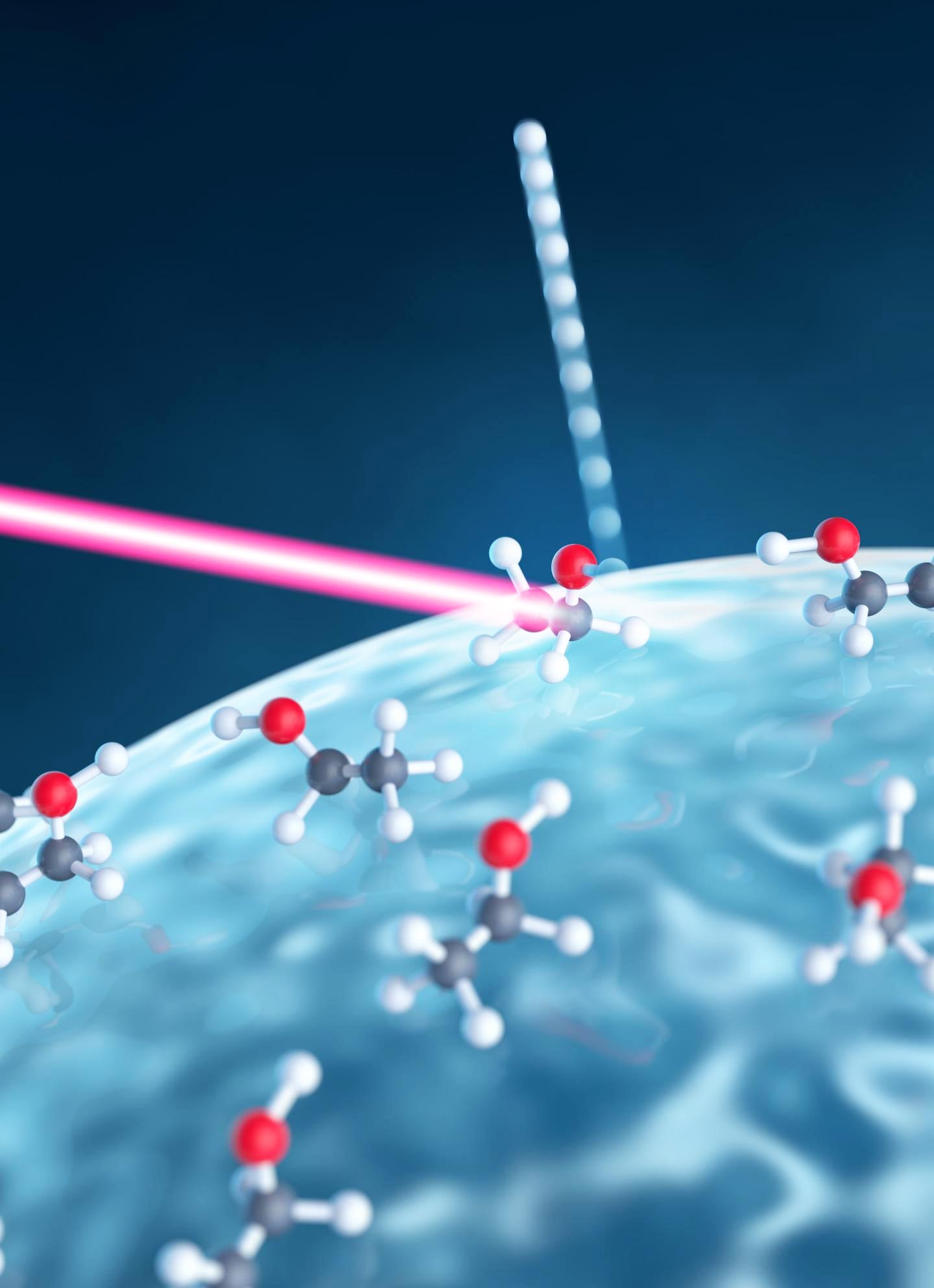
    This is an ultrafast glimpse of the photochemistry of the atmosphere. Credit: Matthias Kling

    Researchers at Ludwig-Maximilians-Universitaet (LMU) in Munich have explored the initial consequences of the interaction of light with molecules on the surface of nanoscopic aerosols.

    The nanocosmos is constantly in motion. All natural processes are ultimately determined by the interplay between radiation and matter. Light strikes particles and induces reactions. By altering the energy states of electrons, it reshuffles atoms and causes molecules to be reconfigured.

    These processes are significantly accelerated when the reactants are absorbed on the surface of nanoparticles in the atmosphere. This phenomenon is crucial for the photochemistry of the atmosphere and thus has an impact on our health and climate.

    One of the light-driven molecular processes that takes place on aerosols has now been investigated in detail by researchers led by Professor Matthias Kling and Dr. Boris Bergues at the Laboratory for Attosecond Physics, which is operated jointly by the LMU Munich and the MPQ. The group has developed a new method, called reaction nanoscopy, which makes it possible to study elemental physicochemical transitions on solid interfaces.

    They have now used it to characterize the reaction of ethanol with water molecules on the surface of glass nanoparticles under the influence of high-intensity laser light. The researchers irradiated the spherical particles with ultrashort laser pulses, each lasting for a few femtoseconds. (A femtosecond is a millionth of a billionth of a second.) With the aid of reaction nanoscopy, they were able to record this ultrashort interaction in three dimensions with nanometer resolution.

    “We have observed the detachment and acceleration of hydrogen ions from molecules on the surface of nanoparticles. The ability to do so forms the basis for the high spatial resolution of our imaging technique,” explains Boris Bergues. “Because the technology enables us to determine the exact position on the nanoparticle with the highest reaction yield, we can trace reactions of molecules adsorbed on the surface of aerosols with high spatial resolution,” adds Matthias Kling.

    Such processes are ubiquitous, especially in the fields of atmospheric physics and astrochemistry. For example, light in our atmosphere interacts with aerosols and their attached molecules, triggering subsequent reactions that may be important for the development of our climate. In the short term, the results obtained with the new analytical procedure by the Munich laser physicists may provide useful insights, especially in the field of atmospheric chemistry.

    Reference: “Few-cycle laser driven reaction nanoscopy on aerosolized silica nanoparticles” by Philipp Rupp, Christian Burger, Nora G. Kling, Matthias Kübel, Sambit Mitra, Philipp Rosenberger, Thomas Weatherby, Nariyuki Saito, Jiro Itatani, Ali S. Alnaser, Markus B. Raschke, Eckart Rühl, Annika Schlander, Markus Gallei, Lennart Seiffert, Thomas Fennel, Boris Bergues and Matthias F. Kling, 11 October 2019, Nature Communications.
    DOI: 10.1038/s41467-019-12580-0

    Never miss a breakthrough: Join the SciTechDaily newsletter.
    Follow us on Google and Google News.

    Astrochemistry Atmospheric Science Ludwig Maximilian University of Munich Nanoparticles
    Share. Facebook Twitter Pinterest LinkedIn Email Reddit

    Related Articles

    Innovative Quantum Dot Monitoring: Real-Time Insights Into Nanoparticle Growth

    The Race for Nuclear Time – Scientists Make Important Advance

    MIT Pioneers Quantum Light Source for Optical Quantum Computers and Teleportation Devices for Communication

    Trapping Light in 3D: Physicists Unlock the Longstanding Mystery of Trapped Waves

    Scientists Use Nanoparticles To “Peel Back the Curtain” Into the World of Super-Small Things

    More Efficient Carbon Capture: Cleaning Up the Atmosphere With Quantum Computing

    2D Quantum Freeze: Nanoparticles Cooled to Quantum Ground-State in Two Motional Dimensions

    Unlocking the Mystery of Unconventional Superconductivity: A Breakthrough Experiment

    Unparalleled Precision: Scientists Reveal the Net Charge in a Single Platinum Nanoparticle

    Leave A Reply Cancel Reply

    • Facebook
    • Twitter
    • Pinterest
    • YouTube

    Don't Miss a Discovery

    Subscribe for the Latest in Science & Tech!

    Trending News

    New Pill Lowers Stubborn Blood Pressure and Protects the Kidneys

    Humans May Have Hidden Regenerative Powers, New Study Suggests

    Scientists Just Solved the Mystery of Why Crabs Walk Sideways

    Doctors Are Surprised by What This Vaccine Is Doing to the Heart

    This Popular Supplement May Boost Your Brain, Not Just Your Muscles

    Scientists Say This Simple Supplement May Actually Reverse Heart Disease

    Warming Oceans Could Trigger a Dangerous Methane Surge

    This Simple Movement Could Be Secretly Cleaning Your Brain

    Follow SciTechDaily
    • Facebook
    • Twitter
    • YouTube
    • Pinterest
    • Newsletter
    • RSS
    SciTech News
    • Biology News
    • Chemistry News
    • Earth News
    • Health News
    • Physics News
    • Science News
    • Space News
    • Technology News
    Recent Posts
    • Hidden Heart Risk Found in 1 in 5 People, Study Warns
    • Scientists Say This Daily Walking Habit May Be the Secret to Keeping Weight Off After Dieting
    • New Therapy Rewires the Brain To Restore Joy in Depression Patients
    • Researchers Discover Efficient New Way To Split Hydrogen From Water for Energy
    • This Korean Skincare Ingredient Could Help Fight Deadly Superbugs
    Copyright © 1998 - 2026 SciTechDaily. All Rights Reserved.
    • Science News
    • About
    • Contact
    • Editorial Board
    • Privacy Policy
    • Terms of Use

    Type above and press Enter to search. Press Esc to cancel.