
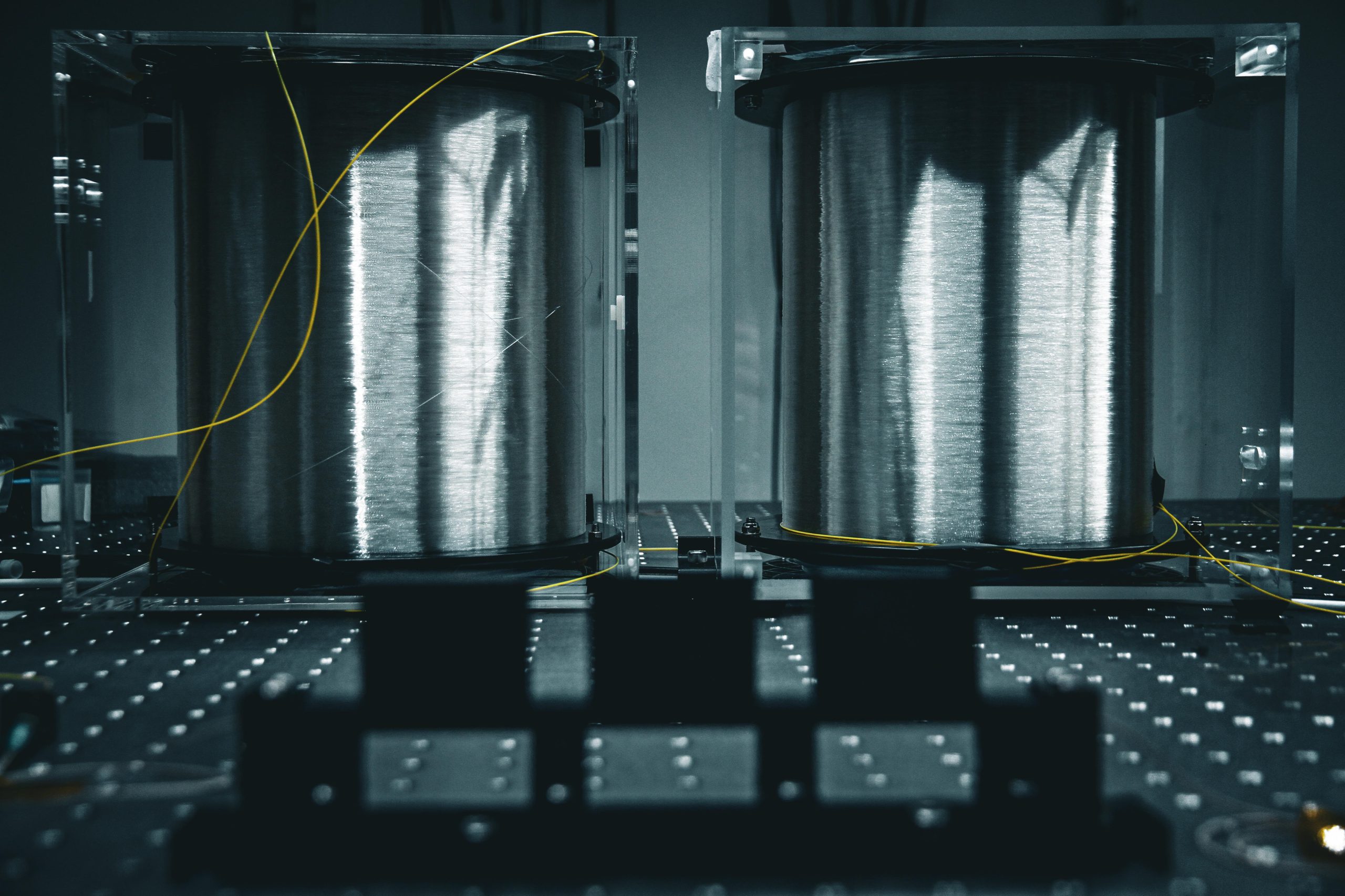
Researchers at the Technical University of Denmark (DTU) have successfully utilized quantum encryption for the secure transmission of information over a distance of 100 kilometers through a fiber optic cable, approximately the same distance as that between Oxford and London.
Scientists at the Technical University of Denmark (DTU) have achieved a breakthrough in secure communication by distributing a quantum-safe key via Continuous Variable Quantum Key Distribution (CV QKD). This team has set a new record by making the technique effective over an unprecedented distance of 100 kilometers, the furthest ever accomplished with CV QKD. The advantage of the method is that it can be applied to the existing Internet infrastructure.
Quantum computers threaten existing algorithm-based encryptions, which currently secure data transfers against eavesdropping and surveillance. They are not yet powerful enough to break them, but it’s a matter of time. If a quantum computer succeeds in figuring out the most secure algorithms, it leaves an open door to all data connected via the internet. This has accelerated the development of a new encryption method based on the principles of quantum physics.
But to succeed, researchers must overcome one of the challenges of quantum mechanics – ensuring consistency over longer distances. Continuous Variable Quantum Key Distribution has so far worked best over short distances.
“We have achieved a wide range of improvements, especially regarding the loss of photons along the way. In this experiment, published in Science Advances, we securely distributed a quantum-encrypted key 100 kilometers via fiber optic cable. This is a record distance with this method,” says Tobias Gehring, an associate professor at DTU, who, together with a group of researchers at DTU, aims to be able to distribute quantum-encrypted information around the world via the internet.
Secret keys from quantum states of light
“When data needs to be sent from A to B, it must be protected. Encryption combines data with a secure key distributed between sender and receiver so both can access the data. A third party must not be able to figure out the key while it is being transmitted; otherwise, the encryption will be compromised. Key exchange is, therefore, essential in encrypting data.
Quantum Key Distribution (QKD) is an advanced technology that researchers are working on for crucial exchanges. The technology ensures the exchange of cryptographic keys by using light from quantum mechanical particles called photons.

When a sender sends information encoded in photons, the quantum mechanical properties of the photons are exploited to create a unique key for the sender and receiver. Attempts by others to measure or observe photons in a quantum state will instantly change their state. Therefore, it is physically only possible to measure light by disturbing the signal.
“It is impossible to make a copy of a quantum state, as when making a copy of an A4 sheet – if you try, it will be an inferior copy. That’s what ensures that it is not possible to copy the key. This can protect critical infrastructure such as health records and the financial sector from being hacked,” explains Tobias Gehring.
Works via existing infrastructure
The Continuous Variable Quantum Key Distribution (CV QKD) technology can be integrated into the existing internet infrastructure.
“The advantage of using this technology is that we can build a system that resembles what optical communication already relies on.”
The backbone of the internet is optical communication. It works by sending data via infrared light running through optical fibers. They function as light guides laid in cables, ensuring we can send data worldwide. Data can be sent faster and over longer distances via fiber optic cables, and light signals are less susceptible to interference, which is called noise in technical terms.
“It is a standard technology that has been used for a long time. So, you don’t need to invent anything new to be able to use it to distribute quantum keys, and it can make implementation significantly cheaper. And we can operate at room temperature,” explains Tobias Gehring, adding:
“But CV QKD technology works best over shorter distances. Our task is to increase the distance. And the 100 kilometers is a big step in the right direction.”
Noise, Errors, and Assistance from Machine Learning
The researchers succeeded in increasing the distance by addressing three factors that limit their system in exchanging the quantum-encrypted keys over longer distances:
Machine learning provided earlier measurements of the disturbances affecting the system. Noise, as these disturbances are called, can arise, for example, from electromagnetic radiation, which can distort or destroy the quantum states being transmitted. The earlier detection of the noise made it possible to reduce its corresponding effect more effectively.
Furthermore, the researchers have become better at correcting errors that can occur along the way, which can be caused by noise, interference, or imperfections in the hardware.
“In our upcoming work, we will use the technology to establish a secure communication network between Danish ministries to secure their communication. We will also attempt to generate secret keys between, for example, Copenhagen and Odense to enable companies with branches in both cities to establish quantum-safe communication,” Tobias Gehring says.
Reference: “Long-distance continuous-variable quantum key distribution over 100-km fiber with local local oscillator” by Adnan A. E. Hajomer, Ivan Derkach, Nitin Jain, Hou-Man Chin, Ulrik L. Andersen and Tobias Gehring, 3 January 2024, Science Advances.
DOI: 10.1126/sciadv.adi9474
The Innovation Fund Denmark, the Danish National Research Foundation, the European Union’s Horizon Europe research and innovation program, the Carlsberg Foundation, and the Czech Science Foundation support the project.
Never miss a breakthrough: Join the SciTechDaily newsletter.
Follow us on Google and Google News.
1 Comment
The article title is completely misleading. The record applies to “Continuous Variable Quantum Key Distribution”; in 2018 quantum encryption could already cover 421 km:
https://www.nature.com/articles/s41598-023-35579-6