
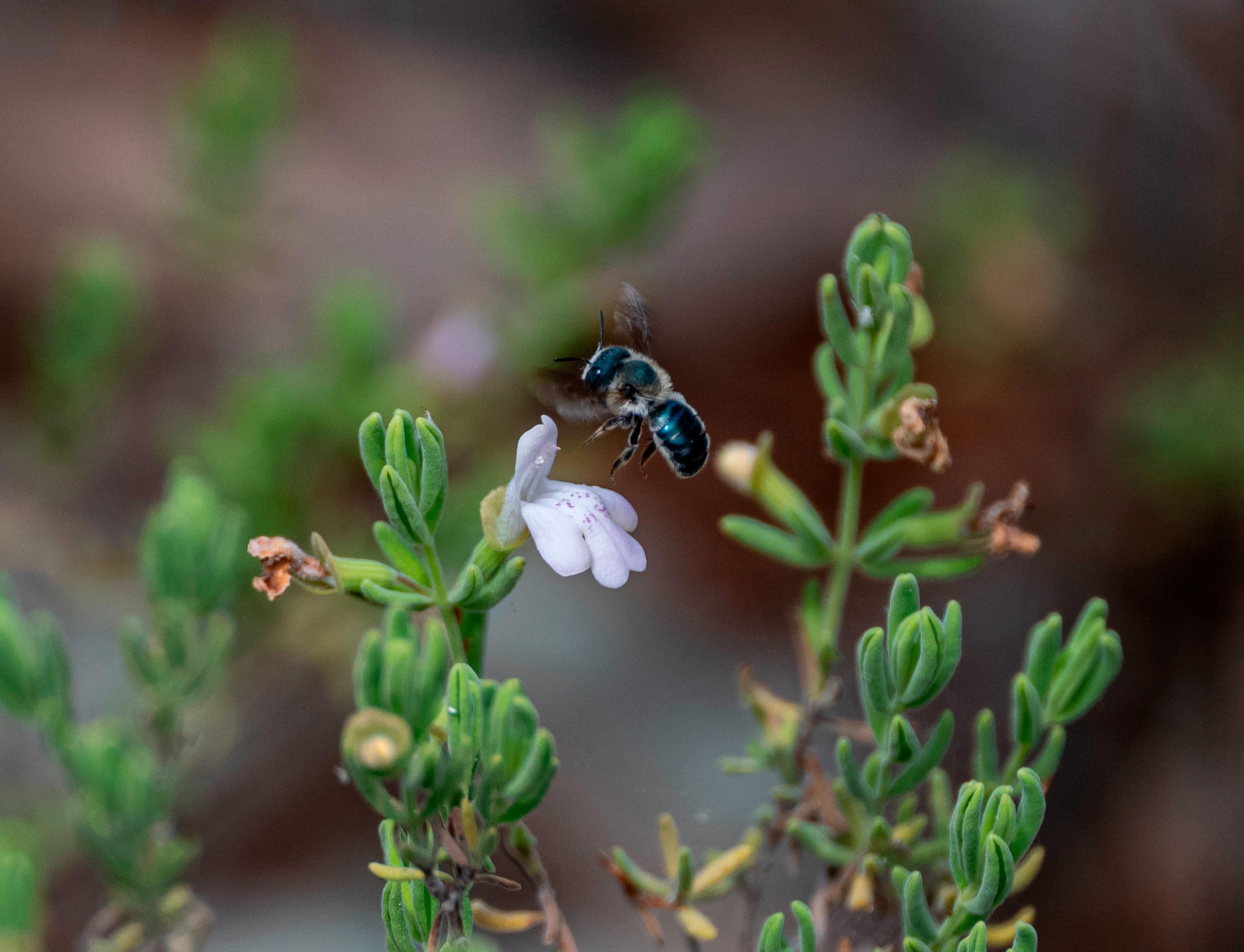
Scrub mints are among the most endangered plants you’ve probably never heard of. Over half of the existing 24 species are recognized as threatened or endangered at the state or federal level, and nearly all scrub mints grow in areas that are being rapidly developed or converted to agricultural pastures.
In a new study, researchers analyzed a distinct type of DNA marker, which shows there are likely more scrub mint species waiting to be scientifically described. And at least one species has been left without federal protection because of a technicality.
“The Titusville balm is currently considered to be a recent hybrid,” said lead author Andre Naranjo, who conducted the study while completing a Ph.D. with the Florida Museum of Natural History. “When you describe something as a hybrid, that implies that it’s not a true species, and it can’t be protected under the Endangered Species Act.”
Naranjo found no evidence for recent hybridization in Titusville balms (Dicerandra thinicola), and his results suggest that a group called the calamints may contain cryptic diversity that requires further study.
Scrub mints evolved during a period of rapid climate change
Naranjo and his colleagues conducted the study to learn about the evolutionary history of scrub mints. The group is native to the southeastern United States and originated during a turbulent time in Earth’s past.
Three million years ago, during a period called the Pliocene, temperatures were 2-3 degrees C warmer than they are today, and sea levels were up to 30 meters higher. At the time, the central and southern half of Florida was an archipelago. But as temperatures cooled over the next several million years, the waters receded, and the Florida Peninsula took on its modern-day dimensions.
Much of this newly surfaced habitat wasn’t exactly prime real estate. Where soils did exist, they were primarily composed of sand, and the cooler temperatures resulted in less rainfall. This was particularly true of the elevated areas that had been islands before sea levels fell.

What’s left of these ancient shorelines is now located near the center of the Florida Peninsula and is often referred to as sand pine scrub. Plants and animals that moved into these vacant spaces had to contend with little water, few nutrients, and rampant wildfires.
The species that managed to survive tended to do well within this narrow framework of harsh conditions but lost the ability to live just about anywhere else. Today, 40-60% of species that live in these areas are endemic, meaning they can be found only in southeastern scrub habitats.
Scrub mints are among the few plants that staked a claim in the new Florida frontier. Originating in the panhandle, the ancestor of modern scrub mints dispersed south as soon as there was land to grow on.
At the height of the ice ages during the Pleistocene, when much of the planet’s reserve of water was locked away in massive glaciers, Florida was up to twice the size it is today, and scrub mints flourished.
“These plants had a much wider range in the past and were readily sharing DNA with one another,” Naranjo said.
But their habitat soon shrank. There were at least 17 ice ages during the Pleistocene, when scrub mints were evolving, and each cold period was separated by warm intervals in which much of Florida was swallowed by the sea.
Widespread scrub environments were repeatedly reduced to islands, severing the connection between mint populations. They began to grow apart, and soon each scrub island contained its own unique mint species. During the cold periods, when sea levels fell, scrub mint populations again overlapped, and these unique species hybridized with each other.
This ancient intermingling created the scrub mints as they’re known today.
The storied history of scrub mints cut short by development
Naranjo sequenced nuclear DNA from scrub mints for the study. Unlike the plastid DNA often used to study plants, which is produced by structures called chloroplasts, the DNA from plant nuclei is especially useful for scientists trying to tease apart historical interactions between species.
According to his results, annual scrub mints in the genus Dicerandra — which grow north into South Carolina and die back during the winter — originated from a back-to-back hybridization event between the ancestors of perennial scrub mints, which have a distribution further south and grow year-round.
Hybridization is a common form of diversification in plants, so much so that nearly every group of plants you might come across has had a hybridization event occur at some point in its evolutionary history.
Crucially, Naranjo’s findings indicate the scrub mints that currently exist have been on separate evolutionary trajectories for hundreds of thousands of years. When modern humans diverged from Neanderthals around 500,000 years ago, scrub mints were already well on their way to becoming separate species.
The study also suggests that calamints are genetically diverse, so much so that new species designations are likely warranted. This is especially true for those with large ranges in the southeastern U.S., including the scarlet calamint (Clinopodium coccineum) and Georgia calamint (Clinopodium georgianum), neither of which is considered to be endangered.
Even if additional species are afforded protection, Naranjo fears it may not be enough to stave off declines and eventual extinction. Lakela’s mint (Dicerandra immaculata), for example, is listed as critically endangered and only grows along a three-mile stretch of scrub, almost all of which is privately owned.
Conditions that once allowed these plants to thrive, such as periodic wildfires, are now impractical, due to nearby urban areas that would be negatively affected. And invasive species are encroaching on what little pristine scrub is left. Work to remove invasives is often done by volunteers, if they’re removed at all.
“If we continue with business as usual, this entire group of plants could go extinct within the next 100 years. And we won’t just lose these species. We’ll lose the scrub, one of the most truly authentic and formerly ubiquitous Florida habitats will just go away,” Naranjo said.
Reference: “Abundant incongruence in a clade endemic to a biodiversity hotspot: Phylogenetics of the scrub mint clade (Lamiaceae)” by Andre A. Naranjo, Christine E. Edwards, Matthew A. Gitzendanner, Douglas E. Soltis and Pamela S. Soltis, 8 January 2024, Molecular Phylogenetics and Evolution.
DOI: 10.1016/j.ympev.2024.108014
Never miss a breakthrough: Join the SciTechDaily newsletter.
Follow us on Google and Google News.