
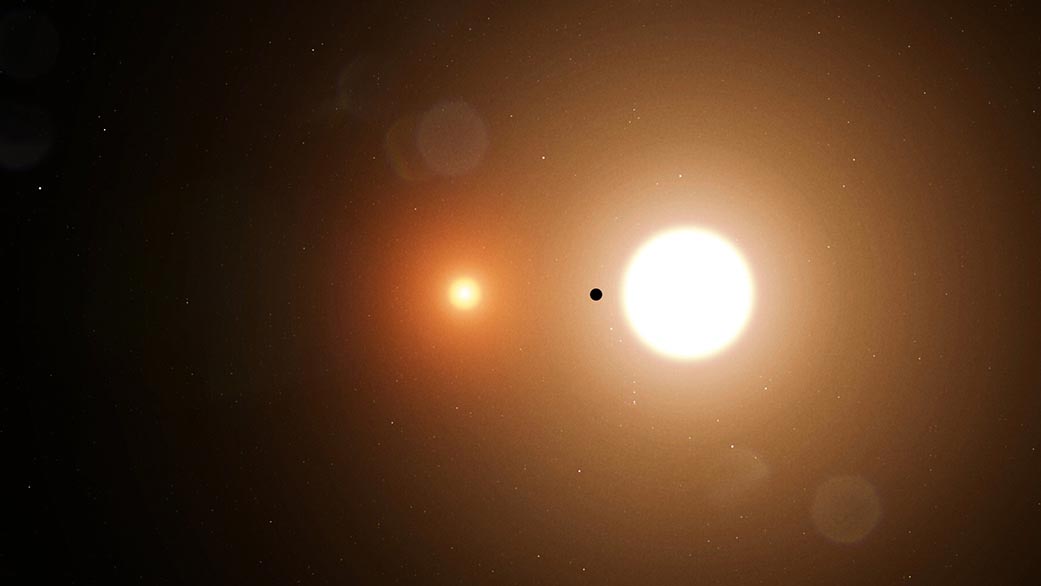
Astronomers announced Monday (January 6, 2020) the first discovery made by NASA’s TESS mission of a two-star planetary system. Led by researchers at NASA’s Goddard Space Flight Center and San Diego State University, with other collaborators, the telescope satellite’s finding marks the start of a much better understanding of the population of such planetary systems.
On behalf of the international team of 60 investigators, the work was presented by researcher Veselin Kostov at the 235th meeting of the American Astronomical Society in Honolulu.
The new planet, called TOI-1338 b, is about 6.9 times larger than Earth. It orbits its pair of host stars every 95 days. One of the stars is more massive and much brighter than the other, and as the planet orbits around it blocks some of the light from the brighter star. This transit allows astronomers to measure the size of the planet. The transit was first found in the TESS data by a high school student working at NASA with Kostov over the summer.
Researchers working with data from NASA’s Transiting Exoplanet Survey Satellite (TESS) have discovered the mission’s first circumbinary planet, a world orbiting two stars. The planet, called TOI 1338 b, is around 6.9 times larger than Earth, or between the sizes of Neptune and Saturn. It lies in a system 1,300 light-years away in the constellation Pictor. The stars in the system make an eclipsing binary, which occurs when the stellar companions circle each other in our plane of view. One is about 10% more massive than our Sun, while the other is cooler, dimmer and only one-third the Sun’s mass. TOI 1338 b’s transits are irregular, between every 93 and 95 days, and vary in depth and duration thanks to the orbital motion of its stars. TESS only sees the transits crossing the larger star — the transits of the smaller star are too faint to detect. Its orbit is stable for at least the next 10 million years. The orbit’s angle to us, however, changes enough that the planet transit will cease after November 2023 and resume eight years later. Credit: NASA’s Goddard Space Flight Center
“Our analysis confirmed the transit was caused by a circumbinary planet and we were able to measure the planet’s properties,” said SDSU astronomer Jerome Orosz.
A dozen such Tatooine-like planets — so named for the desert world in “Star Wars” — were found with NASA’s Kepler Mission, which ended in 2013. The orbiting TESS telescope, launched in 2018, will cover nearly the whole sky and enable many more discoveries, perhaps as many as 100 new circumbinary planets. A sample size that large will allow a statistical analysis of the population, which to date has not been possible because too few systems are known.
New Kepler planet
Helping to boost the numbers, SDSU astronomers at the AAS meeting also revealed a new Kepler circumbinary planet, called KOI-3152 b.
“We first noted convincing evidence for this planet in 2012, but confirmation required additional data and improvements in computer modeling,” said SDSU astronomer William Welsh. “In particular, star spots on the primary host star and a weak eclipse signal from the second star made the analysis difficult.”
In 2019, Welsh’s master’s thesis student Quentin Socia accepted the challenge and spearheaded the investigation.
KOI-3152 b is located 1,347 light-years away and is 3.9 times the size of the Earth. It orbits its binary stars every 175 days. Although KOI-3152 b straddles the hot edge of the habitable zone, it is a low-density gaseous planet and not able to support life as we know it. This work has been accepted for publication in The Astronomical Journal.
This finding marks the latest discovery made by the SDSU team using Kepler Mission data. Their pioneering work established this new type of planet and includes the discovery of the most interesting of the circumbinary planets, the Kepler-47 system, consisting of three planets orbiting two stars.
References:
“TOI-1338: TESS’ First Transiting Circumbinary Planet” by Veselin B. Kostov, Jerome A. Orosz, Adina D. Feinstein, William F. Welsh, Wolf Cukier, Nader Haghighipour, Billy Quarles, David V. Martin, Benjamin T. Montet, Guillermo Torres, Amaury H. M. J. Triaud, Thomas Barclay, Patricia Boyd, Cesar Briceno, Andrew Collier Cameron, Alexandre C. M. Correia, Emily A. Gilbert, Samuel Gill, Michaël Gillon, Jacob Haqq-Misra, Coel Hellier, Courtney Dressing, Daniel C. Fabrycky, Gabor Furesz, Jon M. Jenkins, Stephen R. Kane, Ravi Kopparapu, Vedad Kunovac Hodžić, David W. Latham, Nicholas Law, Alan M. Levine, Gongjie Li, Chris Lintott, Jack J. Lissauer, Andrew W. Mann, Tsevi Mazeh, Rosemary Mardling, Pierre F. L. Maxted, Nora Eisner, Francesco Pepe, Joshua Pepper, Don Pollacco, Samuel N. Quinn, Elisa V. Quintana, Jason F. Rowe, George Ricker, Mark E. Rose, S. Seager, Alexandre Santerne, Damien Ségransan, Donald R. Short, Jeffrey C. Smith, Matthew R. Standing, Andrei Tokovinin, Trifon Trifonov, Oliver Turner, Joseph D. Twicken, Stéphane Udry, Roland Vanderspek, Joshua N. Winn, Eric T. Wolf, Carl Ziegler, Peter Ansorge, Frank Barnet, Joel Bergeron, Marc Huten, Giuseppe Pappa and Timo van der Straeten, 7 May 2020, The Astronomical Journal.
DOI: 10.3847/1538-3881/ab8a48
“KOI-3152 b: A Neptune-sized Kepler Transiting Circumbinary Planet Around a Grazing Eclipsing Binary” by Quentin J Socia, William F Welsh, Jerome A Orosz, William D Cochran, Michael Endl, Billy Quarles, Donald R Short, Guillermo Torres, Gur Windmiller and Mitchell Yenawine, 10 February 2020, The Astrophysical Journal.
DOI: 10.3847/1538-3881/ab665b
This work was supported in part by grants from NASA and the National Science Foundation, and by a donation to San Diego State University by John Hood, Jr.
Never miss a breakthrough: Join the SciTechDaily newsletter.
Follow us on Google and Google News.
1 Comment
Guess science is offensive to women and right wingers now. Oh well.